Showing posts with label gratitude. Show all posts

Wednesday, June 5, 2024

A Little Piece of Heaven.

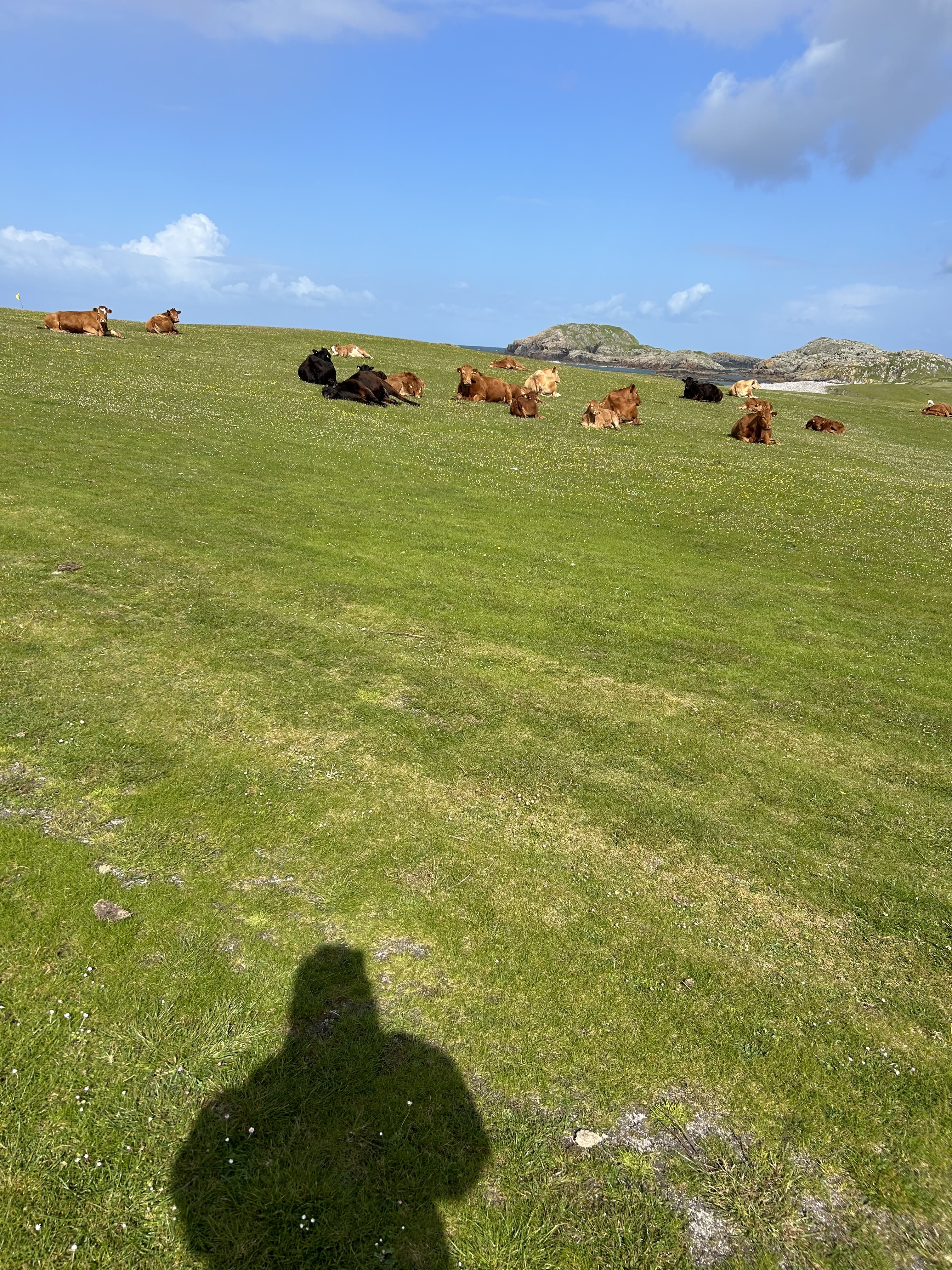
     Today I did the hikes I had wanted to do yesterday: in particular to St. Columba’s Bay, over towards the quarry and then back around and up to Port Ban.  Incredible, all of it!  I will try to upload a video from the Bay for you below… again, with the pictures issue that I’m having, I’m not positive I can make that work, but I will try. Today’s hike was a bit over eight miles.  Yesterday I walked ten miles, though the obvious difference was the terrain.  Yesterday was gentle hills on paved or gravel roads, today was hills, rocky terrain, on paths that were many times barely discernible. The other, more profound difference was how the hike to St. Columba’s Bay felt, and seeing/touching the water of the bay in particular.  Both days I walked alone. While David is here on Iona with me, he is not a hiker.  Additionally, his work has required that he has to still manage to get in 40 hours of work during the three weeks he will be with me in Europe, so he is taking the unscheduled, quiet days on Iona to try to get some of those hours in.  I was actually looking forward to having the quiet, meditative and reflective as well as prayerful time to walk by myself.  None the less, the solitary walk to the North of Iona yesterday was stressful for me: or it produced anxiety for me.  I didn’t see anyone, and I felt nervous about that.  While Iona is pretty safe, I carry with me the reality from home that 50% of women in the United States will be assaulted during their life times, many of those more than once. Walking by oneself as a female is generally not considered wise or safe. If someone had approached me, there would be no one else around to call to for help.  I couldn’t shake it.  I kept trying to just breathe and be in the present, but was unable to do so.

    On today’s hike I also saw no one until I was almost all the way back from St. Columba’s Bay.  But it felt different.  There was no anxiety.  There was instead a calm but strong sense of being where I needed to be in the moment.  I was searching for the trail much of the time, as well as trying to hold my phone with its trail app to make sure I was at least in the right vicinity while at the same time using my poles in the hope that the extra support would prevent my knee acting up. The wind today was still quite strong, and at one point the clouds let loose and I ended up quite soaked.  And yet, despite all this, I kept being astounded by the beauty at every turn, the wildlife and the joys of hearing the sheep and birds talk to one another and occasionally even to me.  It was incredible.  Not a “destination” but really the point of being here: the hard journey which was rewarded at every turn by something beautiful and unexpected. 

    As I stood on the beach I felt tears pouring down my face in awe and wonder at what was before me, and found myself repeating, almost unconsciously the mantra “Thank you, God” over and over and over. The video I attach will not do it justice, and yet, it’s all I can do to try to share with you this little piece of heaven that was the gift of the day for me.


And a few photos: 


Thursday, September 29, 2022

Our Children as Mirrors

             Yesterday when Youngest came home from school, I saw that she was wearing makeup.  She doesn't usually, so it surprised me.   I said, “you are wearing makeup.”  And she became defensive about it, saying she hadn’t been feeling confident that morning and thought it might help.  I told her there was no reason for her to feel defensive as I had no judgment about it. And I truly didn't!  I wore makeup in high school, and I occasionally wear it now. But she did not believe me.  And as I thought about the fact that she is often very private with me, often does not choose to share what she is thinking and feeling, I had the revelation that she is not sharing with me because she believes I will judge her.  “I don’t judge you,” I said.  “I think you are absolutely brilliant, creative, interesting, dedicated, hardworking, artistically gifted, hilarious (when you choose to be), and I adore you!  I don’t judge you.” 

          Her response was, “Yes, you do.  You judge everyone.  When you talk about other people, it’s always judgment.” 

               I was stunned.  I’ve often wondered if I share too much with the kids.  For the longest time, I was very careful about what I shared with them.  After all, it is not their job to take care of me, and I've always been very clear about that.  But after a conversation with a friend about this, I had started to think differently.  My friend had shared that she felt it was important for our kids to hear our struggles as it taught them to step out of themselves.  It gave them practice in listening to other people, and in being compassionate and empathetic to what others experience.  Also, two of my three kids are now "adults" at least in the sense that they are over 18.  My middle child frequently asks me what is going on with me, and when I don't have much to share, he pushes me on it.  He seems to genuinely want to know what is happening in my life, what I'm feeling and thinking.  So, especially with the older two, I have started to share more.  But Youngest sometimes hears these conversations, just as she often hears the conversations I have with David.  And while I have never seen or experienced myself as a judgmental person, I realized as I’ve thought about this that I am much quicker to share my frustrations or hurts at the hands of others, and slower to share the amazing good I see and experience at the hands of others.  That needs to change.  

      At first my reaction was "I will need to be more careful about what I share with the kids."  I envisioned myself "going quiet" in terms of my own personal struggles.  But I think that will not correct the mistake.  Instead, I think I need to be much more intentional about sharing the positive of people, the good I experience and see, than the negative.  This will not be a bad change.  I think about gratitude practices, and the spiritual and psychological disciplines of remembering each day what good has happened and what good has been experienced.  There is great power in these practices.  They help with depression, they help with healing.  As far as I can see there is no downside to sharing the good rather than the negative.  But focusing on the good, reporting the good, remembering to share where people have been kind and unexpectedly thoughtful: these are practices that will require a change in me.  The mirror that Youngest held up to me yesterday hurt.  But that mirror is an opportunity to grow.  One that I will accept as a challenge in my moving forward.

Monday, October 4, 2021

Gratitude Does Not "Jinx" Us

    Yesterday I was driving home from the store with Youngest and David in the car.  We were listening to music and the song "Good Life" came on.  Here are some of the words:

"Sometimes there's airplanes I can't jump out
Sometimes there's b*** that don't work now
We now got stories so please, tell me
What there's to complain about
Oh, this has gotta be a good life
This has gotta be a good life
This could really be a good life, good life
I say oh, got this feeling that you can't fight
Like this city is on fire tonight
This could really be a good life
A good, good life"

Or something like that...that's what I hear anyway.  I like the way I hear it, even if the words aren't quite right.  At any rate, it caused me to stop and pause for a moment, and think.  
    In that moment I was truly happy.  I had two of my very favorite people in the car with me, we were driving home at dusk, a beautiful time of day, we had music, we were safe, the drive was very pretty.  More, as I reflected in the moment, we have more than enough to eat, we have a lovely home, our family is whole and healthy.  We have friends, we have extended family.  We have work we enjoy.  Youngest is learning, and has amazing opportunities, really.  She is in the drama program at school, she takes Aikido after school, and these are things we can afford.  We are putting two kids through college, one of whom will graduate in the spring, both of whom are launching into life successfully and well.  The weather is starting to turn into lovely fall temperatures, we have opportunities to walk and to sing.... I could go on and on.  The reality is we have SO MUCH that is so easy to take for granted.  Health, limbs that work, brains that work, air to breathe, good foods to eat, clean water to drink, community.   
    I talk regularly about the importance of gratitude. Being grateful, remembering all the ways in which we are blessed, and taking time to be thankful actually improves quality of life, helps with depression, helps with anxiety, helps us to really see where God is, where good is, where love is.  
    But I realized as I was driving home that there is a part of me that has held that off: that is afraid to sit in the joy, in the gratitude.  In those times of well being I'm afraid I might "jinx" my current life.  What I mean is that there is a part of me that worries that if things are going well, it is a sure sign that something terrible is about to happen.  This life, after all, seems to be about growing and learning.  We grow most from the challenges, the hardships that we must face.  So if I'm happy, maybe I'm not doing the work of this life, facing the rough patches that will help me to learn and grow.  Maybe I'm only supposed to focus on gratitude when things are hard: looking for what is good in the midst of the struggles, rather than seeing what is wonderful in the good times.   Because maybe if I name a time in my life as "good" I will lose it to another growth opportunity. 
    Rick Warren talked about how he used to see life as ups and downs but now sees it as a railroad track: one rail of the track is everything that is good and beautiful and the other rail are the challenges and hardships that we face.  He said he had come to realize both tracks are constant.  There is always something to be grateful for and always something difficult to face.  And while I experience the reality of this (even now there is a handful of things I am deeply worried about), there are still moments of pure joy that seem to release me from the hardship track, at least for a moment.  Am I to ignore those moments, to avoid being thrown head first back onto the rail of pain and/or fear?  
    I believe the only way to change our thinking is to look honestly and deeply at our feelings and thoughts.  It was a breakthrough moment for me to realize my fear that happiness would jinx my life.  I do not want to be held back by that fear.  I don't want to miss the beauty, the good, the awesomeness of my life now because I am worried that it will make whatever is to come harder to bear.  I think remembering and sitting in the good can empower us to walk with strength through the challenges.  And yes, those challenges will come.  But they will come whether I enjoy today or not.  They will not be harder because I have rested in the gifts of now.  I believe they will be easier to bear as I remember that good things are also always around me to be enjoyed, to be celebrated, to experience in awe and with gratitude.  
    So, for today, I am choosing to delight in the good.  Thanks be to God for this wonderful, beautiful, challenging, and amazing life!

Sunday, August 9, 2020

Giving Hearts


2 Corinthians 8:1-15

Matthew 14:22-33

               Today’s passage from Corinthians is profound as it talks about a depth of giving that we can only imagine.  “While they were being tested by many problems, (their extra amount of happiness and) their extreme poverty resulted in a surplus of rich generosity…. They gave even more than they could afford and did it voluntarily.” We hear this kind of giving and generosity from Jesus as well.  He says that the widow who gave everything that she had out of her poverty gave so much more profoundly than the rich man who had given substantially more, but out of his abundance.  And we hear Paul refer to it here in terms of Jesus’ own life as well, “You know the grace of our Lord Jesus Christ.  Although he was rich, he became poor for your sakes, so that you could become rich through his poverty.”  And I wonder if anyone who is hearing this sermon today can really relate to this level of giving, this kind of giving at all.  We here in this place give out of our abundance.  I give out of my abundance, and I know this.  Do we know what it is like to give out of our need?  Have any of you ever given out of a place of great need?  Have you ever been deeply generous in times of want, hunger, or true financial struggle?   And if you have, how did that feel?  What was that like?

               I’ve shared before that studies show that people are so much more generous in their poverty than we are in our comfortable lives and much more so than the rich are in their wealth.  Truthfully, there is an inverse proportion of giving to how much people have.  Greed is a disease that accompanies and intensifies with wealth.  This has been found in study after study.  The more we have, the more we believe we “need.”  We recognize it also in the joke about the poor man who begged God saying that he would happily give 10% of everything he was given if God would just allow him to have a little.  He immediately found a $10 and out of joy turned around and gave $1, his 10%.  He kept doing this and soon found that he was making more money.  When he made $100, he still joyfully gave $10 out of it.  When he made $1000, he gave $100 but it stopped feeling as “joyful” and felt instead more like a duty.  This was even more the case when he made $10,000.  But the time he made $100,000 he started to resent how much money he had to give back.  And when he made his first $1,000,000, the idea of giving $100,000 back was just too much.  So, he went to the priest and asked if there was any way he could get out of his deal with God.  The priest responded, “Well, I don’t think you can get out of your deal.  However, if you only want to give $1, I’m sure God would be more than happy to have you back to making only $10.”

But many of us who have worked with the poor have also experienced how true this is.  I want to share some stories that came out in my lectionary group meeting this week.  One of my group shared about her experience in Nicaragua.  She went down with a group and they ended up visiting a village that was not expecting them.  They came very late in the evening, but the village none the less came out from their tiny one or two room adobe and grass huts, someone killed the village’s only chicken which they cooked for my friend’s group.  The local pastor invited them all to stay in his tiny hut while he stayed on the floor of a neighbor’s home. They all came with an abundance of food, though the group learned that food was scarce here and that people were truly sharing out of their poverty rather than their abundance.  Still, they shared with great joy and celebration.  I had a similar experience in my time in Central America as well.  The giving and the generosity were astonishing.

               Even in this country I have seen and experienced that kind of generosity of our most poor.  Another pastor in our lectionary group shared that her church has been helping a homeless man – providing food, allowing him to be inside the building on the coldest and hottest days and nights, giving him a place out of the elements for a time.  She shared that one day while he was in the building, he found the pew envelopes that all of our churches have.  The man asked what they were for.  My friend shared that they were there so that people could give to the church: these were envelopes for people to donate money to the church.  My friend shared that the man lit up.  He said, “I want to give to the church, too!”  He dug through his pockets and found six cents. Six cents!!  That was all he had in the world.  But with pride and joy, and apparently even a few tears, he put the six cents into the pew envelope and handed it to my friend.  And she found that his giving of this to the church was worth more than the thousands that the richest member of the church gave because again, the unhoused man had given out of his poverty instead of out of his abundance.

               This is not just about giving money, though.  It is giving in all of its forms.  Our church has supported for several years now the Dougbe River Presbyterian School in Liberia.  This school was started by one of my lectionary group friends, Pastor Francis, as well as a member of his congregation, Isaac, who was from that community in Liberia.  They chose to build this school in a very remote region where the people are, again, extremely poor, and where education was not easily accessible.  But the people who began that school came with a few strong rules.  They approached the village and offered to build and support the school, but there were some trade-offs.  There were a few practices that would not be acceptable, ever, for Isaac or for the Presbyterian church supporting this school.  The practice of  female circumcision, and the marrying off of young girls – neither of these practices could continue if they were going to accept the help of the building and supporting of the school.  These were long-standing traditions, practices and rituals of importance in that community.  But it was made clear to the community that these practices had to stop if they wanted this school.  And they chose to do that.  Isaac, again, a member of their community, was able to frame and explain the necessity of these choices in such a way that the people understood the choice they were making and saw their decision as both a way for them to give back and to participate in the work of the Spirit.

               We experience this here now as well.  There are so many people who are choosing to work – especially our health care workers – despite the fact that they know they are putting their own lives at risk in doing so.  I saw a comment this last week that said “Another word for ‘essential’ is ‘expendable’” and what the author meant was that we have put some people in the category of “essential workers” and we are willing to risk their lives for the rest of us who are more privileged to be able to work from the comforts of our homes.  Sometimes there is no choice for those workers and they must do the work they are given to do.  But other times they are choosing to do the work out of love, out of care, and out of a commitment to serve one another.  They are giving out of their abundance of time, energy and love in support of the community.

               But what I find more interesting in all of this is the joy and the love with which people give.  Even more than this, what people discover to be the gift of giving.  The deep, spiritually transformational gift of giving out of poverty.

 One of our group shared a story of taking a very broken shoe of hers to a poor local cobbler when she lived in a tiny village for a few years.  She brought in her shoe and returned in a week to be told that the cobbler had not yet fixed it because he had been tending to a sick relative.  She returned in another week and found that it still was not fixed as the cobbler had had to catch up on other work.  When she came back the third week, the shoe was beautifully fixed.  But when she went to pay for it, the cobbler refused to take payment for it because it had taken him so long.  My friend insisted saying that he had done the work, she had not needed the shoe and she wanted to pay for the hard and beautiful work that had gone into fixing the shoe.   My friend shared that his response was one she will never forget.  He said to her, “Please do not rob me of my opportunity to give to you.” 

And this too matches what we heard from Paul today when he talked about the giving of the Macedonians: “They urgently begged us for the privilege of sharing in this service for the saints.” Paul names this giving by people as the action of God’s grace. And people who give out of their need experience it as such.  It does not feel like they are giving away something that is theirs, depriving themselves of something that they have earned and worked for.  Instead, giving out of need in this way is often experienced as a gift to the giver for two reasons.  First, they recognize that everything we have: our money, our talents, our time – is not ours.  These are resources entrusted to us for the service of all.  We are to be stewards of what is not ours, to share all of it with those who need it most.  But secondly, what people find in giving from that place of great need is that they experience that grace of God through the giving.  They experience trusting and having faith that their gifts will be used for the good of God’s people.  They experience being part of the movement of the Spirit, feeling that Spirit blow around them, through them and within them. 

And that brings us to the gospel reading for today.  When we hear this story, we generally think of the storm and the waves as the enemy out of which Jesus appears.  We usually think of God as being in contrast to the waves, in contrast to the storm.  But what I want to point out to you today is that, as I’ve said before, there is one word in Hebrew – Ruach, that means Spirit, breath and wind.  In today’s story we are told, “Meanwhile, the boat, fighting a strong wind, was being battered by the waves and was already far away from land”.  And so what I want to suggest to you is that perhaps the “kingdom of God” in this case is the storm.  C.S. Lewis in his Narnia stories illustrates the God character, Aslan, as a Lion.  And we are told throughout the series that Aslan is “not a tame lion”.  We want God to be tame, to be easy, to come to us in the stillness (as God does), and ONLY the stillness (which does NOT happen).  It is in the storms themselves that we often see God and are invited by God to step into faith, to step into generosity, and into being the people God calls us to be.  Jesus tells Peter to step out of the boat.  To “Come” onto the water, keeping his eyes on Jesus, despite the strong wind, despite the ways in which the Spirit moves, despite the poverty, or oppression or challenges that each of us must face.  Peter became afraid when he stopped keeping his eyes on Jesus, on the deep and true love of Christ.  That is when we become afraid as well.  Keep your eyes on that love, keep your faith deep and strong, and you will not sink when you step out of the boat, when you take the risk of trusting in the Spirit even when it is not “tame”.  As Augustine said it, “Pray as if everything depended on God.  Act as if everything depended on you.”  Acting is stepping out of the boat.  Acting is taking the risk to live the lives God calls you to live in the storm, because of the storm, for the sake of the Spirit that is the storm.

Step out into risking giving out of your poverty rather than out of your abundance.  Step out no matter that you have limitations and have areas of poverty and are afraid.  Step out of the security of the boat because it is in risking taking that step, giving out of that poverty, and trusting in God’s love for you that you will deepen, grow and become part of being, living, and loving through, within and with the Spirit of God.  Amen.

Tuesday, July 14, 2020

True Love

          I realize that title may be misleading.  I'm not talking about romantic love, but the love we are called to exhibit for one another.  I'm talking about the kind of love that is truly about working for the others' best and wants nothing in return.  That is genuine love.  That is true love.
        Some of you may say that doesn't exist, but it does.  (Spoiler alert for those who haven't seen or read all the Harry Potter stories) I've written before about the kind of love that Snape demonstrates for Lilly.  She didn't love him back.  She didn't return his feelings.  And yet he chooses to watch out for her child, a child he can't stand, because he loved and loves Lilly still.  He knows he will get nothing from her, indeed she is no longer living at the time he chooses these behaviors.  He seeks nothing in return.  He gives fully and completely out of his love for her.
       We see this similarly in the movie, "Love Actually" (again, another spoiler alert).  There is a man in the movie who is in love with his best friend's wife.  But he chooses out of deep love for both of them to simply distance a bit.  He does not seek to win her over, but he does little things (like making sure that his best friend does not "cheat" on her at his bachelor party, and hiring a surprise wonderful group of musicians for their wedding) that are deep expressions of his love for both of them.  He guises it under his care for his best friend, but as the movie progresses, it becomes clear that in fact, he has done all of this for her.  Again, he seeks nothing back.  He asks for nothing back.  His love is genuine, true, pure, in the deepest sense of the word.  It is not a "trade", it does not need something back in order to be real, it is not seeking anything.  His love is a gift, freely given.  It is true love in the deepest sense of the word.
        I could go on with examples from movies and books, because our stories are rife with examples of this kind of deep, selfless, true love.  Romantic love, love for siblings, love for children, love for friend - so many amazing stories of the kind of love that asks for nothing in return.
       And in real life?  I think most people have that kind of love for their children.  Of course there are exceptions- parents who reject their kids when their kids become people they don't like obviously did not give their love freely.  Instead, they give it conditionally upon the child behaving in a certain way or believing certain things or being a specific kind of person.  But I would hope that most parents love their kids unconditionally and fully.  But beyond that?
      I think there is a reason we put this kind of true love into our stories so often.  We all want it.  We all want to be loved in this kind of completely selfless, unconditional, true way.  Many of us want to be able to love like this too - to know that we are capable of unconditional loving.  But the reason these stories are so moving and profound and important to us is that unconditional, true love is rare.  It isn't the norm.  We expect something back in our love.  I love you so you love me.  I give out of my love to you, so I expect you to give it back to me.  I will care for you, and in return I expect you to agree with me, to support me in my deeply held convictions, to adjust to what I want to do.  It is rare that people have tolerance for the mistakes that others make, or true compassion in the face of perceived hurts, or grace towards others' best efforts if they aren't what we think is best, right and in our best interests.  I keep thinking about a blog post I wrote here in April of 2013 after I had just heard a woman on the radio talking about forgiveness.  She said that her fiancé had cheated on her and that she had responded by finding one of his friends and cheating in return. She said that as a result of that, she was now happily married.  She said, "My motto is, 'a lady's best revenge is forgiveness...after she's gotten even.'" Again, this was in 2013.  I would be utterly astonished if I were to discover that they are still married.  That isn't love.  It isn't forgiveness.  And it really sets a poor stage for any future trust.  But I fear this behavior is more normative than the true love we all seek, hope for, or want to embody in ourselves.  And that is especially true during times of deep stress like we are all experiencing right now.  It is far too easy to take things out on those around us, and it is far too common to think of one's own comfort and forget that others are equally stressed and struggling to be their best right now as well.
      We are called to embody those things that we believe to be true, good and right.  So perhaps we need to start by working a little bit harder at loving one another.  Try to offer more grace and compassion, even to those with whom you disagree.  Seek to be kind, even when it is hard.  Practice generous living and thinking.

Sunday, May 24, 2020

Grace


1 Corinthians 15:1-26, 51-57


A man who died was told by St. Peter outside the pearly gates that he had to have 200 points in order to get into heaven.  The man thought hard and finally said, “Well, let’s see.  I was a member of my church of 47 years, a deacon, and a Sunday School teacher for 32 years.”  St. Peter replied, “That’s very good.  That’s one point.” 

The man looked scared but he continued,  “Oh my.  Let me think again.  I was a good husband.  I never cheated on my wife.  My children loved me because I was a good father.  I tithed and volunteered at the soup kitchen.  I was in the Lions Club...”  St. Peter responded, “That’s very good, too.  It sounds like you were a man of both great faith and great works.  One more point.”  The man began to sweat as he thought and thought, searching for something that could give him the last 198 points.  Finally he said, “Gosh, if I get in here, it will be by the grace of God.”  At this St. Peter exclaimed, “And that’s worth 200 points.  Come on in!”

               Much of the Corinthians passage for today is focused on end-times, and on being ready for whenever God calls on us, whether that be for a specific action or to face the music of the end of our lives.  But the part that I find myself called to focus on today is a small part of today’s readings.  And that is the passage where Paul says, “last of all he appeared to me, as if I were born at the wrong time.  I’m the least important of the apostles. I don’t deserve to be called an apostle, because I harassed God’s church.  I am what I am by God’s grace, and God’s grace hasn’t been for nothing.  In fact, I have worked harder than all the others—that is, it wasn’t me but the grace of God that is with me.”

               Today I want to talk about that Grace.  Paul feels he has been saved by grace, by which he means the gifts of being chosen, being loved into his true calling, despite how he behaved before, despite whatever he had done or been in his past.  And the result of that grace, the forgiveness and that opportunity to begin again is that he works harder than all the rest, that he gives all of who he is in return and in thanksgiving for all that has been done for him.  The gospel lesson describes a similar situation.  The pharisee feels scandalized that Jesus is allowing the woman to touch him.  I want you to think about who it is that you feel worst about in this world.  What kind of sins do you find most unacceptable?  Murder?  Greed?  Abuse of children?  Rape?  Sex trafficking?  What if someone who did these things was a person being cared for by Jesus?  Being LOVED by Jesus?  How would you feel?  You would probably feel the same way that Simon felt: you would probably feel that if he really understood what that person had done, he would not be kind to him, he would not allow him to interact with him in that way, he certainly wouldn’t touch him or love him.  But Jesus points out that the woman knew he would love her, she had faith that she would be seen, valued, forgiven, honored as a child of God, regardless of her past, regardless of what she had done.  She trusted, had faith, in that grace being offered.  And as a result of that faith and the acceptance of that grace, her gratitude and response and giving was far, far greater than that of those who didn’t feel they had anything major that needed to be forgiven, who did not feel they needed grace, who have no reason to feel grateful for the grace, the forgiveness, the second chances, the opportunities that they have been given. 

               But is it ever really true that the grace we’ve been offered has been small?  It seems to be true that the more we have, the more grace we’ve been offered from the start, the more deeply we forget that everything we have, all of it, in fact comes from grace.  We start believing that we’ve earned what we have.  We forget that it is all grace.

Perhaps this is easier to see in the extremes.  We know, for example, that the Queen of England didn’t do anything to deserve being born into the royal family that would then lead to her being queen.  People who have inherited millions and even billions of dollars have not earned that money.  And those who appear to have “earned” huge amounts of money almost universally do so by stepping on other people.  But all of them forget this.  All of them start feeling entitled to the things they have and believe they have them because they are somehow better than everyone else.  While it may be easier to see in the extreme cases, most of us forget that we, too, are where we are by grace.  All of us at one time or another have been given a chance we didn’t deserve, an opportunity that we didn’t deserve.  Additionally, we did not earn being born into families that could support us through our education and through our lessons.  We did not earn having parents who were able to feed us good food growing up and surround us with caring adults that would be in large part the reasons why we have come as far as we have come and succeeded in the ways in which we have succeeded.  We forget this.  We start to believe that we have more than other people because we are somehow more deserving.  But the cost of that arrogance, the result of that mistaken pride is, first of all, a lack of humility, and secondly, which hurts us to a much greater degree, a depletion of gratitude; and all of that, more often than not, leads to a lack of generosity on our parts as well.  We don’t recognize what we have as grace and so we are stingy with what we believe we have earned, what we believe we deserve.  We don’t remember that all of who we are has been because of the many, many gifts we’ve been given throughout our lives, and so we don’t feel the need to return it, to nurture others in the same ways in which we have been nurtured, to return all of who WE are to God, as the woman in Jesus story gave all of who she was to Jesus.

               Henry Covington, in Mitch Albom’s book, Have a Little Faith  had grown up in deep poverty.  He had grown up in squalor in a tiny apartment with seven other children as well as rats, as well as violence.  He responded to all of that the way most kids do: by retreating into drugs, crime and violence himself.  His crimes became worse and worse, and for some of them he paid with jail time.  He kept finding himself being offered second chances, he got away with a great deal, but he was angry and could not hear or accept the grace that was being offered to him.  But at the point at which he thought he, and more, his wife and child, were going to die, he made the decision to accept the grace of God’s love that was being offered to him.  He made promises that he found impossible not to keep.  He turned his life over to God out of gratitude, became a pastor, took care of the homeless and the poor, lived a life of poverty again because he gave it all back to God.  And he said this, “Amazing grace!..  I coulda been dead…  I shoulda been dead! … I woulda been dead!..  But his grace.  His grace saved a wretch and I was a wretch.  You know what a wretch is?  I was a crackhead, an alcoholic, I was a heroin addict, a liar, a thief.  I was ALL those things.  But then came Jesus. (p 136) “

               I think about what Mitch Albom said in his book and it, too, reflects back on how Simon must have felt, “What would you do if your clergyman told you stories like (what we are told in the book about Henry’s terrible past)?  There was a part of me that admired Henry’s honesty, and part that felt his laundry list of bad behavior should somehow disqualify him from the pulpit.”

               Pastor Henry said, “In the book of Acts, we read the Paul – after his conversion – people distrusted him because he used to persecute the church, but now he praised it.  ‘is this the same guy?  Can’t be!  Nuh-uh.’… it’s amazing how folks can’t see you, ‘cause they want to keep you in that past.  Some of our greatest problems in ministering to people is that they knew us back before we came to the Lord - … the same thing with Paul… they just looked at his past.  And when we’re still looking at ourselves through our past, we’re not seeing what God has done.  What (God) can do!  We’re not seeing the little things that happen in our lives…. You are NOT your past!”  Mitch continued, “did you ever hear a sermon that felt as if it were being screamed into your ear alone?  When that happens, it usually has more to do with you than the preacher.”

               The grace that Henry received made him into the man he became, a man who took homeless people in, not only to the church, but into his own home with his own wife and kids.  He became a man who didn’t take a salary for his work, but just served others with everything he had.  He had experienced an extreme amount of grace, and he returned it by giving his life to God.

               This isn’t as distant from us as you might think.  As most of you know, I am VERY close to a man who grew up with very little… who experienced extreme poverty as a kid, but who is now doing extremely well.  He is one of the most generous people I know.  And I know that this comes from a place of gratitude for the grace of what he has had, what he has gained through a life of challenges.  When he is given anything, he still expresses more gratitude than others.  He remembers, daily, how far he has come.  And he responds to the grace he has been given by giving even more grace, compassion, care and love to those around himself.

               But even when we fail to see the grace that is given to us, it is offered to us, every day in so many ways.  There was a boy who wanted so very much to play baseball well.  But every game he played he was simply unable to hit the ball.  In the very last game, of the very last inning of the season, his turn to bat came when there were already two outs for his team.  When the first ball was pitched, he missed it completely.  Second ball pitched, he missed as well.  Finally, when the third ball was pitched, he got a hit!  But this boy who had tried so hard and wanted so much to do well was so excited when he finally hit the ball, that he ran to third base instead of first and so he got out and lost the game for his team.  He was devastated.  He felt like a failure not only for himself but for his team.  Perhaps the “fair” thing in that situation would have been for his team members, and maybe even especially his coach, to give him a hard time. But instead his couch was waiting for him as he walked back to the dugout area and give him a big hug and said “that was a great hit! Well done.”   

God’s grace is like that.  Jesus tells us that he came not to condemn the world, but to save it.  Well, much of the time, we as a people, we as a country, and even we as individuals, God knows we deserve judgement, anger, condemnation.  We hurt each other, we hurt the earth.  We don’t succeed, most of the time, in loving God above all else, and we fail miserably in loving our neighbors as ourselves.   And yet in the face of that we are offered grace.  We are offered love.  We are offered the opportunities to try again, to do better, to celebrate life and to return it.  We are given the chance to erase the past and start again.  When we can summon gratitude for what we have, when we can remember that truly all we have is through grace, we are usually much more able not only to be grateful, but to be generous and kind to others as well. 

The commentary, “Feasting on the Word”  says that the antidote for hypocrisy is grace. “The unearned favor of God may seem a foreign import to Matthew's demanding Gospel, where a banqueter gets tossed into the outer darkness for showing up in the wrong clothes (22:11-14). Acts have consequences in Matthew, and there is a structure of reward for faithful work done well; but his coin has another side. Matthew's God forgives infinitely (18:21-35). His Jesus will forgive Peter's denials and the disciples' cowardice—will even abide their post-resurrection doubt to entrust them with his message for all the world (26:56, 69-75; 28:16-20). This Jesus keeps loving and loving, despite failings and blemishes.” (Feasting on the Word: Preaching the Revised Common Lectionary - Feasting on the Word – Year A, Volume 4: Season After Pentecost 2 (Propers 17-Reign of Christ)).

God first gave us life.  God then gave us families, the beauty of nature, the gifts of the talents and resources we have.  Jesus’ first gift to us was the gift of celebration as he turned water into wine.  God begins by giving us abundance, which is a reflection and an offering of God’s grace. And we respond by giving back, by giving to others, by sharing love and resources and gifts with those around us.

               That is amazing.  That is grace.  It is offered to people we don’t like, it is offered to people we love and it is offered to us.  When we love God, when we come to know God through Jesus, we see a God of grace and we know a God of grace and we are loved by a God of grace. 

A friend of mine had a parishioner at one of his churches who could not sing “amazing grace.”  It turns out the reason was that it was sung at the memorial service of her father who died when she was just a girl.  Every time she heard the song it brought back images and feelings of loss for her.  But before my friend was aware of this, he preached a sermon that told the history of the writing of Amazing Grace.

The composer of the song, John Newton, was the captain of a slave ship when slavery was a profitable and popular occupation.  But after years of leading this slave ship he had a remarkable conversion experience in which he came to believe at a deep level in the grace of Christ and the call for justice and love to all people.  The grace that saved him, the grace the brought him into faith was so transformational to him that, like the woman in today’s gospel story, he quit his work as a slave boat captain.  He went to seminary and became a strong protestor and preacher against the slave trade.  The song, Amazing Grace, is autobiographical.  “Amazing grace, how sweet the sound that saved a wretch like me!  I once was lost, but now am found: was blind but now I see.  Twas grace that taught my heart to fear, and grace my fears relieved; how precious did that grace appear the hour I first believed.  Through many dangers, toils and snares, I have already come: ‘Tis grace hath brought me safe thus far, and grace will lead me home.  When we’ve been there ten thousand years, bright shining as the sun, we’ve no less days to sing God’s praise than when we first begun.”

               Several weeks after my friend preached this sermon, the now old woman who had not been able to sing Amazing Grace came up to him and said that for the first time in 60 years she had been able to sing that hymn.  And in some way had found a deep healing because of knowing the history of the composition and her now new experience of singing it.  The sharing of stories is often grace too.

               Everything that we have has come to us through grace.  And when we take the time to remember that, to celebrate that, to have gratitude for that, then we can also become more the people God calls us to be: people of compassion, people of gratitude, people of generosity, and mostly, people who in thanksgiving and love for God can turn and offer the same grace that we have been given, to those around us. 

               I want to end by telling a personal story of grace:

               25 years ago I attended a General Assembly which is when our National Presbyterian Church meets every couple years to work through issues and make decisions.  That particular year was another banner year for infighting over issues.  I went to General Assembly and spent most of my time in the chapel praying.  The whole time I was there, there was only one other person who came into the chapel to pray, and she, too, came daily.  The first day we met there we fell into discussion and it became very clear that we were on opposite sides of pretty much any theological debate and in particular those many issues that were on the floor of GA that particular year.  For the first several days this successfully isolated us from each other.  We no longer talked, no longer made eye contact.  But rather we sat on our opposite sides of the chapel each praying earnestly for the other persons’ enlightenment and even redemption.  It would have been easy for me to start seeing her as “the enemy” and as a prime example of a reason why I would have been perfectly fine with our church splitting over some of these issues.  By the last day it was obvious that neither of us had been changed in our stances or opinions by the other person’s prayers. 

               And yet, at the same time, both of us were changed.  Because, by the last day, we sat together and as were both about to leave the chapel to attend the GA session that would decide some of the issues we disagreed so strongly about, we decided instead to spend the time praying out loud together, each respectfully and earnestly caring for one another and for the whole General Assembly as sisters and brothers in faith.  Afterwards we spent some time talking, getting to know one another more personally, hearing each other’s stories.  We came to truly love each other, and in so doing, were able to have more compassion for all of those on the other sides of these issues.  She could no longer be “the enemy”.  She was family, and not someone I could or wanted to push out of “my” church.  This began with grace offered to each of us.  It moved from that into grace that we offered to one another.  And that grace changed us both.  Grace is always offered to us.  All we have to do is accept it in, and that taking of it in can change us completely.  Amen.   

Monday, March 30, 2020

The Anxiety of a "New Normal".

           I'm not sleeping well.  I'm tense, irritable and moody.  I forget things a lot, normal things, regular things.  For example, I went to start writing today and then couldn't remember why I'd opened my computer in the first place.  I walk around with a general feeling of unease or "dis-ease".  I want to get things done but find that it sometimes takes me three times as long to do half as good a job on things that I used to do with efficiency and confidence.  I find myself feeling a bit lost, wandering around wondering what I'm doing, why, and for how long.
         Does this feel familiar?
         We are all in a state of crisis.  I realize that for some it is a much bigger crisis than for others.  Far too many are looking at financial strain at the least, and for some it is truly financial catastrophe.  Some are extremely ill or worrying about friends or family who are ill.  Some are isolated and alone while others are packed into situations with too many people in a small space.  The situations we face are different, the things that worry us are varied.  But all of us are in a state of crisis.  Things are not the same, for all of us.  And I think it's important for us to name that, because of this, all of us are dealing with many feelings, many fears, and anxiety is a part of that for all of us.  So I just want to name some of that reality that we have in common, that we are all facing during this time.
         1.  We are all grieving.  Life is very different now.  We don't know for how long, but my guess is that some things are changed in a permanent way.  Since we don't know what things are temporary and what things are permanent, we are grieving what was without any real sense of what is coming to replace it.  That grief itself involves many feelings that are uncomfortable: anger, sadness, some denial, depression are just a few of those feelings.
        2.  We are all anxious about what the future looks like.  We rely on certain things being the same.  People tend to have daily rituals, daily behaviors and activities and many of these have changed.  We now have different times to sleep, different times to get up, different ways of meeting with one another (on-line), different ways of getting our work done or looking for new work or preparing for changes in our work lives.  For many of us, the new routines are not yet set.  Our bodies as well as our minds and hearts are needing to adjust to these changes, and that takes time and intentionality.
         3.  We all have some fear.  What we fear may be different, but there is fear for us all.  Will we get sick?  Will our loved ones get sick?  Will some of those we care about die?  Who will care for our children if something happens to us?  Who will care for us?  Will we have work?  Will our communities look the same when we have a chance to come together again?  What will happen to our relationships?  To our jobs?  To our communities?  How will we get food in a safe way?  How will we get enough for our kids to eat?
          There is more, but as I said when I started this post, my mind isn't what it usually is, so I think I'll stop the list of experiences there and move on to what I really wanted to say.  In the midst of all of this, I want to encourage you to seek to stay emotionally and spiritually healthy as well as physical healthy.  Towards that end I want to encourage all of us to try to do at least some of the following each day:
         1.  Breathe.  I know, you may tell me that of course you are breathing.  But I think we need to be more intentional about taking deep breaths.  Breathing helps us to stay healthy physically, but it also calms down our anxiety.  It causes us to pause in our other thinking and to simply BE.  It pulls us out of our fears and anxieties and refocuses our attention on just existing. Intentional breathing reminds us that we are alive, and that each breath is a gift, an expression of grace, not something we should assume is ours.  Notice your breathing, pay attention to your breathing, be grateful for your breaths.  Notice your loved ones' and pets' breathing and be grateful for each breath they are taking.
       2.  Take time to meditate and pray.  For me, prayer is talking to God (or the Divine or the Universe, or "that which is greater than oneself"), to articulate what I am feeling, what I am thinking is a gift.  It not only helps me to release those feelings and thoughts, but sometimes saying them in a prayer allows me greater insight into what those feelings and thoughts actually are.  Meditation is the opposite of prayer for me.  It is listening, rather than talking.  And in that space of listening I often hear the wisdom, the comfort and the care that I am most needing in the moment.  I invite you to find a way to be intentional both about speaking your experience and listening to the wisdom that is out there for us. God is there to hear and to talk, to listen and to love you into each moment.
      3.  Exercise.  Move your body.  Get your heart rate up.  Dance, walk, do yoga... whatever it is that you can do in whatever space you must stay in, to connect with the gift of your body, to step out of your mind for a few minutes and focus on just being physically alive in this world.
      4.  Connect.  We can't touch each other.  We can't visit with each other.  We can't go out to eat or go for a walk.  But we can still connect.  Be intentional about connecting with others.  Call, email, write letters, skype, zoom, or do whatever you can to work hard to stay connected with one another.  Take the opportunity of this time to reach out to someone you haven't connected with in a long time, take this time to work on relationships that might otherwise not have your attention.  Other people can help us to be more realistic in our anxieties, they can balance out our extreme thinking with their own vision and understanding, and they can remind us what is really important to us in this life time.  Other people are there to support us when we are struggling and to give us the opportunity to offer support when they are struggling.  We need each other now more than ever.  Allow yourself to ask for help and to offer help to one another during this difficult time.
       5.  Engage art in some way.  Draw a picture, sing a song, dance in your living room, look at pictures of beautiful art on the internet, read a good book, watch a good movie, write a poem or story, write a song, work on a quilt, engage in creating something outside of and beyond yourself.  Art is healing to our souls, singing opens our spirits, creating brings back purpose and meaning to our lives.
      6.  Take time for gratitude.  Keep a gratitude journal of what has been good each day during this time.  Remember where life has given you gifts.  Look for God and appreciate where God has touched and blessed your life in this moment.
      7.  Rest.  Take naps.  Be intentional about down time even if you are having trouble sleeping.  Let this time allow for some body and mind healing from the frantic-ness of normal life.  Move slowly and let that be okay.
      8.  Be gentle with yourself and with one another.  In all of this, try to remember that this really is a crisis time.  It is taking more energy than normal to function and it is taxing all of us in ways we don't usually experience.  Allow room for errors, allow time for new routines and new ways of doing things to be learned, explored, and tried.  Give yourself a break when you feel overwhelmed and lost.
      9.  Remember, beyond all else, that you are valuable, that you are loved, that you are precious.  Each breath you take is a reminder that you have been loved into being and that you will be loved through and beyond each breath you take.  Take time to remember that even when you are lost, God is there to find you again, and to help you find peace and wholeness.

          As we walk this difficult time together, I want you to know that I am here for you.  I am grateful for YOU.  And we will get through all of this together.  All things pass, and while there is grief that what has come before is different than what now is, we can be reassured that this crisis time, too, will pass.  Breathe through today, look for the good in today, but also look towards tomorrow.  It is just around the corner.

Thursday, September 5, 2019

Moments of Kindness

       I think right now it can be so hard to see people as kind, as good.  We hear about these outrageous cruelties, many of them perpetuated by our government, but supported by the people in this country: keeping children in cages, tearing them apart from their families, letting them die of neglect, dehydration, sexual abuse; sending people back to countries where they will die from persecution or from lack of medical care; the racism, the attacks on people of different orientations, identities, faiths... the list goes on and on.  I see this in smaller ways by the way people are now acting in their cars.  Red lights out here are merely suggestions and people are no longer feeling they have to obey basic rules of the road.  They take what they want, when they want it, and to hell with anyone else.  It is disturbing.  It is distressing.  When they do this in the name of God, in the name of a God who is, instead, all about love and caring and kindness, it takes on a demonic quality.  It is evil.
         And I find in the face of all of it, that it can be very hard to hold on to any respect for humanity.  I do not understand how we can be so unkind to our own (and they are ALL our own: brothers and sisters whom we are called to treat as such).  I do not understand the greed, the fear of others, the decision to not see other people as people.  It is devastating, it is beyond comprehension.  There are more days than not that I feel a sense of despair for our world.
         In the midst of all of this, I am trying to follow Mr. Roger's encouragement to "look towards the helpers."  But more, I am mixing this with Micah's command about loving kindness.  And while I am doing my best to act with kindness, even in the face of cruelty, I am also looking, constantly, for the ways in which others are being kind.
       Yesterday I was walking across Clayton Rd (a very busy street), and I was seeing more of this crazy driving thing.  I had a green light to walk across, but the cars turning right onto Clayton from Ygnacio did not care that a pedestrian was trying to cross with the green light.  They continued to zoom around the corner in front of me.  But eventually a truck came to the light and stopped to let me through.  I walked very quickly across so he could turn.  We both waved at one another: both of us.  I was thanking him for letting me through.  He was probably both acknowledging that and thanking me for walking quickly so he could turn.  Obviously that wave was a really small thing.  A truly small effort on both of our parts.  But it stayed with me, gave me a vision of hope.  Those tiny acts of kindness... they can mean the world.
       The more I look, the more I see.  And I am hoping that the kindnesses I see will inspire me to also be kinder in turn.  I plan to post new kindnesses, with regularity, on Facebook just to remind people of the good.  I am hoping the kindnesses of others will inspire us all to also be kinder.

Monday, January 21, 2019

Deep Yearnings

         On Friday I had the gift of going on a mother-daughter day with number one child before she returns to college for the second semester of her first year.  We did one of our favorite trips: drove down to Monterey, went to the aquarium, ate clam chowder in sour dough bowls, drove along the coast to Carmel, where we went to the beach and then did some art gallery exploration and window shopping before returning home.  A full day.  A wonderful day.  We listened to books on tape for the drive up and back, had a lot of time to talk and walk, did some singing in the car together as well (which we love), and just enjoyed each other's company.  All of it was good.  My favorite part was the time we spent on the beach.  


           The beach was almost empty of people, the tide was out which created a hugely expansive beach, the sun was in a perfect location adding a touch of mystery and sheer beauty, the weather was absolutely perfect - not hot, not cold; the water was not too icy for walking barefoot through the waves, and I had the best company I could imagine.  We walked, we played in the sand, Eldest danced a bit, we gloried in the beauty of the day.  We saw interesting dogs running around, and interesting shells and rocks:

         I felt this deep sense of gratitude for the day, for the time, for the experience.  I still do.  It was, in so many ways, a perfect day.  I couldn't have ordered one better.  It was a day for us, which is a rare thing, and because of that, so much more deeply appreciated.  I breathed it in.  I still breathe it in with thanksgiving and with humility for the gift of the day.

         But underneath it all, I also felt this yearning, this restlessness, this … maybe it was grief.  Grief that the day would not last?  Grief that my daughter would soon be leaving again for her second semester of college?  Grief that everything is temporary, that everything passes, including the beautiful? At some level it was grief that this day pulled out of regular life is not one that everyone can experience, especially in this difficult time when there is so much extreme poverty (and increasingly this exists even here in the U.S.), so much war and chaos, so much pain and discrimination, so much fear and hatred.  It is also painful to me that those thoughts cross my mind when I am in the midst of beauty.  I would like to be able to put aside, just for a day, awareness of the pain in our world, the destruction of our environment, the inequality and inequities that are rampant around us, the acting out by building walls of hate, discrimination, prejudice and "us vs. them" thinking that are tearing our world apart.  But I don't seem able to do that.  Even to be present with my daughter, I can't put all of that aside.
      I read somewhere that our deepest yearnings are ultimately an ache for the divine.  And that the pain we feel is that sense of separation from that which is beyond and bigger and better than ourselves.  Partly true.  But I would say it goes even deeper than that.  As I have said before, I believe that we, all of us, are, ultimately, one.  What hurts you, hurts me: what hurts me, hurts you.  As I said in my sermon yesterday, we are one body (I didn't make this up, folks: it's in every sacred text ever written).  When the foot is injured, we limp.  When the eye is not allowed to see (because that eye is scary and might take something from me), then our vision is limited.  When we do not allow others to have the same quality of life that we have, the person who is damaged by that decision is ourselves.  The point?  That yearning is not just for the wholeness of God.  That yearning is for the health and wholeness of creation, of all of us, of the world.  And until we can create a world where we all have enough, and we are unafraid, and we can look at each other person with eyes of love and care and compassion - until we create such a world, all of us will have within us somewhere that restless yearning, that ache for what we can only imagine, that longing to be whole again, to be home again, to be right within ourselves and right with the world.  It is only through loving each other more fully that we do connect more deeply with God.  The reason we are only given two commandments: to love God and love our neighbor as ourselves is that they are the same thing.  We only love God as much as we love our enemies.  And we only connect to God as deeply as we can connect to those we fear the most.
        I am still grateful for the day I had with my daughter.  I think that time and those experiences strengthen me to keep going in the battle for all people.  I think that vision of what could be for all of us gives me the strength to work for everyone to have this, too.  At the same time, the yearning, the pain, the ache is as much a part of the memories of the day as all of the good.  And perhaps that is just as important as it also pushes me to keep stepping forward in a pro-active way.
        I wish our world were different: I wish it were kinder, gentler, more loving, more compassionate.  And those are things we have to keep working for.  At the same time, there is still a great deal of beauty out there; the times of connection with loved ones, the incredible beauty of nature, the smells of fresh air and salt water, opportunities to walk and learn and grow and be.  It's all part of what we are.  May the good strengthen us all for the work ahead.  May the yearnings be a call into action.  May our deep desires and the aches of our hearts that ultimately are a call to connect to the divine create within us a commitment to love all that God loves with fullness and without prejudice.  For it is in that loving that we will connect more fully and deeply with God and in that connection that, finally, our deep yearnings will find satisfaction.