Showing posts with label connection. Show all posts

Friday, July 26, 2024

Little Lamb

     I'm in the last week before returning from sabbatical and have been visiting with friends, working in the garden, resting, spending time with my family.  I've also done much reflection, both on life in general, but on the sabbatical in particular as well.  

    There was one event from this time that keeps coming back to me.  I was hiking on Iona and was in an area with a herd of sheep.  As I walked I heard this young lamb bleat for its mother.  A second later, the mother responded.  She was a long way away, but as I looked out over the meadow, I could see the little lamb running towards the sound.  Then the little lamb stopped, bleated again, waited for the mother to respond and then took off running again towards the sound.  Because they were quite a distance apart, this call and answer routine went on for a good five minutes.  But I found it both intriguing and compelling.  I couldn't stop watching and listening to this very normal, very beautiful drama playing out between this ovine mother and child. 

    It is a familiar situation with so many species of animals.  Babies go exploring, trying the world out on their own.  But eventually they become a little uneasy or a little hungry or a little tired, and then they need the reassurance of the parent that the parent is still there, still loving them, still available for them to come home to.  Even now, with young adult children I see this play out with my own kids.  Middle is still in Europe, exploring with his friend from college.  They have travelled from Norway through Portugal, Spain, France, Slovakia, Poland, Austria, Italy and more.  Middle is very independent.  Most of the time he travels on his own or with his friend and seems very competent and confident in finding his own way.  But every once in a while he reaches out.  "Just checking in" he says.  Usually he doesn't need anything, though he does drop hints about money running low (which I send over) or he mentions missing something (that I make sure I'll have on hand when he comes home in a couple weeks).  He values his independence, but there is still that need for reassurance and safe connection as well.

    Middle might argue with my assessment.  He might say he just values the relationship and that is why he calls.  He might say he's calling to reassure me that he is okay.  But this morning when he called, I still found myself remembering the sheep.  
        As a parent, I have found the independence of my children difficult at times.  I have and continue to love being a mother.  I enjoy hearing their stories, their thoughts, their feelings.  At this point I learn from them and have at times asked them for information about new technology, new or slang terms, or about information specific to what they each are learning or have learned at school.  I love spending time with each of them, and I love how specific the things I do with each are.  With Eldest, we go to Heather Farms park to walk, we get sandwiches at Sweet Affair across from Heather Farms.  If we have more time, we go down to Monterey together and have our routines there that include the aquarium, walks along the beach front, eating clam chowder in sour dough bowls and getting ice cream at Ghirardelli.  We sing together in harmony in the car as we go to these places.  And that is what Eldest and I do.  
    Middle and I talk philosophy, politics, theology.  I love these conversations with him and I always learn a great deal from him.  We love to hike together, to travel together to new places.  With Eldest it is the familiar, with Middle it is almost always the unknown and unfamiliar.  
    Youngest and I work puzzles together, including the ROKR puzzles that are permanent additions to our house.


    While Eldest and I sing together, Youngest and I dance together: putting in music and just moving to the beat.  Youngest has less intensity than the other two, so our relationship involves more teasing and playing.  There's an easiness there that allows us to do simple things like go to the grocery store together to just enjoy each other's company.  
    But while we have grown into these ways of being together as adults, they are still also doing the age appropriate stepping into independence.  While I am incredibly grateful that they still enjoy and seek out time with me, I miss them needing me as they used to. But the gift of the sheep Marco-Polo routine is the reminder that no matter how far they go, there will be times when they call my name just for that tiny reassurance that I am still here for them, something I will always and forever be.  

Friday, July 19, 2024

More Reflections On This Time

    I've had some time to reflect more on my sabbatical time, and what I found, once again, was that the parts I enjoyed the most were the unplanned and unscheduled surprises.
    Starting with my time with eldest and youngest as we toured the gardens in CA, the two gardens that we enjoyed the most were the unexpectedly large gardens of Davis, and Descanso garden in LA.  Neither were on the list of gardens we planned to see, neither made it into my sabbatical grant application, and yet, these two gardens were by far the most interesting, most beautiful, most serene gardens we saw.  Our time in both was the best we had of any of the gardens, and I find myself looking at the pictures I took from those two especially.  
    Then when David and I were on Iona, the hikes I took to parts of Iona that I didn't even know existed were an amazing gift.  The view from our room as well as the view from the hotel conservatory were also unexpected gifts.  The conversations I had with strangers were an amazing addition to my time there, and even the extended train trip back to Glasgow was a gift of scenery and time to just rest and be with David. The little hotel we stayed at in Glasgow was also a gift.  From the street it looked like a dive, a hole in the wall, difficult even to spot.  But when we went into the building and ascended to the 6th floor where the actual hotel was, we found a truly lovely place that had set out free homemade cakes and tea for its guests.  I ate an amazing mocha cake with my tea, that was a very unexpected surprise.
    On our UK tour, too, while there were scheduled visits I really enjoyed (such as listening to the story teller and the time with the forager), most of the times that I reflect on and enjoyed the most were the unexpected and unscheduled times.  I loved that the day David and I arrived in London, we learned that the Mousetrap was running that evening, tickets were available and we had time to go see it! What a gift for this Agatha Christie fan!  I also had time to hike out to Hyde park on my own and spend time really enjoying that garden.  The Kew garden in London as well as the gardens I found in Bath, in Weymouth and at St Fagan's National Museum of History that weren't on the tour, but that I took the time to find, stepping out of the scheduled events to do so... these were by far the best gardens we saw!  While others went shopping in Windsor, David and I found a garden with a Ferris wheel that allowed us an incredible view of the river and of Windsor Castle.  The hikes I took by myself in Lulworth and Lynton, also while others were shopping, were incredible!


    Even coming to Porto to begin the Camino was filled with unexpected and wonderful gifts: I loved walking around Porto with David, even though it was in pursuit of a dentist to look at my tooth.  With Middle, I loved walking around Porto to try to get him a better backpack.  As I mentioned before, we didn't find one for him, but instead, we found this amazing garden that overlooked the river.  This was completely off my radar, and yet, it was beautiful, serene, and to just walk around it with my son incredible!  Even needing to go home early had its gifts.  My friend who helped me set up my time and stays for the Camino kept in constant contact with both Middle and I as he finished out his pilgrimage.  Having that extra support and connection with someone I value so very deeply was also an unexpected but deeply appreciated gift. 


    Now I'm back and trying to garden in the mornings.  Here, too, I've found some unexpected gifts.  For example, last night I dreamed that one particular plant in my garden was crying for help and was sagging and not doing well.  This morning I went out to look at it.  I have planted over 30 plants this summer, but this was a very particular plant that I dreamed about.  Sure enough when I went out to look over all the plants, it was this very plant that needed a little extra TLC: it was wilty and struggling.  None of the others were.  I don't know what you might make of that, but I have my own interpretation.  It is wonderful to feel so connected to this life that I've been surrounding myself with.  
    As I mentioned in other posts, I can focus on what went wrong and was a disappointment, or I can take the space to focus on the unexpected and lovely gifts that come my way every day.  Today I am remembering and enjoying what was unplanned but beautiful.  I am grateful that for me, there are by far more unexpected wonders than unexpected disappointments.  

Friday, June 7, 2024

Traveling

         My sabbatical (according to the extensive grant application I wrote) is focused on healing time and towards that I said there were several activities that were healing for me: gardening, hiking, and writing being three of those.  Towards that end, I divided the three months into different sections:

1. Rest and work on my own garden

2. Travel through California with my girls to see and visit gardens throughout the state to learn and gain more ideas for continued work on my own garden.

3. Visit Iona to hike, pray, write.

4. Go on a garden tour of England and Wales with David

5. Walk the Camino with my son.

6.  Continue to work on my garden at home.

Yesterday I finished part 3.  In a reverse of how we began our time in the UK:

 We walked to the ferry,

Took the ferry from Iona to Mull.

Took the bus across the Island of Mull.

Took the ferry to Oban.

Took the train back to Glasgow.

Walked to our hotel.

We had nothing else scheduled for the day, which turned out to be a good thing.  I mentioned in another blog post that there would undoubtedly be challenges but I would strive to see them as adventures.  Yesterday was our day of “challenges”.  First, the water was extremely choppy because the high winds continued.  As a result, the ferry arrived on Mull a bit late: it just couldn’t go the speed it usually does.  That meant the bus left late, though it had waited for the ferry to arrive.  Then, as we were on the drive around Mull, the bus actually broke down.  By the time they were able to do a “bandaid repair” on the bus to get us the rest of the way around Mull to the repair hub (which was only about .2 miles from the ferry terminal), the ferry had left.  That meant we all waited for the next ferry, two hours later. This set a number of people back, but we had actually sort of prepared… we’d bought a late train ticket to get back to Glasgow, just with a sense that we didn’t want things to be rushed “just in case” there were problems.  so we caught the train just fine, but apparently one of the train lines had had a fire, which meant the train we took was re-routed a different way to get back to Glasgow.  What was supposed to be a three hour train ride actually took SIX!!  AND, the train terminal where we were supposed to exit was closed, so that added a short extension to our walk at the end.  It all worked out fine: again, we had nothing else scheduled for the day and we had more interesting conversations with locals.  One man in particular wanted to talk politics with us (which I’m happy to share with anyone interested) but also wanted to give us some of his Scottish snacks, which were interesting. Another family talked about what they had done in Scotland and where they were headed, and another couple shared with us what they thought we ought to see while in London.  What continued to be interesting to me is that many of these folk also shared about recent losses they’ve experienced: one woman sharing that her brother had just died, another that his wife died nine months ago.  I don’t know what I carry that invites this, but I’m always happy to be a support and to listen.  It just continues to feel like an unbelievable privilege to me when folk go deep with me: and to have these strangers choose to do so was another unexpected gift.  When we finally arrived in Glasgow it was fairly late. We ate our Scotland-required fish and chips for dinner and then went to bed.

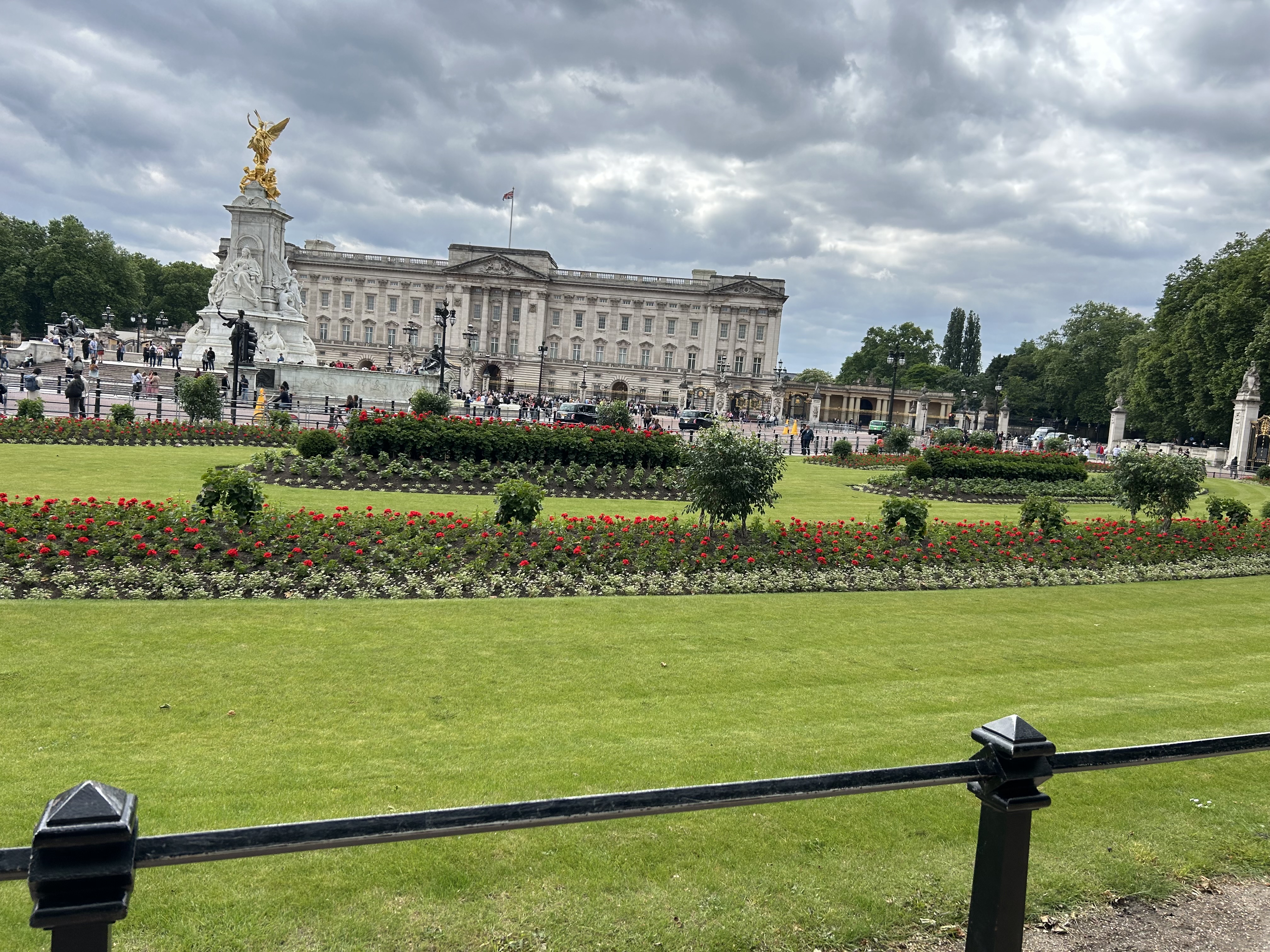
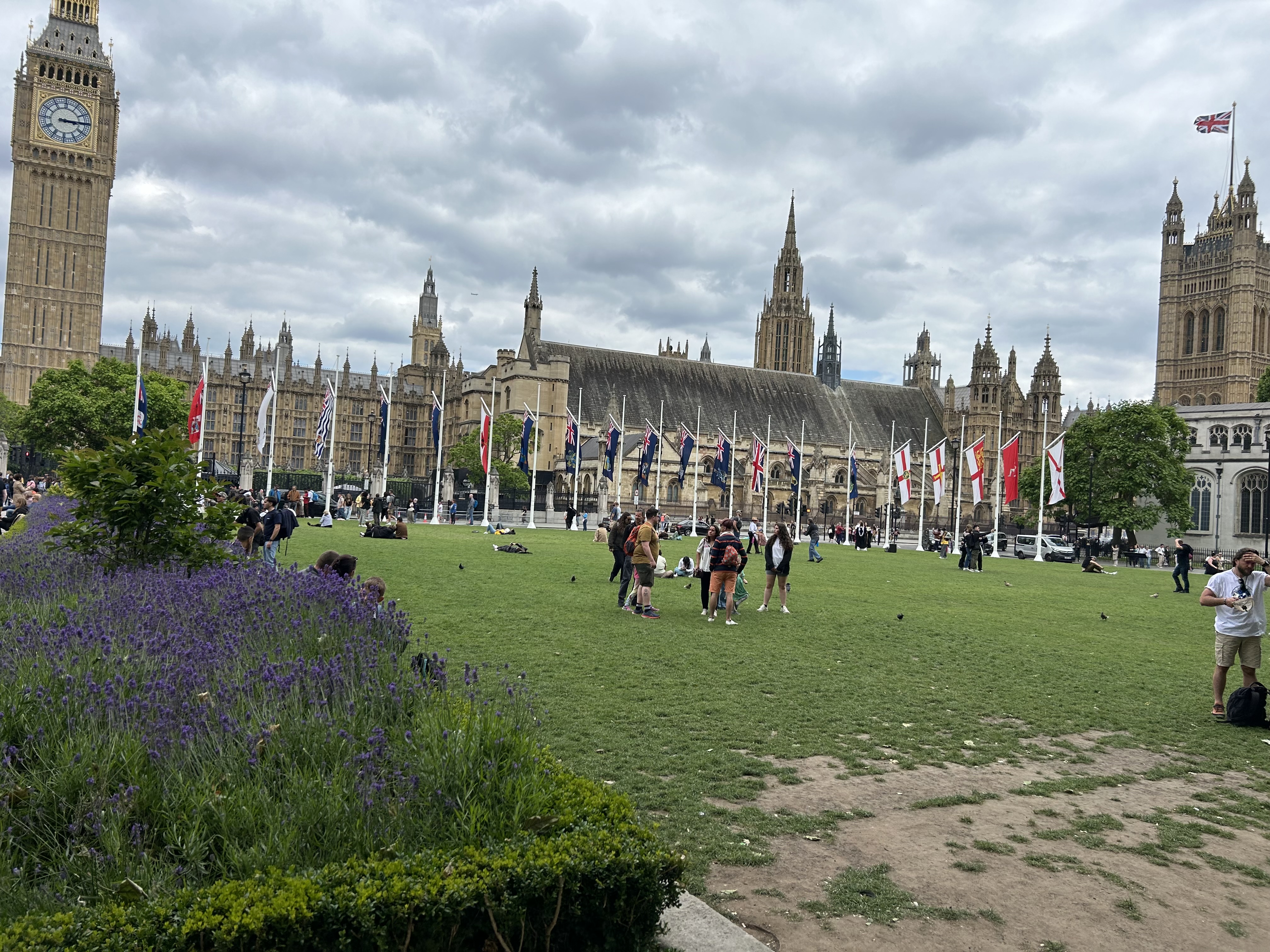
Today then was another travel day.  We took the train to London from Glasgow: a beautiful ride that again took a large part of the day.  More interesting conversations: one with a nurse whose daughter is getting married this weekend and another who works to provide supported housing for the mentally ill.  That was an amazing conversation, and we had a lot in common to talk through.  We arrived here at 2PM which gave us enough time to be regular tourists for the afternoon: seeing Buckingham Palace, the Elizabeth Tower (Big Ben), Trafalgar Square as well as several beautiful parks: St. James Park, Parliament Square Garden, the Queen’s Gardens, and ending it all with high tea at the English Rose. This evening we have the great treat of going to see The Mouse Trap live in London’s west end!  I can’t wait!!  It’s the longest running show in the world and as a big Agatha Christie fan, I couldn’t NOT see it!  Tomorrow we return to focusing more on Gardens and Parks.  We are planning to go to the Kew in the morning and then I will walk Hyde park while David works.  

The main thing I learned from all of this was that I really don’t care to be a regular tourist most of the time. I’m glad to say that I’ve actually seen Buckingham Palace and Big Ben. But we didn’t go inside either: Neither of us were interested.  What I really value is talking with people, experiencing a bit of the culture and walking in the gardens, parks and natural landscapes of the areas.  When we arrived at the train station here and disembarked into huge crowds of people rushing, pushing, trying to get to wherever each was going, I felt overwhelmed and like I just wanted to hide. We had to take a subway (or the “underground”) after the train and it was even more crowded, loud and overwhelming. On the one hand, I appreciate not paying for taxis or cars but actually traveling the way most people travel.  But I found myself texting the kids with the phrase, “Once again, I’ve been reminded that I am NOT a city girl!”  That is definitely part of it.  But also, I feel like the tourist traps, or the things that people usually come to see keep those who visit them at a surface level of interaction with a different place and people.  I’m not so interested in that surface level interaction.  I want to know how people think and feel, I want to get to know the landscape and the land itself, I want to see the animals and watch them in their home places.  

I find myself increasingly grateful for the few days we had on Iona that were just mine to walk, to write, to attend services, to talk to folk, and to just be.  I’m glad we began our European time there, and I’m aware that I could easily have spent much more time there.  It was a centering gift; and a time that I will reflect on often for the gifts it gave. I’m going to end this for now as we need to take the underground to see our play this evening.

I hope all of you are well. While I miss you, I feel connected to you all still through my writing: it feels like I’m writing letters to a friend.  So thank you for reading these my letters to you.


Monday, April 15, 2024

Season of Change

           Last week I wrote a letter for our church newsletter that focused on the nature of change.  I want to include part of what I wrote here, but take it a step further.  

          Every change involves grief.  Even good changes mean there is loss: something that was is now no longer and we have moved into something that is different from what was before.  While some of these changes are easier to get through than others, they all invite us into a process where we can either grow or stagnate, learn and develop or become angry and bitter.  When we try to skirt around the feelings of grief that change brings, usually it ends up hurting us in the end: we are not as able to truly move forward, to grow through the healing process, or to do the inner work required to become the whole people God calls us to be.  

          As I write this, I am preparing to go on Sabbatical.  This is a joyous time: both for me and for my congregation.  For me, I will have intentional and extended time off.  I don’t believe I’ve ever had a vacation or even a day off that was completely free from work in my years serving as a pastor.  There have always been phone calls, texts, emails that need my attention and I’ve been happy to give it.  I love my work and that call has shown me that my work has been valued and appreciated.  At the same time, I am tired and taking a true step away for a few months will be different for me. I will be turning off my computer for these months, stepping away from phone calls and texts.  For much of the time I will be out of the country and unable to receive contact of any kind, but even while I am in the country, a sabbatical requires a stepping away, a silencing of these modes of contact. That will be new for me, but in 28 years of ministry, I’m hoping it will be a time of spiritual renewal.  Jesus modelled stepping away to pray and to regroup and I am trying to learn from his example as I take this time apart.

For my congregation, they will have the experience of a wonderful woman coming to fill in for me who is a colleague, friend and mentor whom I'm hoping will be able to lead them in a different way for a few months.  She will bring different visions, different insight and will be able to lead and walk with the congregation in new ways.  These are all good things.  I will return in August and that will also be a good thing: I hope to come back with renewed energy and vision and I look forward to hearing what my congregation has learned during my time away. 

               But I also need to name, as I began, that every change involves grief.  Grief can include feelings of sadness, depression, anxiety.  While my hope is that these feelings will be minimal for my congregants, I can honestly say that they are rising steadily for me.  I worry about life transitions that I may not be here to support or to walk through. I wonder what my parishioners feel and how they will move through this time. Personally, I worry how it will be for me to not be defined by my ministry.  I have anxiety about the transition back when I return in August.  

            Our session (executive council) for our congregation met yesterday.  We are reading together a book about family and church systems and the chapter we read for yesterday discussed how the anxiety of grief can cause people to "act out."  I feel called to name that despite my understanding this to be true, it is still the case that I find my anxiety causing me to behave differently than I would choose. Today I was snippy and unusually direct with a congregant about something that had hurt someone I love.  Normally I would step back, take a breath before reacting, and be able to be more pastoral in my response.  But today I acted from that reactive anxious place.  I apologized, and fortunately was able to see it for what it was: a reaction based in anxiety and the grief of change.  Even more fortunately for me, he was also able to see that as well and so did not take it personally.  Still, my own behavior was a call to pay attention, and to breathe more deeply through the next couple weeks as I prepare to go.  

            As with all transitions, this is an invitational time for me to pay attention.  As with all feelings, the anxiety calls us to listen and to be honest in our feelings.  But once again, God did not leave me alone in my anxiety.  In the middle of today's drama, I received a phone call from someone I haven't spoken to in nine years.  It was a delightful and unexpected "catch up" conversation with a parishioner from my last congregation. I left the call with several gifts.  

         First, it was a reminder to me that even if I were not returning (and I am returning!!), there would be people who had valued my time here.  I do not need to be anxious that my presence has been unvalued or unimportant.  Even parishioners who experienced me for a much shorter time and during an unusually dramatic and difficult time value what I had to give.  

       Second, it was a reminder that even when we are apart from one another, we remain connected.  Our hearts, our experiences together, our walks together matter.  They continue to be part of who we are even when we are separate.   

      Finally, and always, it was a reminder that God never leaves us alone. At the moment when I most needed reassurance and comfort, I was given the gift of this re-connection.  The ways in which God binds us to one another and is the glue, the love, the communion in community is so important and essential.  And for all of that I am deeply grateful.

     During this season of change I am striving to walk with my eyes open.  I will make mistakes.  But none of us are alone, and with love and intentionality we will walk through the struggles to emerge in a better place on the other side.  Thanks be to God.

Monday, October 10, 2022

Covenant Relationships


1 Samuel 17:55-18:9

Matthew 5:33-37

10/9/22


               Both of the passages that we read today have to do with commitments, with promises, or with, as I would say Covenants.  So to start, what exactly ARE covenants?

               Well, what is a contract?  A contract is generally between equals, or is about offering one thing in exchange for something else that is considered of equal value.  I exchange my house for this amount of money in a sale: that’s a contract.  We agree that the house is worth this much and we exchange it.  I contract to hire you to build something: we agree that your work is worth this amount of money.  Those are contracts.  And they are usually created based on what is generally considered fair.

               Covenants, as we saw in the Samuel passage are very different.  For example, the covenant relationship that is entered into between David and Jonathan is anything but equal.  Jonathan was the son of a king: a prince.  David was the son of one of the king’s servants.  As such, he had nothing to give that could possibly be of the same worth to what was being offered.  Jonathan gave to David his robe, tunic, sword, bow and belt and in “exchange” David stayed with him.  It was a covenant that in many ways mirrors the covenant relationship that God has with us:  God as the creator has everything.  Everything and all things belong to God, were brought into being by God.  We are called to be God’s  people, in our covenant.  And God’s part in the covenant is everything that we are given from God: life, family, friends, food, a beautiful planet on which to live, bodies that can eat, sing, dance, play, stretch.  We are given everything in this covenant and asked, for our part, to simply love God and one another in return.  It, too, is an extremely unequal, uneven, some might say ‘unfair’ CONTRACT.  So much so that it is no longer a contract, but a covenant. 

               And then we come to the Matthew passage.  And it says that we must not pledge or promise or swear to do something.  As Jesus says “Let your yes mean yes and your no mean no.”  Be true to your commitments without needing to make promises or oaths that say that you will keep them.  Why would this be important?  First of all, if you need to promise something or swear something in order to keep the covenant, it cheapens all the rest of your words when you don’t.  It implies that without that promise, without that solemn oath, you are somehow less likely to keep to your commitments and your agreements.  Secondly, sometimes things happen, sometimes things do pop up that make our promises impossible.  And there is no room in an oath for life to interfere, for life to happen, for the unexpected to be taken into account when we judge someone else’s actions.  But once again, this comes down to relationships.  We trust those closest to us, without their needing to “promise” or “swear” things because of the relationships, the covenant relationships with have with them.  And so this, passage, too, is calling us to go deeper in our relationships, to not need those promises, or oaths, but instead to live in trust and understanding. 

               You all have heard the story of the beheading of John the Baptist.  Herod valued John very much.  But when his daughter pleased him he made an oath to her to give her whatever she wanted.  And when she said she wanted John the Baptist’s head on a platter, he gave it to her because he had made an oath.  It was the wrong thing to do, but he felt bound to the oath he had made to do it.  If he had just asked, “what do you want?  I would like to give you something you desire,” there probably would have been more room to talk through what that should look like.  They would have been more closely connected because they would have had to discuss and connect to reach an agreement. 

               But what I want us to do today is to look at several modern situations that occur in the church in which we seem to ignore this mandate not to make oaths, not to make pledges, and discuss with you how this mandate might apply.

               The first situation is the constitutional questions we ask of people when they become ordained in various capacities in the church.  We ask similar questions when people become members.  Here are the constitutional questions:

1.      Do you trust in Jesus Christ your Savior, acknowledge him Lord of all and Head of the Church and through him believe in one God, Father, Son and Holy Spirit?

2.      Do you accept the Scriptures of the Old and New Testaments to be, by the Holy Spirit, the unique and authoritative witness to Jesus Christ in the Church universal and God’s Word to you?

3.      Do you sincerely receive and adopt the essential tenets of the Reformed faith as expressed in the confessions of our church as authentic and reliable expositions of what Scripture leads us to believe and do, and will you be instructed and led by those confessions as you lead the people of God!

4.      Will you fulfill your ministry in obedience to Jesus Christ, under the authority of Scripture, and be continually guided by our confessions?

5.      Will you be governed by our church’s polity, and will you abide by its discipline?  Will you be a friend among your colleagues in ministry, working with them, subject to the ordering of God’s Word and Spirit?

6.      Will you in your own life seek to follow the Lord Jesus Christ, love your neighbors, and work for the reconciliation of the world?

7.      Do you promise to further the peace, unity and purity of the church?

8.      Will you pray for and seek to serve the people with energy, intelligence, imagination and love? 

And then there is always a specific question for those being ordained to the different areas of ministry: deacon, elder, pastor, commissioned lay pastor, certified Christian educator.

               In addition there are questions asked of the congregation:

Do we, the members of the church, accept whomever as our pastor, chosen by God through the voice of this congregation to guide us in the way of Jesus Christ? Do we agree to pray for them, to encourage them, to respect their decisions and to follow as they guide us, serving Jesus Christ, who alone is Head of the Church? Do we promise to pay them fairly, and provide for their welfare as they work among us: to stand by them in trouble and share their joys?  Will we listen to the Word they preach, welcome, their pastoral care and honor their authority as they seek to honor and obey Jesus Christ our Lord?

               Most of these, one could argue, are not oaths made.  Most are just statements of commitment.  But this isn’t true of all of them.  There are a couple in each that are “do you promise…?”  Additionally, if we are taking seriously the “let your yes be yes and your no be no” do we really need to make these statements?  After all, we would not have signed up to do take these jobs or positions if we were not people of faith committing to care for and serve God’s people in these ways.  And finally, perhaps most importantly, I know that some of you have said you have a hard time making some of these promises, and yet we as a church have traditionally insisted that they be made anyway.  We are setting people up to make statements that lack integrity.  For example, the question I have the most trouble with: “Do you promise to further the peace, unity and purity of the church?”  Because while I am all for peace and unity, I know what those who wrote these words meant when they originally put into these promises that we need to work for the “purity” of the church and I struggle deeply with that.  Originally it was a statement of exclusion: making sure that those who did not fit into the writer’s ideas of “purity” were not allowed to be equal participants of the family of faith without changing, conforming, or denying themselves.  But while that has changed, I still struggle with this.  We are not “pure” people: we are children of God with all of our flaws, all of our concerns, all of our doubts and issues.  And to me, the church has to be a place that embraces and accepts all of us with all our parts and pieces.  It has to be a place where the “unrighteous”, to use Jesus’ word, are still at home.  How can we be a place of healing if we only have room for the pure?  If we only have space for those who are reflections of someone’s ideas of what is “right” and good and decent?  I hate this question every time it is asked, every time it is answered.  And yet, how do we stand with integrity and say, “well, actually, I’m all for the peace and unity, but not such a fan of the purity part of that!”  So I find I have to reinterpret what that question is asking every time I promise to “further” that purity.  In my mind I have changed it to “health” or “well-being”.  I want this to be a place of health, wholeness and wellbeing, so I can work for that.  I want us to help each other become more whole, healthy and well.  But, that “twisting” is uncomfortable.

               And then to go deeper into another situation: our marriage vows are exactly that: oaths that we take, promises that we make in front of the church and one another and God.  When we consider the fact that over 50% of all marriages end in divorce in this country, what do these vows mean?  How can we make these promises to one another to love, cherish and honor ‘til death do we part, knowing that over half of those marriages will not last until death?  Are we confident that we can beat the odds?  Is good intention enough? 

               I also think that it causes problems for those whose marriages become abusive.  There is the discomfort with breaking a vow, even when the other has broken theirs in unjust and unfair behavior.  But sometimes, the healthiest thing we can do for ALL involved is to step out.  Do our vows prevent some from doing that?  Yes.  And then with marriages that do end there are problems too.  Just like when Herod felt he had to go through with his promise to Herodias just because it had been a promise, when people’s marriages end, there is an unusual amount of folk who feel they have failed.  I actually don’t see that.  I’ve seen too many marriages where people feel they are living up to their vows by staying married when this is the worst choice that could be made by either partner.  We end up with people saying “yes” and then being resentful and angry about those commitments.  I’ve also seen many divorces that are not failures at all, but are a step into life for both persons in the relationship.  But they often carry a feeling of guilt for those who make that decision because they represent these broken promises, broken “vows”, broken oaths. 

               In contrast to all of this, then, we have covenants.  And Covenants are not promises, or oaths.  Instead, they are commitments to God, to life, and to love.  They are intentional bonds of caring, of love, and of grace.  By love here, I am using Scott Peck’s definition of “working towards the highest good for the other”.  Covenants are the commitments that we make as people of God to being people of God: to loving our neighbors as ourselves and to caring for each person as the child of God that they are. 

I think about Tolstoy’s three questions.  Those questions are: who is the most important one, what is the most important thing to do, and when is the most important time to do it.  And the answers are always: the most important one is the one right in front of you.  The most important thing to do is what needs to be done for that person right in front of you.  And the most important time to do it is now.  When we can honor and act on these things, we are living our covenant life.  We are living THE covenant life. 

               In covenants, then, there is room for change.  There is a recognition that the most loving thing we can do for the other, and the highest good for the other sometimes, and might I say through the course of our lives, often, change.  That means that the covenant might look different from one day to another.  In a covenant, what you need today may be more of our attention and care, and what I need tomorrow may be more of our attention and care.  There is movement, flexibility, and a recognition of our call, our movements towards growth.  In covenants, we can make commitments that recognize the true diversity and differences between us that therefore call for each commitment to be made in a slightly different way for each person.  Are covenants more complex then?  Of course.  They are much more nuanced, and they require really knowing each other and each part of the covenant in order to be genuine.  But that is our call.  To see one another, hear one another, love one another and care for one another.  I invite you to let your yes be yes and your no be no, and to celebrate the changes, movements, and diversities that we share, without legalizing or concretizing them into unmoving, unchanging contracts.  We are a covenant people, called into relationship with God and each other through those covenants.  Thanks be to God!  Amen.


Monday, August 15, 2022

Community and Suffering

 Ruth 1:1-22

The book of Ruth in so many ways shows us exactly the opposite of the book of Job.  In Job when everything goes wrong, he first piously pouts and prays, and then as things get worse and worse, he eventually yells at God.  I’ve shared with you before that I love the book of Job because it shows a God who responds to our pain, responds to our cries, responds even to our anger when it is expressed directly to God.  Our God shows up, is present and loving.  And in the end of Job, all that he had comes back to him in greater abundance than before.

But, while I deeply love the message of Job that God is there when we are honest, real and completely open with God, I think I love the book of Ruth even more.  In the book of Ruth, we see a very different response to a similar situation.  Naomi, who is, in many ways, the real star of the book of Ruth, has, like Job, lost everything.  As you know, women had no agency at this point in time.  They could not own property, they could not hold jobs.  Everything they had and everything they were was dependent on the men to whom they were attached.  So when Naomi loses not only her husband, but both of her sons, when her spouse and her children are dead and along with them, her livelihood, her property, and all that she has, she, too, has truly lost everything.  This can’t be understated.  Everything she knew was gone.  And as she says here herself, she is too old to remarry and produce more sons.  Unlike Job who can go on to remarry and have more children, Naomi is past that.  So, like Job, she too is angry and grieving.  As she says, “Don’t call me Naomi, (which means pleasant) but call me Mara (which means bitter) for El Shadai has made me very bitter.  I went away full, but the Lord has returned me empty.”  

Like Job, Naomi is angry.  Like Job, Naomi is in deep grief.  Like Job, Naomi seems beyond hope.  But unlike Job she does not act like she is beyond hope.  Job sits and complains.  Job sits covered in sackcloth.  But Naomi moves herself into action, instead.  She picks up to move back to her home land, having hope that there will be food there for her.  She doesn’t start with a complicated plan.  She just starts by putting one foot in front of the other.  We are told, “She arose… because while in the territory of Moab she had heard that the Lord had paid attention to his people by providing food for them.”  So while she may have been expressing pain, expressing despair, she chose to act out of her hope.

And what she finds, in this first step, this unclear, unplanned, but decisive first step to go home is that she is not alone.  Ruth, who has also lost her husband and therefore her livelihood as well, commits to going with her.  And Ruth is adamant in that decision.  Naomi takes a step into life, and in doing so finds she is not alone.

This is my message for each and every one of you today, and what I hope you will take from today.  When we choose to step forward in hope, to take action despite our feelings of grief, of loss, or of despair; when we follow the call to act, we will find that we are not alone.  We will not be sent on the journey by ourselves.  The helpers are there, and they will come.  And along with them, there is often a plan, often a vision, often the insight to see the call into the next step, and the next, and the next.

My family has been watching the series, “Call the Midwife”.  This week we watched an episode from the second season in which the main character, Jenny, is trying to help a woman who had been forced, out of complete destitution, to go into the workhouses in London.  She had been there for 35 years, until they closed.  And now her life is one of agony, one of deep poverty.  But at the base of her pain and her grief is the fact that when she had first gone into the workhouses, she had entered with five little children.  The way these workhouses functioned was that all children would be taken from you when you entered into the workhouse.  All five of these very young children were taken from her.  This woman, now an old woman, has no knowledge of what happened to her kids past the day that they were taken from her.  But she yearns for them, calls for them, cries out for them.  When one of the nurses goes to help her, all this woman can talk to her about is seeing her hope of seeing her daughter, Rosie, who at the time was the eldest of the five, and was 8 years of age, in particular, again.  The nurse, Jenny, is so upset by all of this that she decides to find out what happened to the children.  And she discovers that all of these five very young children died very quickly after being taken from their mother.  “Failure to thrive” it was said.  The system destroyed the children by taking them away from their mother.  Jenny doesn’t know what to do with this information.  She brings it back to Nanatus house, devastated by this history that she has discovered.  And the response?  “And what do you propose to do, Nurse Lee, now that you have garnered these unedifying facts?”  When Nurse Jenny Lee says she doesn’t know, the nun continues, then, to quote the apocrypha, “you have been curious in unnecessary matters.  The past remains the past.  The present, unamended.’”  Another of the sisters joins in, “Sister Monica Joan is right.  It’s what happens in the here and now that counts.”  Nurse Jenny Lee responds with, “Forgive me but her life in the here and now is not safe or filled with love.  She waits every day for a child.  For children that are never coming home.” The nuns respond, “Then you should turn your mind to that.”  And so she does.  Nurse Jenny goes and does more research, and she finds where the children have been buried, which is in a mass burial ground.  But within that mass grave, there are specific locations for each of the children.  She memorizes where each child is and then takes the old woman to the grave site.  She says “We are standing by a public grave.  There are many put in here.  This is where they buried the workhouse inmates.”  

“I had too many,” Mrs. Jenkins says.  

“Yes, and they are all here.”  Jenny replies.

“Together?” she asks.

“I was able to get plans of the cemetery and the graves in the public records.  It’s all written down.  Percy and May are lying next to each other.  Just over there.  Alice is to the right, over there.  I think in the summer that tree must cast some shade there.  And George is by the cross.  Rosie is right here, Mrs. Jenkins, almost underneath your feet.”  The old woman bent down, putting her hands on the snow over the grave of Rosie “I’d have liked her in with me to warm her feet.  But I can see she’s tucked up safe.”  She sobbed and cried, but was then was able to grieve properly and to finally find some peace, knowing where they were, knowing what had happened to them.  Jenny then invited her into a new life: invited her to help her community to sew and make costumes for the Christmas pageant.

Nurse Jenny had seen a problem: the suffering of this older woman who had no closure, no way to grieve, no way to move on past those horrible 35 years.  And while Jenny did not know what to do, she took her own suffering, her own pain, her own despair to her friends.  While they didn’t give her the exact answer, they pointed her in the right direction.  And in the end, after Jenny had taken the steps to learn, to share, to help move Mrs. Jenkins forward, it was the entire Convent that helped Mrs. Jenkins to find work, to find meaning in making the costumes.  They, together, invited her into their community, and they, together, helped her to grieve, to mourn, and to find peace.

 I think about Moses who knew what he had to do but was afraid to do it.  In choosing to step forward, God provided that Aaron and Miriam would go with him and would help him.  He was not alone.  

I think about the women who started MADD: when Candace Lightner’s child was killed by a drunk driver, she knew something had to change.  She put it out there and Cindi Lamb joined her (who had also lost a child due to a drunk driver).  Together they were able to make a huge change.  MADD has lowered the number of those who have died from drunk driving by half!  That is huge.  

The work that people are doing to help refugees from the Ukraine they are doing together.  The work that Hope Solutions is doing to help the homeless in Contra Costa County started with people from a church dreaming and envisioning and planning together.  There are so many needs in our world.  But when we get stuck in the “I don’t know what to do” there is no movement.  Pray, ask God what is the thing that is concerning you the MOST right now.  And then speak about that!  Share with us your fears, your concerns.  Do you try to solve these problems alone.  Together we can do so very much!

When we are in pain, when we are grieving, when we are struggling against loss and fear, we are called to listen to that pain as a calling from God to act.  And when we do not know what we can do to act, the first thing we must do is to say “yes”.  That’s it.  Say “yes, I will act.”  The second thing then that we are called to do is to remember that we are not lone rangers.  None of us is here alone.  Not one of us has been put here on this planet to solve the problems of the world on our own.  We are made for connection, we are made for community.  That pain in your heart, that tugging on your sleeve, that call to action: it is not given to any one of you alone.  Our lone ranger complexes keep us stuck in inaction.  And while God showed up for Job, and God will always show up for us, too, Job was not able to do what Ruth and Naomi did.  Job stands as a lone book.  Ruth, in contrast, is an ancestor of Jesus.  Our ideas that we should be able to figure it all out on our own keep us from acting at all.  We end up being Jobs rather than Naomis when we forget that God has not put us here alone.  

It was together that Ruth and Naomi were able to rise above their situation and survive.  It was together that Ruth and Naomi were able to make enough difference in the world that Ruth is listed as one of the ancestors of Jesus.  It was together that they were able to thrive.  And it is together that we, too, will change our world.  All we have to do is say “yes”.  And then look for the helpers.  They are there.  God makes sure of it!


Thursday, May 12, 2022

Changed in a Moment


Acts 9:1-19a

5/1/22


Today we heard about Saul/Paul’s conversion, and his being filled with the Spirit rather than persecuting those who would follow Jesus.  We have all heard this story before: it is a very familiar story.  It is so familiar that when people talk about great changes in their lives they sometimes refer to them as “Damascus Road experiences”.  But what I want to focus on today is that, while we in the extremely individualistic United States always hear this story as being a story about Saul and Saul alone, that Christianity is, in actuality, a very communal faith.  Our scriptures are not speaking to us as individuals, they speak to us as communities.  This story about Saul is no exception.  This is a story to a community of people, and the change that Paul experienced was a change that affected a great number of people.  But also, Paul did not experience this in isolation.  There were other players in this story who had very important roles to play.  We are told he was traveling with a group who also heard the voice.  We are told that he stayed with the disciples.  We are told that Ananias was the one who laid hands on him and healed him in Jesus’ name and then baptized him.  These are communal events.  And after all of this takes place, his call, and what he does from this point out, is to build communities of believers, entering synagogues, talking about Jesus, building up communities, groups of followers.  He is not about converting individuals, he is about building communities of believers. 

Christianity is very, very communal.  A commitment to the faith is a commitment to spend time in Christian community, caring for and serving God’s people, also in community.  I realize this is a foreign concept to many people.  Perhaps this is especially true of our younger generations at this point in time.  There is a myth at large, for example, among many young adults that religion is a private thing and does not require being in a community of faith.  But if you read the scriptures with intentionality, it becomes very clear that they have something very, very different to say.  Jesus, himself, was never a “lone ranger” but a person with a community not only of disciples but of many others as well, including women who were not counted among the twelve.  In Matthew 18:20 Jesus tells us, “For where two or three gather in my name, there am I with them.”  This is a strong statement, a strong, strong statement that it is not just that God stands beside us when we are alone and praying, but that Jesus is actually tangibly present, here in this place, in this room, when we are gathered in his name.  We do not experience Christ, God-among-us, Emmanuel, when we are alone.  It is an impossibility to do so.  Christ is to be found in community.  God might be experienced alone, but CHRIST, God with us cannot be.  We, together, are the body of Christ – but not alone, not in our own individual practices.  We are the body of Christ as a community of faith. 

It goes even deeper than that.  In today’s passage from Acts, when Jesus speaks to Saul, he does not say, “Why are you persecuting my people?”  I want you to think about that for a minute.  Those were not the words that Saul heard.  Remember that according the book of Acts, Saul was hunting down people who were followers of Christ.  As the passage we just read put it, “Meanwhile, Saul was still spewing out murderous threats against the Lord’s disciples. He went to the high priest, seeking letters to the synagogues in Damascus. If he found persons who belonged to the Way, whether men or women, these letters would authorize him to take them as prisoners to Jerusalem.”   But Jesus, speaking to Saul does not say, “Why are you persecuting my people?”  Instead he says, “Why are you persecuting ME?”  When we injure God’s people, we are injuring God, God-self.  This, of course, mirrors Matthew 25: “Whatever you do to the least of these you do to me.”

This story here, and Jesus’ words to Saul: these were not the exception.  This was the whole point.  We are deeply interconnected.  And when we try to separate ourselves from one another, walling off parts of our beings as “private” and “personal”, especially something as big as our faith, the people we harm are ourselves.  Our connections to others are our deepest connections to God.  Our faith conversations led us to a deeper understanding and therefore a deeper connection with God.  The sharing of our faith experiences also rounds out our vision and understanding of God.

When we are worshiping together, God is with us.  When we are feeding God’s sheep, God is with us.  When we are serving God’s people, God is with us.  When we connect with others in kindness, in care, in grace, God is with us.  And when we fail to connect with love and kindness towards others, we are failing to connect with God in those moments.  I think that part of the reason why meanness, why tearing, why estrangement and disconnection from others is so very painful for us is that it is not just a disconnecting from someone else.  It is a disconnecting from our very selves and a severing, in those moments, from God. 

               I think about when Pope Benedict made his decision to resign from his job as Pope.  That had not happened since 1294.  It was unheard of by many, and others saw it as unacceptable.  He made a very brave decision to do what he believed was best not only for himself, but for the church, since he could no longer serve as well due to failing health conditions.  In many, many ways he put the needs of the church and of the world above himself.  It was a brave and compassionate decision that recognized our deep interconnections and the need for wholeness and strength in leadership roles. 

               There is a story about a hospital volunteer who shared about a little girl named Liz who was suffering from a rare & serious disease.  Her only chance of recovery appeared to be a blood transfusion from her 5-year old brother, who had miraculously survived the same disease and had developed the antibodies needed to combat the illness.  The doctor explained the situation to the girl’s little brother, and asked the little boy if he would be willing to give his blood to his sister. The hospital volunteer share that she saw him hesitate for only a moment before taking a deep breath and saying, "Yes I'll do it if it will save her."  As the transfusion progressed, he lay in bed next to his sister and smiled, as we all did, seeing the color returning to her cheek. Then his face grew pale and his smile faded. He looked up at the doctor and asked with a trembling voice, "Will I start to die right away?" Being young, the little boy had misunderstood the doctor; he thought he was going to have to give his sister all of his blood in order to save her.  But the point is: he did it anyway.

               Another story shares about a professor who gave a pop quiz.  The student wrote, “I was a conscientious student and had breezed through the questions until I read the last one: "What is the first name of the woman who cleans the school?" Surely this was some kind of joke. I had seen the cleaning woman several times. She was tall, dark-haired and in her 50's, but how would I know her name? I handed in my paper, leaving the last question blank. Just before class ended, one student asked if the last question would count toward our quiz grade. "Absolutely, " said the professor.  "In your careers, you will meet many people.  All are significant. They deserve your attention and care, even if all you do Is smile and say "hello.." I learned that her name was Dorothy.”

               These are stories that remember our connection.  These are stories that remind us of the importance of each person but more, the importance of our relationships with those we encounter.  Those connections are vital in every day life, but even more vital for those of us who believe in God, who believe that God is the connection between all of us, is the love that we share between one another.  The more that we can love, the more that we can connect, the deeper our relationships with God.

A member of a certain church, who previously had been attending services regularly, stopped going.  After a few weeks, the pastor decided to visit him.  It was a chilly evening. The pastor found the man at home alone, sitting before a blazing fire. Guessing the reason for his pastor's visit, the man welcomed him, led him to a comfortable chair near the fireplace and waited.  The pastor made himself at home but said nothing.  In the grave silence, he contemplated the dance of the flames around the burning logs.  After some minutes, the pastor took the fire tongs, carefully picked up a brightly burning ember and placed it to one side of the hearth all alone then he sat back in his chair, still silent. The host watched all this in quiet contemplation.  As the one lone ember's flame flickered and diminished, there was a momentary glow and then its fire was no more.  Soon it was cold and dead. Not a word had been spoken since the initial greeting.  The pastor glanced at his watch and realized it was time to leave.  He slowly stood up, picked up the cold, dead ember and placed it back in the middle of the fire.  Immediately it began to glow, once more with the light and warmth of the burning coals around it. As the pastor reached the door to leave, his host said with a tear running down his cheek, 'Thank you so much for your visit and especially for the firey sermon. I will be back in church next  Sunday'.

               It is essential that we remember this.  That when people are dying in wars, that we are lessened, that when people are hungry, we are hungry.  When people are angry and vengeful, we are suffering too.  If we want to be the people of Christ, we have to remember our connections, our unity, that we need each other and are deeply connected to one another.  Paul’s conversion did not happen to just one person. It affected all who interacted with him.  Those who traveled with him when it happened, those who were with him with Ananias came to heal him, and all the rest of those with whom he interacted afterwards.  Similarly, everything we do, everything we choose, the words we use, the attitudes we have: all of these have an affect.  It’s the butterfly affect, it’s the quasar affect: everything we do interacts with everything else.  It all matters.  Let us, in all things, remember our deep connections and choose actions therefore that reflect love, grace, and caring for one another.  Amen.

Monday, October 4, 2021

"I Am"

Exodus 2:23-25; 3:1-15; 4:10-17

John 8:58

Psalm 46

World Communion Sunday


What are some of the ways that you come to know God?  Scripture, nature, worship, prayer, meditation, fasting, spiritual disciplines such as lectio divina and clearness committee and ....  Do you have one or two ways that speak to you more than others?  That you tend to gravitate towards?  Are there other ways of knowing God that are less comfortable for you?  Or ways that you avoid?

               You know the familiar story about the blind men and the elephant.  I read it to you in January.  But I think it’s a story we should all be remembering on a regular basis, especially as we seek to cross our differences, to be in relationship despite our disagreements, to work to love those who don’t see things the same ways that we do.  So here it is again:

It was six men of Indostan, to learning much inclined,

Who went to see the elephant (though all of them were blind),

That each by observation might satisfy his mind.

The first approached the elephant, and, happening to fall

Against his broad and burly side, at once began to call:

"I see," said he, "the elephant is very like a wall!"

The second, feeling of the tusk, cried, "Ho! What have we here?

So very round and smooth and sharp? To me 'tis mighty clear

This wonder of an elephant is very like a spear!"

The third approached the animal, and, happening to take

The squirming trunk within his hands, thus boldly up and spake,

"I see," said he, "the elephant is very like a snake!"

The fourth reached out his eager hand and felt about the knee:

"What most this wondrous beast is like is mighty plain," said he,

"'Tis clear enough the elephant is very like a tree!"

The fifth, who chanced to touch the ear, said, "E'en the blindest man

Can tell what this resembles most. Deny the fact who can,

This marvel of an elephant is very like a fan!"

The sixth no sooner had begun about the beast to grope,

Than, seizing on the swinging tail that fell within his scope,

"I see," said he, "the elephant is very like a rope!"

And so these men of Indostan disputed loud and long,

Each in his own opinion exceeding stiff and strong,

though each was partly in the right, and all were in the wrong!

So oft in group endeavors, the members of the team

Rail on in utter ignorance of what each other mean,

As if it were an elephant not one of them has seen.

               So, too, I think we are all limited in our knowledge of God by many things.  For example, our circumstances in life limit what we see of God.  The limits of our experiences, the limits of the time that we can give over to our spiritual lives, these limit our understanding of God.  We are limited by our beliefs in seeing the whole picture of God.  The really wise person is the one who recognizes they lack knowledge because that is the person who is open to learning and experiencing more.  Our "knowledge" of God can often limit what we see of God, what we hear of God.  Let me give you a specific example - those who "know" that God is only male miss seeing the feminine or even binary or fluid aspects of God.  Those who "know" that people are made in the image of God may miss seeing aspects of God reflected and alive in nature or in other ways that are beyond human. 

               We see this with scripture too: if we only take scripture as literal and historic, we frankly miss the deeper messages within it.  When we miss those layers and layers of wisdom and meaning, we also miss out on deeper and different ways to see and understand God. 

               We also limit God by what we leave God out of in our lives, or what parts of our lives we keep separate from our faith.  Can you think of areas people hide away from God?  Can you think of areas that YOU keep separate from God?  Or areas of our lives in which it might be a challenge to include God in?   

               Besides all of these things that limit our relationships with God, I would also say that spending time with God only in the ways that are familiar and make us comfortable also limits our understanding of God.  We only see the part of God that we are touching, that we are exploring in those moments.  For example, when we only know God through prayer, we may come to see a God who listens, a God who loves, but we may miss that God also instructs, also guides, also has words to speak to us.  We have heard some people say they don't come to church because they find God better on their own.  Well, I suggest that only finding God in church, and conversely, only finding God outside of church - both of these limit our vision and understanding of God.

               The scriptures we heard today present two ways that people might meet God.  Moses met God in a burning bush.  The Psalmist tells us to meet God in silence.  Both are important.  Both give us information about God.  God appearing in the burning bush tells us that God is amazing, can do anything, can appear in any form, and that God does speak to us, does come to us, does have instruction for us.  It shows us the drama and wonder of God, the ways in which God can be so obvious, so hard to ignore, so beyond our expectations.  God telling us to be still to know God tells us that God is also gentle, and at times is not dramatic, but calls us into a stillness and into a place of listening and being present in the quiet and stillness.  That God is as close to us as our own breathing and heartbeats, if we but quiet down for a moment to experience God.

               In the book Eat, Pray, Love, Elizabeth Gilbert takes a year "sabbatical" or pilgrimage to explore her spirituality.  This was not always a comfortable experience for her.  She found herself confronting difficult parts of herself within her spiritual journey.  And some of the things she tried - extended periods of meditation for example, were downright frustrating and uncomfortable at first.  But she continued to try them, to work with them, to give them a chance.  It took time, it took commitment, it took a real desire to see God, to know God in a different way, in a fuller way, in a more complete way.  When we strive to know God in a different way, she discovered, we cannot just try something new for a minute or an hour, a day, or even a week.  It took months, but she was blessed with a deeper, broader, new look at God.  And she found that not only did she encounter God in new ways, but through her encounter with the Divine, she came to understand herself better, to heal some deep brokenness within and to find the courage to heal some brokenness outside of herself, in relationships, as well. 

               This is not surprising.  When we come to know God in a new way, we also come to understand ourselves more deeply, because we are made in God's image.  Similarly, we can come to understand those around us more deeply as well.  We can grow in our capacity to love and to care as we encounter Love itself, as we strive to know God better and in different ways.

               On this, World Communion Sunday, we remember that other Christians around the world, Christians who experience and celebrate God in different ways than we do, are also part of our faith family, part of the family of God.  In their different ways of worshiping and celebrating their faith, they have things to teach us about who God is and where God can be found.  In hearing and learning and experiencing the ways others do worship differently, and understand God differently, we come to see more aspects of God, more nuances to the face of God, more parts of who God is.  I would say this also expands beyond Christianity.  When we encounter and talk and interact with people from different faith traditions, even atheism and agnosticism, we can also learn from them.  Even those who say there is no God or that they don’t know if there is or they don’t care if there is, there are still things we can learn about God even from them!  As I worked on my doctoral dissertation, I interviewed a number of atheists and learned that those I interviewed had a very specific vision of God as a white bearded man sitting in the clouds, literally making the world in 7 of our human days, that they couldn’t accept.  Well, I can understand that.   I tend to agree with them on that.   

These beautiful passages in which God says God’s name is “I am” or “I will be who I will be” or “I am becoming who I am becoming” tell us that God is so very much bigger than we can imagine.  God IS, and in that BEING we find God.  It is not just God’s name.  It is who and what God is.  God IS being.  God IS.  We find that God in the burning bush and in the stillness and in so many ways.  Jesus, too identifies as “I am” repeatedly, “I AM the bread of life,” “I AM the way, the truth and the life,” etc.  Jesus also says this BEING existed from the beginning.  But we humans, we have a hard time with just “being”.  We want to define things more tightly.  We want to assign qualities and attributes.  And those qualities and attributes limit who God really is for us.  If you are happy, you are not sad.  If you are a democrat, you are not a republican.  If you are an athlete, you are not a coach potato.  Whatever it is: our attributes, even of God, limit in our minds not just who we are, and who other people are, but who God really is.  But God IS.  God IS.  And so, we expand our understanding by taking the time to intentionally see other sides of God that may not be as comfortable or easy. We expand beyond the boxes and the attributes and into the BEING of God.

               And so, my challenge for all of us is that we take the risk, and take the time, to try to know God in a way we haven't encountered God before.  I encourage us to try something that we may not have tried before.  We can try a classic spiritual discipline such as daily meditation for a month, or we can try a 24 hour fast.  You can invite someone to be your prayer partner, especially someone you don’t know very well, or someone you’ve had issues with.  This doesn’t necessarily have to be someone you pray with, but someone you can check in with about your prayer life and that can help hold you accountable to daily personal prayer.  You might try a Taize service, or attending one Sunday a service that is completely different.  You could help serve a meal with Winter Nights, or volunteer to help with our laundry program.  You can commit to reading a part of the Bible with which you are unfamiliar, to study it, to discuss it with a small group.  I would be happy to help you form that group.  You might take a journey or pilgrimage to Israel/Palestine.  You might talk to someone that you don't think you like.  Or simply make a commitment to take the time to be still, even amidst the crazy business of our lives.  But the challenge is not to just try this new thing one time, but to really give time to whatever you are trying that is new.  Give it time, give it space, give God time to talk to you through your new experience and to reveal God-self to you in a new way.  Whatever it is, I invite you to seek to feel more of the elephant...or rather, to seek to see more of God and who God is in your life, and in the world.   God is waiting to be known more fully by you, and God promises that in return you will know more of yourself as well.  Amen.