Showing posts with label values. Show all posts

Friday, June 7, 2024

Traveling

         My sabbatical (according to the extensive grant application I wrote) is focused on healing time and towards that I said there were several activities that were healing for me: gardening, hiking, and writing being three of those.  Towards that end, I divided the three months into different sections:

1. Rest and work on my own garden

2. Travel through California with my girls to see and visit gardens throughout the state to learn and gain more ideas for continued work on my own garden.

3. Visit Iona to hike, pray, write.

4. Go on a garden tour of England and Wales with David

5. Walk the Camino with my son.

6.  Continue to work on my garden at home.

Yesterday I finished part 3.  In a reverse of how we began our time in the UK:

 We walked to the ferry,

Took the ferry from Iona to Mull.

Took the bus across the Island of Mull.

Took the ferry to Oban.

Took the train back to Glasgow.

Walked to our hotel.

We had nothing else scheduled for the day, which turned out to be a good thing.  I mentioned in another blog post that there would undoubtedly be challenges but I would strive to see them as adventures.  Yesterday was our day of “challenges”.  First, the water was extremely choppy because the high winds continued.  As a result, the ferry arrived on Mull a bit late: it just couldn’t go the speed it usually does.  That meant the bus left late, though it had waited for the ferry to arrive.  Then, as we were on the drive around Mull, the bus actually broke down.  By the time they were able to do a “bandaid repair” on the bus to get us the rest of the way around Mull to the repair hub (which was only about .2 miles from the ferry terminal), the ferry had left.  That meant we all waited for the next ferry, two hours later. This set a number of people back, but we had actually sort of prepared… we’d bought a late train ticket to get back to Glasgow, just with a sense that we didn’t want things to be rushed “just in case” there were problems.  so we caught the train just fine, but apparently one of the train lines had had a fire, which meant the train we took was re-routed a different way to get back to Glasgow.  What was supposed to be a three hour train ride actually took SIX!!  AND, the train terminal where we were supposed to exit was closed, so that added a short extension to our walk at the end.  It all worked out fine: again, we had nothing else scheduled for the day and we had more interesting conversations with locals.  One man in particular wanted to talk politics with us (which I’m happy to share with anyone interested) but also wanted to give us some of his Scottish snacks, which were interesting. Another family talked about what they had done in Scotland and where they were headed, and another couple shared with us what they thought we ought to see while in London.  What continued to be interesting to me is that many of these folk also shared about recent losses they’ve experienced: one woman sharing that her brother had just died, another that his wife died nine months ago.  I don’t know what I carry that invites this, but I’m always happy to be a support and to listen.  It just continues to feel like an unbelievable privilege to me when folk go deep with me: and to have these strangers choose to do so was another unexpected gift.  When we finally arrived in Glasgow it was fairly late. We ate our Scotland-required fish and chips for dinner and then went to bed.

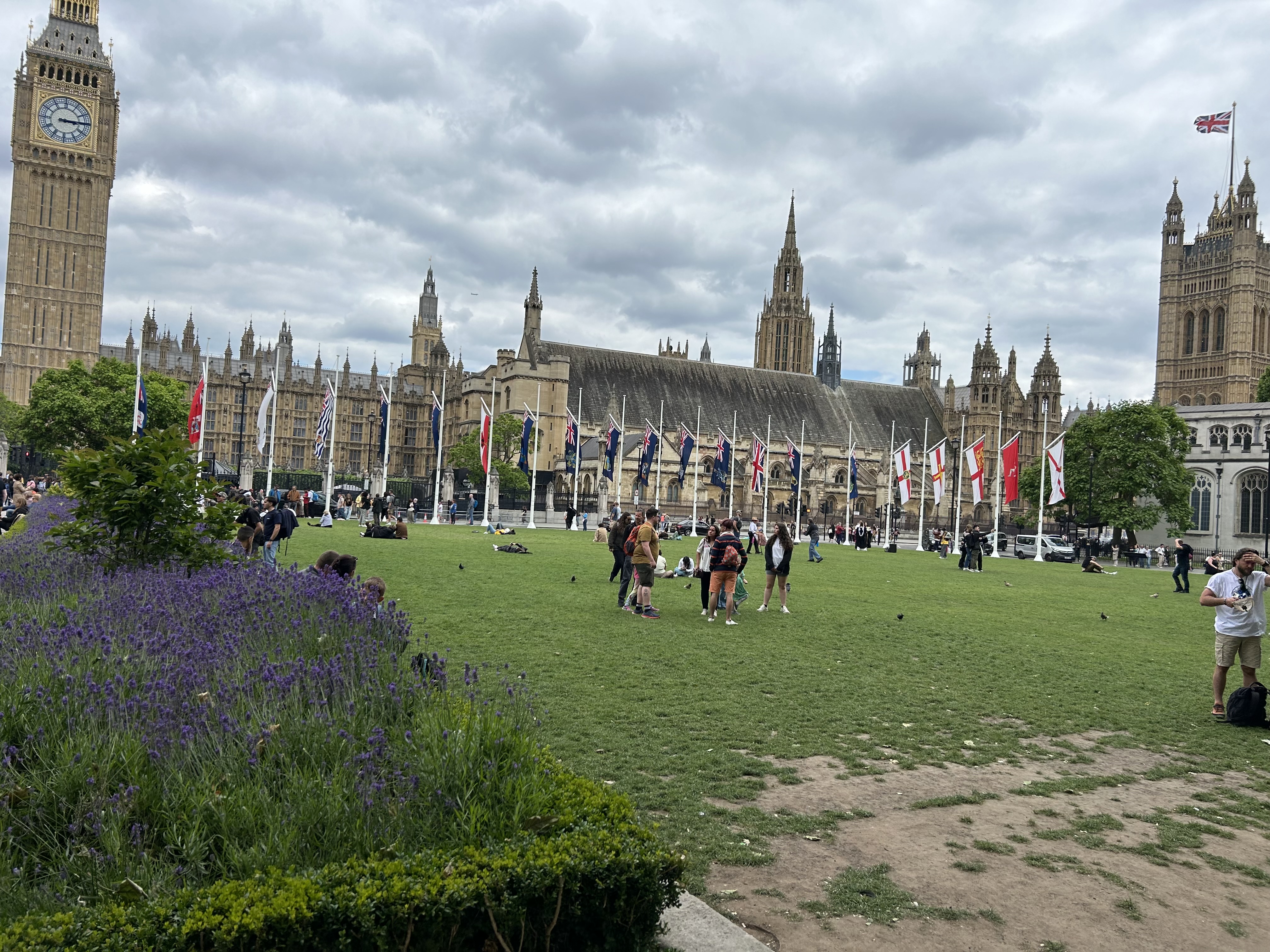
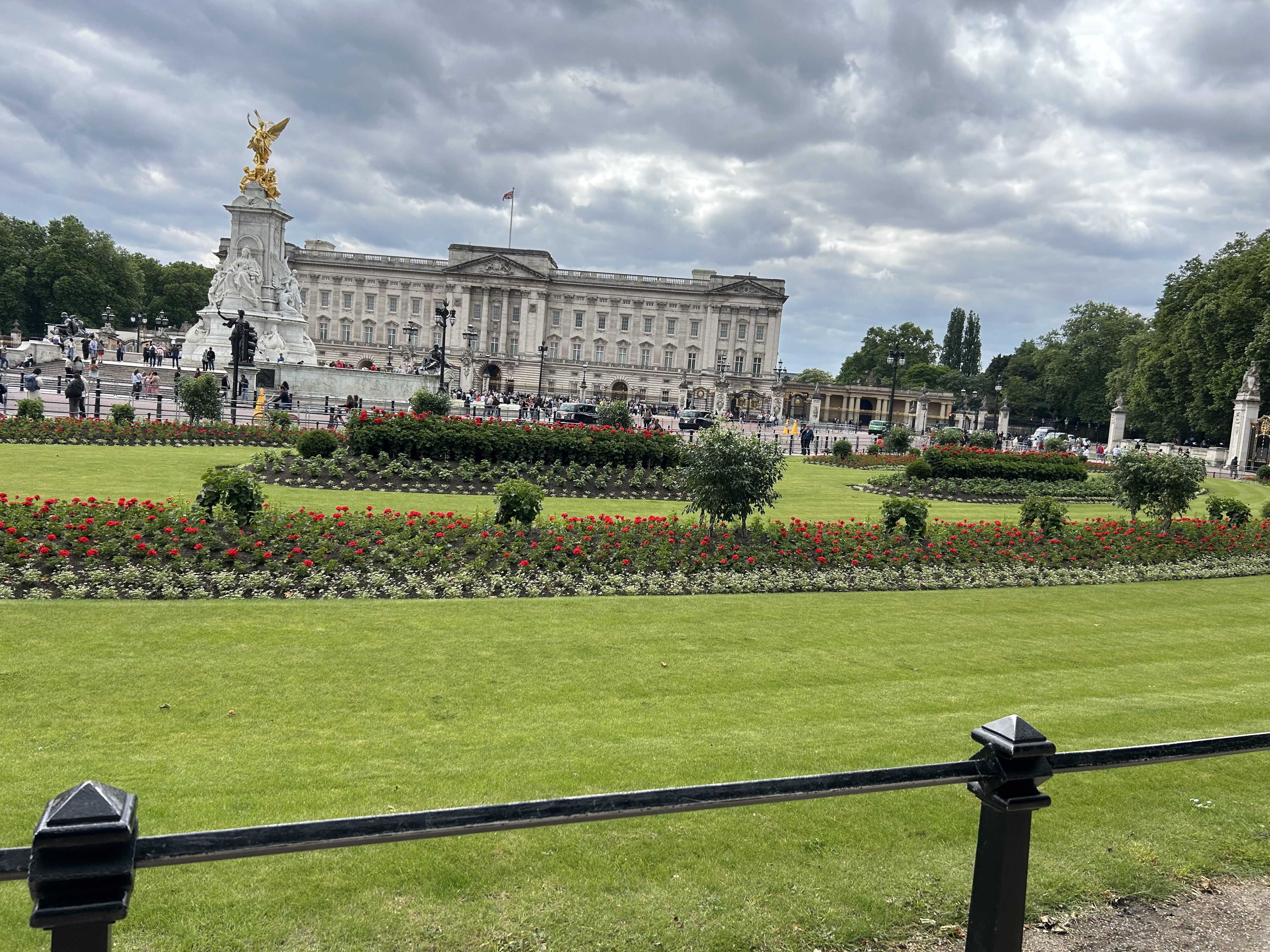
Today then was another travel day.  We took the train to London from Glasgow: a beautiful ride that again took a large part of the day.  More interesting conversations: one with a nurse whose daughter is getting married this weekend and another who works to provide supported housing for the mentally ill.  That was an amazing conversation, and we had a lot in common to talk through.  We arrived here at 2PM which gave us enough time to be regular tourists for the afternoon: seeing Buckingham Palace, the Elizabeth Tower (Big Ben), Trafalgar Square as well as several beautiful parks: St. James Park, Parliament Square Garden, the Queen’s Gardens, and ending it all with high tea at the English Rose. This evening we have the great treat of going to see The Mouse Trap live in London’s west end!  I can’t wait!!  It’s the longest running show in the world and as a big Agatha Christie fan, I couldn’t NOT see it!  Tomorrow we return to focusing more on Gardens and Parks.  We are planning to go to the Kew in the morning and then I will walk Hyde park while David works.  

The main thing I learned from all of this was that I really don’t care to be a regular tourist most of the time. I’m glad to say that I’ve actually seen Buckingham Palace and Big Ben. But we didn’t go inside either: Neither of us were interested.  What I really value is talking with people, experiencing a bit of the culture and walking in the gardens, parks and natural landscapes of the areas.  When we arrived at the train station here and disembarked into huge crowds of people rushing, pushing, trying to get to wherever each was going, I felt overwhelmed and like I just wanted to hide. We had to take a subway (or the “underground”) after the train and it was even more crowded, loud and overwhelming. On the one hand, I appreciate not paying for taxis or cars but actually traveling the way most people travel.  But I found myself texting the kids with the phrase, “Once again, I’ve been reminded that I am NOT a city girl!”  That is definitely part of it.  But also, I feel like the tourist traps, or the things that people usually come to see keep those who visit them at a surface level of interaction with a different place and people.  I’m not so interested in that surface level interaction.  I want to know how people think and feel, I want to get to know the landscape and the land itself, I want to see the animals and watch them in their home places.  

I find myself increasingly grateful for the few days we had on Iona that were just mine to walk, to write, to attend services, to talk to folk, and to just be.  I’m glad we began our European time there, and I’m aware that I could easily have spent much more time there.  It was a centering gift; and a time that I will reflect on often for the gifts it gave. I’m going to end this for now as we need to take the underground to see our play this evening.

I hope all of you are well. While I miss you, I feel connected to you all still through my writing: it feels like I’m writing letters to a friend.  So thank you for reading these my letters to you.


Wednesday, November 17, 2021

What really matters?

     As I was getting dressed this morning, I made the unusual (for me) choice to dress down for work.  I often wear jeans on the days our hiking group walks but otherwise I usually dress up in "business professional" wear.  The reality is, though, that I really prefer what is comfortable to what looks good.  Maybe in part this is because I'm just not a really visual person.  I understand my world primarily kinesthetically and secondarily through hearing.  Vision is somewhere pretty far down the list for me, and so, more than most people, I just don't care about appearance.  Those of you who know me well know this.  I don't wear make-up, I don't spend time on my hair, I don't wear jewelry or paint my nails.  Almost all of my clothing is either gifts or hand-me-downs, and all of it is old.  The dress I wore to church on Sunday I was given when I was ordained 25 years ago.  The boots I'm wearing today were a gift when we moved to Ohio 13 years ago... you get the idea.

    None the less, as I was getting dressed this morning and decided to wear jeans instead of nicer pants, and a t-shirt under a sweater, I had to wrestle with myself a bit about it.  I kept remembering an incident at one of the other churches I served years ago.  That congregation had an evening praise service that was more focused on younger families and children.  It was, intentionally, a very informal service.  So we would all come wearing jeans and whatever clothing was comfortable.  We had a visitor come one evening for this service, but when she walked in and saw that those attending were dressed casually, she was so offended she turned around and left, commenting to the greeter by the door that "it's disrespectful to God when you don't dress up for church!"  It was a flippant remark made by someone I never saw before or since that evening.  None the less it stayed with me and its weight was reinforced for me by other comments other people have since made in my hearing.  I heard someone else say, for example, that he didn't respect another pastor because that pastor didn't dress up for church.  

    From a scriptural perspective, I can't support these attitudes.  1 Samuel 16:7b says: "God doesn’t look at things like humans do. Humans see only what is visible to the eyes, but God sees into the heart.”  In proverbs 31:30 it says "Charm is deceitful and beauty is vain."  And maybe the most clear passage is 1 Peter 3:3-4 which says, "Don’t try to make yourselves beautiful on the outside, with stylish hair or by wearing gold jewelry or fine clothes.  Instead, make yourselves beautiful on the inside, in your hearts, with the enduring quality of a gentle, peaceful spirit. This type of beauty is very precious in God’s eyes."

    From a theological perspective I also struggle to understand this.  Do we really think that God cares about what we wear?  Or how much money or time we put into our clothing?  Amos, among other prophets makes it really clear that what God cares about is our service to one another, our caring for the "least of these" rather than how we adorn ourselves.  

    That being said, I do understand the thinking of those for whom this is important.  Taking the time to put on your best says that the one you are going to see, to worship, to spend time with is important to you, is someone you value.  So the choice to dress up for church is a choice to make a statement that God is worth your best, worth your time, worth the effort it takes to dress up.  

    I understand this.  I also understand that God knows that sometimes the best I can do is to be the best I can be that day in terms of my behavior rather than what I am wearing, and that sometimes wearing what will be comfortable, what will not be distracting and need my constant care to make sure I stay tidy and neat, is the best way for me to be the best I can be.  The bottom line for me, again, is that people come with different values and different things that take priority in their lives on different days.  For me, today, the priority has not been on looking presentable, but on being able to be my best in terms of how I emotionally present on a very hectic and busy day.  

    This may feel like a small and insignificant thing, but my thoughts around all of this led to thinking more deeply about judgment on the whole. We are so quick to judge those around us who make different choices than we make.  Perhaps we are needing their affirmation of the choices we have made in order to feel okay.  Perhaps we need them to think and act and look and make choices that mirror our own so we feel good about our own choices.  Perhaps we need to be critical and then to feel superior about our choices just to feel okay about ourselves.  I don't really know.  But I do know that we don't get very far by focusing on what others are doing or failing to do. We don't grow through our judgments of others.  We grow by focusing on our own choices and actions.  The choices others make can help us to see alternatives and to think through what really matters to us.  But determining that the only way we can make the best choices for ourselves is to judge other people's choices is false.  There is room for diversity, there is room for differences in our thinking, acting, and living.  

    I can't change the judgments that come my way about my clothing choices or anything else.  But I can use my experience of those judgments to remind me that similarly judging others is not what I choose to do.  It is not kind.  It is not loving.  And judging can waste a lot of space in my heart and head.  I'm not saying I won't ever be judging.  Unfortunately it is in the nature of our culture to be critical of those around us.  But I will work harder to put those judgements aside when they do come and to just focus on what I will choose for myself.  Today that's the best I can do.

Tuesday, July 20, 2021

Making One Out of Two

 Mark 6:30-44, Ephesians 2:11-22 

            Today we continue with our second week study of the book of Ephesians.  And while we didn’t focus very much on Ephesians last week, today we will spend a little more time with it.  Today we hear these words of unity, of reconciliation, “For he himself is our peace, who has made the two groups one and has destroyed the barrier, the dividing wall of hostility,… His purpose was to create in himself one new humanity out of the two, thus making peace, and in one body to reconcile both of them to God through the cross, by which he put to death their hostility.  He came and preached peace to you who were far away and peace to those who were near.”

            What is interesting is that, biblically speaking, we usually talk about God’s “peace” as something God creates between us and God, or something that we find within ourselves.  But the promise here in Ephesians is extraordinary.  The promise is that peace will be created between divergent and even fighting peoples, as it was between the Christian Jews and Gentiles of that time.  When I think about the many generations of racial strife and fighting in our country, when I think about the Israelis and Palestinians currently, when I think about the divisions along political lines in our own country, the words of not only disagreement, but frankly hatred that I have heard people speak for those who disagree… when I think of ALL of this, to hear these words from Ephesians which speak of Christ’s sacrifice, his death, as a bridge that will create PEACE and reconciliation between these different groups, it is truly almost beyond hope.  How big and different from what we know will God’s realm, God’s reign have to be for us all to be in it together in peace, for us to come together as diverse people to love and care and connect to one another, to be “one”?

            But this passage from Ephesians promises this.  It says that Christ’s cross has destroyed and will destroy three things: a barrier or wall, the law of commandments and decrees, and most importantly enmity.  According to Ephesians, by dying on the cross, God breaks down a wall that separated humanity from God.  This is not about atonement, according to the author of Ephesians.  This is about experiencing and living fully our humanity.  As the NIV commentator said it, “Humans are too trapped in the deadly effects of sin to return to God on their own – or even to notice the wall that is keeping God out?  People still need to be convinced of God’s unconditional love for them….  People have to be loved into forgiveness.”  And it is from that place of being convinced of God’s unconditional love, of God’s unimaginable forgiveness, that breaking down of the barrier between us and God that all barriers between humans, between dividing forces are also being broken down.

            So how is this possible?  And since the cross has already happened, if the cross unites us, why are we not united?  Why are we still so very divided, still separating ourselves into “us” and “them”, still estranging ourselves from people who think differently, rather than being one, being reconciled, working towards healing, wholeness and the living into the new and full humanity that the cross has created for us?

            The thing is, as I have said so many times before, what we do for ourselves affects greatly what we do for others.  If we cannot accept God’s unconditional love for us, if we cannot accept in forgiveness, or grace, how can we extend that to others?  We can’t.  Period.  We can’t. 

            But I want to say again, that I think culturally the cards are stacked against us stepping into that.  Which is why faith is countercultural.  Faith calls us into a very different way of being than we see modeled and even idolized in our culture.  Faith calls us into a different set of values than what we have presented in our culture.  The cross, and the reconciliation it offers calls us to be very, very different in this world than what we are told is the best and right way to be.

            One of my lectionary friends told us this story this week:  there was a congregation down the road from her own congregation: a predominantly African American congregation and they ran a food pantry for many years.  But there came a point at which they needed help.  So they called on my friends’ congregation and asked if they could partner together to keep the food pantry alive.  After one week of working together, my friend asked the folk in the originating congregation how the food pantry work was going.

            “Terrible!”  one woman said, while all the others nodded in agreement. 

            “Terrible?  Why?” my friend asked.

            “Well, the folk from your church show up, they quickly load up the bags, they put them into the cars of the guests who are coming, they clean up everything perfectly and then they leave.  The whole thing lasted from 8am-10am and then it was over.”

            My friend was stunned.  This sounded wonderful.    But she had enough wisdom to ask, “What did it look like before, when it was not terrible?”

            “Oh!” the woman said with joy as she remembered how the food pantry used to be run.  And then the whole group of them began to quickly talk over each other sharing their past experiences.  “We would gather between 7 and 8, we’d talk, we’d check in with one another, we would laugh and play around as we gathered together the things to put in each bag.  Sometimes we’d stop, pause, sit down and have a drink to talk together and cool down.  Then when people came to get their food, we would talk to them, sit with them, ask them how they were doing, laugh more, talk more, sit again and share a coke for a bit.  We’d spend the whole day at the food pantry, just being together.”

            Different values, yes.  But I think we miss something with our emphasis on efficiency.  I speak to myself here.  I am the queen of efficiency.  I was thinking about this this last week when I went to pick up a book from a parishioner.  When I stopped at her house, she invited me in to sit and talk for a while. After we had talked for some time, she said to me as I was getting up to go, “I needed to grab you while you were here picking up the book because I know you are just so very busy.”  And it hit me differently.  I hear all of you say this, often, to me.  “Oh, I know you are so busy!”  and at some level, I think, I’ve always heard that as a positive: you all know how much I work, how hard I work, and that answers my value of needing to work hard, do well, work harder, do better.  But is that really a godly value?  As I heard one of you speak to me this last week, I realized that it would be more valuable to slow down, to be with people for more time, to dig in more deeply with people.  For the first time I heard “you are so busy” as a critique – not because it was meant to be, not because it was spoken as such, but because I heard it with different ears this time.  I could hear God whispering to me through this parishioner that I had gotten lost, distracted about what really matters, and had forgotten about what I am really here to do.  My job as a child of God, as a follower of Christ, as a person on the way, is not to be rushing around “accomplishing things” or “getting things done.”  My job, as a disciple of Christ, as a person striving to be closer to God is to take the time to be with each person who is in front of me in any one moment.  I think about the comment, “If you’ve ever seen a chicken running around after its head has been cut off, you know that running around is NOT a sign of life.”  We are called to live fully.  But what we are doing by being so busy is not fully living and is certainly not fully living into our calling as children of God.

            I think about Tolstoy’s three questions:  “Who is most important?  What is most important?  When is the most important time?”  He answers it this way, “The one you are with at any moment is the most important one.  The most important thing to do is what is right in front of you that needs to be done.  And the most important time is this moment that you have now, for there is no other.”

            I am not alone in these struggles.  As I was telling my lectionary group, a group of pastors who have committed to meeting every single week for two hours and sometimes more to pray together, study scripture together, check in and support one another: I could not get such a group going here in the Bay Area.  All the pastors here who I know are “too busy”.  Again, we feel our “importance” by filling our time with programs and activities and work.  But that is not what God is calling us to do.

            What does all of this have to do with the Ephesians passage?  Crossing those bridges, building those relationships, reconciliation, the peace with our neighbors – the one that is offered through Christ: these things take time, take commitment, and take intentionality.  If we are too busy “doing” things to sit with people who disagree with us, to talk together, to be in relationship with one another, to do the work of reconciliation, then that peace of Christ, which is what is being offered through these relationships and through our faith – it will never be ours.  

            Our churches are failing in this, maybe even more so than in the bigger community.  Did you know that the most segregated hour of the week is 10am Sunday morning?  Our churches are the last bastion of segregation.  And that is not what God wants from us nor for us. 

            The cross is there, reminding us that God knows all of what we live, all of what we suffer, all of what we struggle against; and it is offering us reconciliation, not only with God, but with one another.  It is a profound promise.  A very deep and full promise.  But we have to step into that.  If we truly want reconciliation, we have to act like we believe the promise that it is available for us.  If we truly want unity and wholeness, we have to step forward in the faith that it is a gift offered to us that we have only to claim.  If we want the peace of Christ in our lives, we have to start by working to trust God’s unconditional and overwhelming love, and more, to trust that through God’s grace it is offered to each one of us.  It’s all that easy, and all that hard.  Amen.

Sunday, July 26, 2020

Treasure in Small Places


2 Corinthians 4:1-18
Matthew 13:31-33, 44-46. 51-52

We make choices in life, especially about what we value, often without even realizing we are making those choices.  I think about this regularly, especially as it pertains to spending money.  I often have conversations about this with my kids, too.  Are we going to eat out tonight?  Or would you rather I put $100 towards paying off your student loans.  Would I rather have that mocha and scone at the coffee shop, or would I rather put that money towards a vacation with my family.  Should I give the money we received from our tax return to Hope Solutions, or should I put it away for college for the kids?  I try to be very intentional in our spending choices, recognizing that every time I choose to buy something that is a luxury or something to fix up the yard and or the house, which are still a mess, frankly, I am also making a choice NOT to spend that money towards my kids’ college expenses or towards feeding people who are in dire-straights right now.
We come today to some very interesting parables about the kingdom of heaven.  And while there were a bunch of them that we read today, there is definitely a predominant theme within them all, and especially within the last two.  The kingdom of heaven is like a treasure that someone hid in a field, which someone else found who then bought the field to obtain the treasure.  And the kingdom of heaven is like a merchant in search of fine pearls. When he found one very precious pearl, he went and sold all that he owned and bought it.  Both of these tell the story of something so valuable that the protagonist in the story will give up everything to obtain it.
As you make your choices in life, is there something that you would give up everything for?  Everything?  Have any of you ever done that?  Given up everything for one thing?  Or for one person? 
“The kingdom of God is like…”  Jesus spoke in these parables and the disciples claimed that they have understood.  But I find myself both deeply blessed by these stories, but also a bit confused.  Is Jesus saying that we should seek the kingdom of heaven as the merchant sought the pearl, and as the person who bought the field, give up all we have to seek it because it and it alone is worth everything?  That interpretation would make sense.  We know that it is true.  God’s realm, God’s life, the life and love and connection that God offers should be and are worth everything.  But that doesn’t seem to be what he is saying here.  Does Jesus mean that WE are like that pearl or that treasure to God and God will give it all up for us?  This too makes sense and is true.  We know God did and does and will give up everything out of the deepest and truest love for us.  God gives up power, gives up control, gives up life in order to have real and genuine relationships of love and care with us.  But I don’t think that’s really what’s being said in these particular parables either.  I think perhaps these parables are much more straightforward.  The kingdom of God is the place where you come to KNOW what you really want, where you have the opportunity to gain it, and where you will happily and joyfully give up everything to attain it.   
In which case, I want to suggest, that the kingdom of God is much closer to us, ALWAYS, than we imagine.  The kingdom of God is here for us to be part of it, for us to see it, for us to enter it.  There are people who discover in this life what that thing is that they want beyond everything else, and who seek that out, being willing to give up everything for it, doing so, and finding their bliss.  It’s people who take risks, who trust that God is with them in those risks, and put fear aside to seek out what they want more than anything. 
I used to have a relative who had a dream of creating a successful business.  He really wanted to be an entrepreneur and create something that others found useful, valuable and that grew strong and big.  That was his dream.  He tried again and again, starting random businesses, which also failed again and again.  He was bankrupt on several occasions, without a penny in the world.  But he wanted to do this.  His family all thought he was nuts.  Completely nuts!  They would mention Paul and just shake their heads.  He was a fool in their minds.  A risky, stupid fool.  They knew he’d never make it and wanted him to just get a regular job, a real life.  They believed he’d be a sponger for his entire existence, just relying on his family again and again to bail him out.  But he kept trying.  He started one business, then another, then another.  Through that time he lost a spouse, he alienated much of his family.  He lost everything again, and again.  He gave everything to try to reach his pearl, to purchase the situation he wanted for himself.  Finally, he came across the idea of beginning a quick stop barber shop for both genders.  It took a little time, but Paul became the founder, owner, and CEO of Super Cuts.  He found his pearl of great cost, and he spent everything to get it, despite his family’s judgment, despite the losses he experienced.  He is now remarried to the love of his life, and he is extremely comfortably retired.  I have to admit, that wouldn’t be my goal.  That wouldn’t be what I would want or would see as blissful or the kingdom of God.  But it was what he wanted.  He wanted to create a business out of his imaginings and his gifts and he wanted it to grow and succeed. 
We may wonder what this has to do with God.  I mean his search for this job was a pearl that we may not understand or value or find godly at all.  But I want to suggest to you that God’s realm, the kingdom of God, that bliss of living in God’s light, God’s way, God’s presence can often be found in your heart’s desires.  God is in the dreams that you have, especially when you invite God in, especially when you seek for God’s will in your dreams, especially when you meditate on God’s call for your life.  Our family member, Paul, was a man of deep faith.  He remains so.  He took the wealth that he earned from his company and has done much to contribute to the church and to Christ’s work in the world with that money.  His seeking of his pearl was also an act of faith.  He trusted God to be there enough that even when he lost everything in pursuit of what we might think of as a worldly goal, he knew God would sustain him through the financial and emotional catastrophes and hard times.  Even when he lost his wife, he did not cave in, but kept working for his goal, seeking for that treasure. 
Children are often much closer to the kingdom of God than we are.  Our children have dreams, they have visions, they have hopes, they have sight that allows them to see the kingdom of God around them.  Recently a saw a post that said that a child was asked to list the seven wonders of the world and she was really struggling with it.  Finally, the teacher approached and asked her if she needed help.  She replied that she thought she was done but there were a couple more she could think of that didn’t fit into a simple list of seven.  The teacher asked what she had so far.  She listed as her seven wonders: hearing, smelling, tasting, seeing, feeling, laughter, and love.  She was seeing the kingdom of God, she was experiencing the kingdom of God, not in the yearnings of her heart, but in the joy of her heart.  Children are better at having awe and seeing the wonder and majesty in the world.  We, as parents and grandparents, sometimes are given the gift of seeing through their eyes.  The kingdom of God is like the awe and wonder of our children.
I saw another story about a child who was trying out for a part in the school play. He had his heart set on being in it, but chances were very good that he would not get a part.  On the day that the kids were learning what parts they were getting, the boy’s mother went to pick him up from school with not a little amount of fear and trepidation.  But her son rushed up to her, eyes shining with pride and excitement as he said,  'Guess what, Mom, I've been chosen to clap and cheer.'  Again, that vision into joy, that vision into possibility, that vision into God’s kingdom with us no matter what our lot in life.
In the book Finding Chika, Mitch Album wrote about a time he and his wife took Chika down to Disneyland.  He wrote,
“What I remember most is what you did first.  We entered through Main Street, passing souvenir shops.  The rides were up ahead and I wondered which would make you scream, ‘Can we do that one?’
Instead we passed a small pond, and a gray duck wandered out of the water.  And with Astro Orbitor to your right, Thunder Mountain to your left, and Sleeping Beauty’s Castle straight ahead, you pointed down and yelled, ‘Look!  A duck!’ And you chased after it and giggled wildly, ‘Duck! Duck!’
I glanced at Miss Janine who was smiling too.  With all those amusement park attractions calling, you got low to marvel at another living creature….
…you came along Chika.  And maybe because I’m older now, or maybe because your eyes were so much wider than mine, or maybe because it’s simply different when the child is in your care, something stirred.  I began to lean over, to see tiny miracles the way you saw them.  Baby ducks running.  Frogs hiding in the weeds.  The wind lifting a leaf you were about to grab.  One of the best things a child can do for an adult is to draw them down, closer to the ground, for clearer reception to the voices of the earth…”
           
            Chika, as with all young children, saw the kingdom of God, experienced the kingdom of God.  But as adults, sometimes we have a harder time hanging on to our dreams, our hopes and our vision of God.  We lose sight of those deep, deep yearnings and tuggings at our hearts because we stop having the faith that those come from God.  But the Kingdom of God is like the man who found a pearl of great value, sold everything and went and bought it.  The Kingdom of God is like a treasure hidden in a field that when found, the man who found it sold all he had to buy the field that contained that treasure.  And God wants you to be in and part of the Kingdom of God.  Not tomorrow, not after you die, but NOW. 
What is your pearl?  What is your treasure?  And do you trust God enough to let God lead you into the kingdom where you find, or with God’s help create, that which you value the most?  If you’ve forgotten what that is, I invite you to take time with God and ask what dreams God planted within you that you can’t remember.  If you’ve never had a dream like that, ask God what dreams God wants to plant within you to seek out. 
The Kingdom of heaven is here.  Waiting.  For you.

Thursday, July 2, 2020

Disagreements in Faith Communities

         When the PCUSA made the decision in 2013 to ordain LGBTQ+ people, there was a strong push back from many people in our churches.  Many people who had wanted this inclusion had hung in with the church for a very long time before the decision was made.  They had chosen to stay within a body even when things were different from what they believed to be right, to be moral.  They stayed, and worked for change.  However, when the decision was made to open up our ordination limitations, many people who disagreed with this new decision left their individual congregations and many congregations left the denomination.  Many people grieved that loss of those members, but more, I think they struggled to understand why they were expected to stay despite disagreements when other's had their way, but those same others would not in turn stay if they did not have things going their way.
       Regardless, the choice for those other churches to leave has, in many ways, made other decisions in the national church easier.  As a denomination we are more on the same page now, the great differences in our opinions and beliefs are hugely lessened in the wake of those who have left.  While the decision to leave made a big statement, it was a one-time statement that left no room for any weigh-in on any future decisions.  And that, then, is the cost of leaving.  Once you have left, your voice no longer carries the weight it had when you were willing to still be in conversation with those with whom you disagreed.  You can no longer impact decisions, you no longer have sway or persuasive authority.  Your last vote, your last voice, was cast when you left.  The denomination as a whole has swung, has moved, because the "center" is now in a very different place than it was before congregations and individuals left the church.
         One of the things I find interesting about this, though, is that while we have fewer disagreements within our denomination now, in some ways those disagreements are now more heated.  It seems that when the church mirrors yourself more fully, the disagreements are more painful.  There is more "buy-in" when the body is less diverse in opinion and looks more like you in terms of values.  And so when that body disagrees, that disagreement seems more painful.
         All of this is true on the smaller scale as well.  I remember reading somewhere that by year five of a pastorate, a congregation tends to look like its pastor.  I also remember thinking as I read the article that I didn't think this was actually accurate for most Presbyterian churches.  Certainly it has not been accurate for the churches I have served.  Presbyterian churches, for those who don't know, aren't run by their pastors.  They are run by sessions, or boards, that make the decisions for the congregations.  Pastors are "teaching elders" which means we teach, we preach; our power is persuasion and not ultimate authority.  In contrast, the elders who serve on our sessions are "ruling elders" - they make the decisions for the congregation.  I have yet to be part of a congregation in which every decision made by the session was something I agreed with.  And that remains true no matter how long I've been in a church.  I served one church for 8 1/2 years and at the time of my leaving there were still decisions made with which I disagreed.  That was also the case with the next congregation where I served 6 1/2 years.  And this is true of the church where I have been serving for the last five years as well.
            And what has been interesting to me is that, just as debates in the larger church seem more painful when the body tends to be more homogenous in terms of beliefs, decisions in the more homogenous congregations (theologically) tend to be impacted at a deeper level too.  My last congregation was extremely theologically and politically diverse.  When decisions were made that some people did not agree with, it was easier to shrug them off, to delight in the diversity of opinions and differences.  For myself, besides enjoying the different voices and remembering that the body of Christ contains all different parts, I would remember that as the pastor, I was a servant to the congregation, but that I was not a member of the congregation.  The church was the people who made up the membership of the congregation.  And I was there to pastor them, but it was, ultimately, not my church.  Pastors come and go, but the church remains the people. That distinction may feel strange, but it is and was a necessary distinction.  I was there to guide, to encourage, to give my insight from a theological perspective.  But I was not there to control, to insist or even to "lead" in the sense of taking charge and determining the future of the church.
           But I see that in my current congregation, which in many ways is more theologically homogenous, when disagreements do arise, the pain of difference, the pain of disagreement, seems so very much harder to take for everyone involved.  And again, I think that's a symptom of the homogeny that has been shared.  Is this a good thing?  There are definitely gifts in hearing voices of difference.  There are also definite gifts in being like-minded in terms of being able to make a difference and impact the world around us in a more definite way.
           I think the trick in all of this is to find balance, always.  And to learn some tolerance for different opinions.  We can't grow unless we hear other voices.  And we can't make a difference unless we are saying something in a different way or with a different voice than others have inside their own heads.  So the questions of who we want to be in the world, what kind of difference we choose to make, and how we want to be in relationship to one another are important.  Especially in this time of increased polarization, sitting around the table with different opinions and voices is necessary and invaluable.  When we leave the conversation, we can no longer contribute in that way.  Maybe your reason for staying in a church community should not be because that community serves you, supports your beliefs, and validates your thinking.  Perhaps your reason to stay should instead be because the church needs you, your voice, your opinions, and your vision.   Are we here to give or to receive?  Are we here to serve or to be served?  I understand that this does not always make our communities and conversations comfortable.  But is the goal really our comfort?  Jesus never called us to be comfortable.  Jesus called us to heal, to bring justice, and to be willing to lose our lives in order to gain them.  Therefore, these questions are the questions we must ask as people of faith.

Wednesday, June 12, 2019

Moments with a bigger view

        I was on a very quick 24 hour retreat at San Damiano Sunday-Monday of this week.  I love it there.  Beautiful in every way.  Also challenging of my soul in so many ways.
         While I was sitting at breakfast I had this sudden moment of stepping out of myself, the culture, the routines and seeing everything in a completely different way.  I was watching people walking to the food that was set up, filling their plates, heading back to their tables.  Each person did exactly the same thing: walked to the same place to pick up a plate, walked over to the buffet at the same place, picked up the same utensils to serve themselves the food, walked to their tables, sat down, put their own utensils on their plates, put their napkins in their laps... you get the idea.  The conference wait-staff were walking around filling people's mugs with coffee or hot water, checking in with folk about their food, directing where guests were to take their dishes when they were done.  It was "normal" in terms of the way we eat, serve ourselves, do things in this culture at retreat centers.  There is a flow, there is an expected movement, there is a "script", if you will, for how we move and function and work.
         But I had this moment of stepping out, a moment of remembering that this was exactly what I said it was: a script, a cultural routine that is not innate to being human or being each individual that we are.  This is a learned behavior of how we do things in this particular setting.  It does not define us, it is not set by genes or by some higher authority that tells us that this is what it looks like to be civilized, educated, "acceptable" people.  These are traditions, practices, and rituals of how we function that we've all sort of tacitly agreed to without thinking too much about it.  And in that moment those particular movements struck me as so odd, so contrived really, that I had a hard time not bursting out with laughter.  I saw and found myself questioning everything.  Why did we decide that we need to eat three times a day?  Why not 5 or 6?  Why not twice or even just once?  Why do we butter our bread on one side?  Why do we toast it on both sides?  Why do we put our napkins in our laps?  Why do we cook our eggs the way we do?  Why do we eat together at tables?  Why do we sit in chairs?  The questions went on and on.
          We've separated ourselves from the basics of survival through these rituals.  Our meal times were "normal" but decided for us based on what we do as a culture, not when we are hungry.  None of us picked the tomatoes, none of us retrieved the eggs from the chickens, none of us milked the cows.  None of us slaughtered the pig for the bacon, or cured the ham, or even saw the animals or plants: the life that was involved in our breakfasting.  We did not touch our food with our hands, but ate with utensils that further separated us from the baseness of what we were doing: supplying nutrition to our bodies, all of which was life for something else at one point or another, so that we could continue another hour or day or week.  It is a strange part of our current humanity that we try to hide the realities of what we need to do to survive under layers and layers of "culture" that separate us so fully from acknowledging our basic needs and the first level of survival that is central to living for all of us.  But I had a bigger moment, a bigger insight into seeing all of this as just a game, a play, an act.
          I heard recently about a Dungeons and Dragons game where the player rolled a 20 on perception (for those who don't play this game, that means that in the role playing situation, they rolled the highest possible number to perceive perhaps something that they were unaware was going on).  The Dungeon Master had nothing new to give the player: there was nothing there to perceive.  So he said, "For just a moment your character sees dice, a table, a group of huge giants looking over the landscape.  And then everything returns to normal."
         At my meal at San Damiano, I felt I'd been given that 20 perception roll and had suddenly stepped back to see the world as it really was, rather than as we pretend it to be.
         My daughter is struggling to find her way.  That is the job of teenagers.  She is struggling with the patterns of culture, how to fit in to what society tells her she must do to make friends, to get along, to walk through this world.  She is especially struggling to make sense of it in light of who she is.  How does she maintain her integrity in terms of being herself, while still putting on enough of the cultural garb of acceptable behaviors to walk through the world in a functional way?  We learn how to share, we learn how to greet one another and talk to one another, we learn to say "hello" when we enter a place and "goodbye" when we leave.  We learn please, thank you, and I'm sorry (if we are wise), we learn to hold doors open for one another and to smile when we pass each other while walking the dog.  But these things are not who we are.  For example, my daughter struggles to decide how much of her introverted self to honor and how much she must put aside to not appear to be snobby or aloof.  She struggles to know how much of her true feelings and thoughts she should share, and how much she needs to keep inside in order to not be "threatening" or invasive of the other.  These are the dances and lessons of growing up.  But they also cause many people to forget that these are not who we are: these are cultural behaviors and routines and not the depth of our beings.  
        The rituals of our faith are the same.  For outsiders they feel odd, different, "weird" maybe... but they are also things we put on to make sense and to navigate complex beliefs and ideas and even feelings: intuitions, hunches about what is beyond.  And sometimes I have moments in church as well where I feel it is all so contrived.  Do these rituals still mean what we intended them to mean?  Do they still serve and communicate and support us in our faith, in our love, in our growing?  Or do they keep us stuck and unseeing of who we and God and one another really are at our core?
       We've all heard stories of wild children, kids "raised by wolves" as it were, who somehow did not grow up in a culture and so did not learn our routines, our ways of being.  They seem wild, they seem untamed.  Do we also see that they are really, in many ways, so much more real?
       We need our rituals.  We need our routines.  We need our ways of navigating how to work and talk and worship and live.  But it is important that we remember that they are just that: rituals, routines, practices and ways of working with and walking with and being with one another.  They are not who we are, they are not who we are called to be. Those moments of perception also give us options as they help us to remember that we have choices about which cultural constructs we choose to adopt and which ones we can choose to put aside in favor of something different, something more true to ourselves, something that perhaps carries for us more integrity in our living and being.
       I see some of those choices in the people around me and in myself.  I know people who, out of their concern for the environment, grow their own vegetables and who bike everywhere rather than driving, trying to lessen their carbon footprint, striving to truly live with more integrity in this way.  I have a couple friends who are truly trying to "live off the grid" - making their own electricity, using well water, living in a home that is not tied in to the usual systems, growing their own food.  Personally, I am trying to use minimal plastic.
        For other people, values may center more around not spending money on things the culture decides are "necessary" but are really luxuries.  My girls choose not to cut their hair, feeling that a monthly hair cut is an unnecessary expense.  I cut my son's hair and my own myself, for the same reason.  We don't find using blowdryers to be necessary.  These are small things, but they are steps towards seeing that not everything we are told is necessary really is.  
        Our cultural activities contain within them many assumptions about what matters, what is important.  But they are often not said outloud.  They are assumed, and they take form through our daily practices.  The more we can step outside of those routines and rituals, the more we can choose for ourselves what really matters, and to make choices based on what we really value, rather than what the culture tells us to value.  So my prayer for all of us is to have more moments of perception, more times when we see the values that are behind each act, each thing, each interaction, and that we therefore have a chance to choose what we really value and to live with deeper integrity, closer to being who we truly are.  

Friday, January 12, 2018

What did you ask for, for Christmas?


What did you want for Christmas this year?  I’ll admit I had a pretty extensive list of wishes for things that I can’t really afford, don’t need, and am just fine without.  But as I moved  through Advent I found in reading so many scriptures that tell us that the coming of Christ looks like nothing other than a turning of the world on its head, and which challenge us to love neighbor truly and fully as self, that my true wish list, my deep wish list, was not for objects or material possessions, but for more important things.  For my neighbors I wish for relationships that are honest, real, whole, healthy, positive, and life-giving.  For the people of our community I wish for healing from physical, emotional or spiritual distress.  For the world I wish for peace, compassion, generosity, understanding, grace, wisdom, courage, justice and discernment.  And then I found that I was wishing for these things for myself, too.  I wish for the relationships in my life to be honest, real, whole, healthy, positive, and life-giving.  I wish for healing for myself, my family, the church, the community from distress.  I wish for clarity in decision making, and the strength to make necessary decisions and necessary changes.  I wish for the serenity to accept the things I could not change, the strength to change the things I could and the wisdom to know the difference.  I wish for courage, justice, grace, compassion, and forgiveness both towards others and towards myself. These gifts – the real gifts that we yearn for, wish for beyond all else, these gifts come from God. 
And so this Advent and Christmas I was more intentional about praying for the things I believe we are called to pray for, for our neighbors, for the world and for myself.  And when I did, when I sat in silence, asking God for God’s guidance and reign of love to come for all people, and then listened, I found guidance.  I am not always given the strength right away to act on that guidance, but God’s timing is better than my own.  When I continue to pray, when I continue to ask, when I continue to listen, when I continue in relationship with God, the directions that I am given that I sometimes feel I lack the strength to follow, eventually become…well, not easy, but doable, necessary, inevitable.  I find myself doing the very thing that days before I knew was impossible for me to do.  I find myself stepping towards wholeness when I was certain it could not be found.  I have a little more patience with the people in my family who need my attention and care.  I have a deeper appreciation and respect for those who are trying, as I am, to live their faith to the fullest.  I see needs I never saw before, and more, I see ways to respond to those needs.  And finally I find I am able to step away from hurtful or destructive things that I cannot change, trusting God to take care of them, to heal them, to transform them into new life. 

This Advent we again offered Monday evening Taize services as a time for intentional prayer and meditation.  I am so grateful for those times of prayer and meditation and to those who joined me.  I am even more grateful to God, who also shows up every time I pray to listen, to communicate, to be present, to be in relationship with us.  Our relationships with God are the beginning of the answer to all of the desires on my real Christmas wish list.  And for that I am eternally grateful.

Monday, August 31, 2015

Sunday's Sermon - What Comes Out

What Comes
Song of Solomon 2:8-13
James 1:17-27
Mark 7:1-8, 14-15, 21-23
8/30/15

         “Nothing outside of a person can enter and contaminate a person in God’s sight; rather, the things that come out of a person contaminate the person.”  I found myself thinking about this passage a great deal over the last few weeks, especially as I was confronted, again and again, with values that are different than what our faith teaches. 
I began thinking around this when I noticed a magazine cover in the grocery store that said this, “Hair, sex, money, happiness” and then under all of that in bold letters it said “Goals”.  And as I stared at this magazine cover, as I reflected on the popular TV programs and the ads that sprinkle through those TV programs, as I thought about conversations overheard in the parent night at the kids’ schools and in the grocery store, I realized those really are the goals for so many in our society.  Hair (or appearance), Sex (or physical pleasure of any kind), Money and Happiness - maybe even in that order.  Some people believe that the first three lead to the last – happiness.  But I’m no longer convinced that even Happiness is the goal our faith sets for ourselves.  Jesus never said, “Do whatever it takes to be happy.”  Instead he said, “Pick up your cross and follow me.”  Picking up one’s cross does not make one happy.  It may bring joy, the joy of meaning, the joy of connecting with God.  But happy?  No.  Being willing to die out of love for our neighbors is not about being happy.
The truth is, being happy is an American value.  It is not a Christian one.  I want to repeat that.  Happiness is not a Christian goal.  Still, I want to be clear.  This doesn’t mean that we won’t find happiness or that we shouldn’t be grateful for life.  But the fact is that setting happiness as the goal often has the reverse result of the one we want it to have.  When we think we should be happy, when we think being happy is the goal, it is in fact harder to be happy.  I’ve shared this before in a blog post for those who read my blog, but a good friend of mine was born and raised in Holland.  And one of the things that she pointed out to me years ago was that people in other countries tend to be much more content, much more joyful, much happier than people in the United States.  And one of the reasons for this is simply that we who were raised here tend to expect life to be happy and easy and fair.  My friend told me that in other countries people don’t expect ease or justice or happiness.  They expect that life will be hard.  But because of that, they take the gifts of life, the good things that happen to them, each one, as exactly that – an unexpected gift that they then enjoy and appreciate with much greater depth.  When things go wrong, they just expect that so they shrug it off.  It’s life.  That’s what life is, no big deal.  But when things go right?  That’s unexpected and amazing and wondrous and to be celebrated.  In contrast, here in the United States we are constantly bombarded with the messages, “you deserve this!”  “Claim your happiness!”  “It’s all there right for you!”  “If you think positively, it will be yours!”  “You deserve to be pampered and spoiled and happy.”  And as a result, when things go wrong, which they will because that is life, we can’t handle it.  We think it’s unfair and not right.  And when things go well, since we believe that’s is how it is supposed, we don’t appreciate it. 
               But the point I want to make here is that whatever it is that we value, those values truly define what we become, who we are and how we act.      Thomas Merton put it this way, “a life is either all spiritual or not spiritual at all.  No one can serve two masters.  Your life is shaped by the end you live for.  You are made in the image of what you desire.”  Thomas Merton was really quoting Jesus when Jesus said it like this, “No one can serve two masters. Either you will hate the one and love the other, or you will be loyal to the one and have contempt for the other. You cannot serve God and wealth.”
So, if what you desire is, like the magazine declared, “hair, sex, money and happiness,” your life will demonstrate those values.  Your resources will be aimed towards achieving and obtaining those things, and therefore that is how you will spend your time, your money, your energy. 
             But as I said at the beginning, these are not the things that Jesus calls us to value.  We know what Jesus calls us to value:  The passage in James put it like this, “True devotion, the kind that is pure and faultless before God the Parent is this: to care for orphans and widows in their difficulties and to keep the world from contaminating us.”  Micah said it this way, “What does the Lord require of you but to love kindness, to do justice and to walk humbly with God.”  In John, Jesus said it like this, “Love one another.  By this you will be known to be my disciples, if you love one another.”  And in the other three gospels Jesus said it more simply still:  “Two commandments I give you: to love God with all your heart, soul and mind. And to love your neighbor as yourself.” 
When we fail to do those things, that is when we “defile” ourselves.  It is not what goes in, it is what comes out of a person.  It is what a person says, it is what a person does, it is how a person behaves, which says everything about who we ultimately are.  The Pharisees had a lot of rules, they were good at following those rules.  But when it came to actually caring for the people who were most in need, they did not follow God’s will or obey what God asked them to do.  Their lives reflected their values.  They valued church authority.  They valued the rules.  They valued a hierarchy and a ranking of people that allowed them to appear superior, righteous, above others.  And in turn, they treated those who they did not “rank” as equal with disdain and without compassion.  Their behavior defiled them.  If you really want to know what a person’s like, what they value and therefore who they really are, take a good look at how they treat those they consider inferior, not those they consider equals.  That poor treatment of those who have less, those who appear inferior, that is what defiles.
               I have a story to tell you that is really more about education and educators than about being a good follower of Christ.  But I think it is appropriate since we just began school this week, and also because I think it, too illustrates the point I’m trying to make:
The dinner guests were sitting around the table discussing life. One man, a CEO, decided to explain the problem with education. He argued, "What's a kid going to learn from someone who decided her best option in life was to become a teacher?" To stress his point he said to another guest; "You're a teacher, Bonnie. Be honest. What do you make?"
Bonnie, who had a reputation for honesty and frankness replied, "You want to know what I make? (She paused for a second, then began...)
"Well, I make students work harder than they ever thought they could. I make a C+ feel like the Congressional Medal of Honor winner.  I make kids sit through 40 minutes of class time when their parents can't make them sit for 5 without an IPod, Xbox or netflicks.
You want to know what I make? (She paused again and looked at each and every person at the table). I make kids wonder. I make them question. I make them apologize and mean it. I make them have respect and take responsibility for their actions.  I make them care about serving other people.  They use their God given brain, and they learn that their brain was made to love and grow in understanding. I make my classroom a place where all my students feel safe and respected.
Finally, I make them understand that if they use the gifts God gave them, work hard, and follow their hearts, they can succeed in life…
(Bonnie paused one last time and then continued.)
Then, when people try to judge me by what kind of salary I make, with me knowing money isn’t everything, I can hold my head up high and pay no attention because. …. You want to know what I make?  I MAKE A DIFFERENCE.”
--

               What do we value?  Do we value the things we are taught by our culture to value?  Appearance, popularity, money, things?  Getting what is best only for me and for mine?  Or do we value service, meaning, purpose, caring – love for God and God’s people?  Our lives tell.  Our lives show.  It is what comes out that defiles, not what goes in.  And similarly, it is what comes out that makes a difference for the better and can change the world.  Not what goes in.  Amen.