Showing posts with label beauty. Show all posts

Wednesday, June 5, 2024

A Little Piece of Heaven.

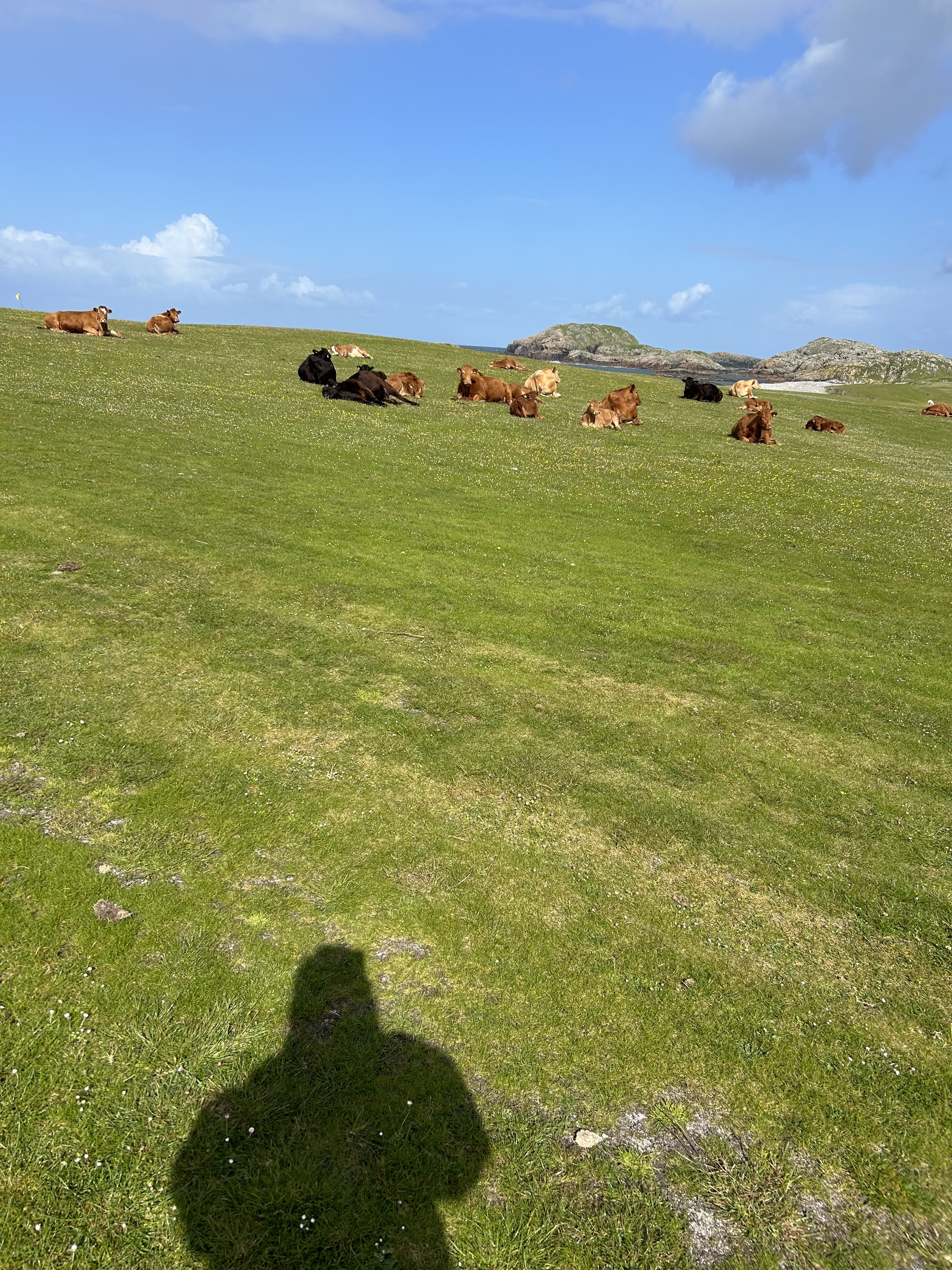
     Today I did the hikes I had wanted to do yesterday: in particular to St. Columba’s Bay, over towards the quarry and then back around and up to Port Ban.  Incredible, all of it!  I will try to upload a video from the Bay for you below… again, with the pictures issue that I’m having, I’m not positive I can make that work, but I will try. Today’s hike was a bit over eight miles.  Yesterday I walked ten miles, though the obvious difference was the terrain.  Yesterday was gentle hills on paved or gravel roads, today was hills, rocky terrain, on paths that were many times barely discernible. The other, more profound difference was how the hike to St. Columba’s Bay felt, and seeing/touching the water of the bay in particular.  Both days I walked alone. While David is here on Iona with me, he is not a hiker.  Additionally, his work has required that he has to still manage to get in 40 hours of work during the three weeks he will be with me in Europe, so he is taking the unscheduled, quiet days on Iona to try to get some of those hours in.  I was actually looking forward to having the quiet, meditative and reflective as well as prayerful time to walk by myself.  None the less, the solitary walk to the North of Iona yesterday was stressful for me: or it produced anxiety for me.  I didn’t see anyone, and I felt nervous about that.  While Iona is pretty safe, I carry with me the reality from home that 50% of women in the United States will be assaulted during their life times, many of those more than once. Walking by oneself as a female is generally not considered wise or safe. If someone had approached me, there would be no one else around to call to for help.  I couldn’t shake it.  I kept trying to just breathe and be in the present, but was unable to do so.

    On today’s hike I also saw no one until I was almost all the way back from St. Columba’s Bay.  But it felt different.  There was no anxiety.  There was instead a calm but strong sense of being where I needed to be in the moment.  I was searching for the trail much of the time, as well as trying to hold my phone with its trail app to make sure I was at least in the right vicinity while at the same time using my poles in the hope that the extra support would prevent my knee acting up. The wind today was still quite strong, and at one point the clouds let loose and I ended up quite soaked.  And yet, despite all this, I kept being astounded by the beauty at every turn, the wildlife and the joys of hearing the sheep and birds talk to one another and occasionally even to me.  It was incredible.  Not a “destination” but really the point of being here: the hard journey which was rewarded at every turn by something beautiful and unexpected. 

    As I stood on the beach I felt tears pouring down my face in awe and wonder at what was before me, and found myself repeating, almost unconsciously the mantra “Thank you, God” over and over and over. The video I attach will not do it justice, and yet, it’s all I can do to try to share with you this little piece of heaven that was the gift of the day for me.


And a few photos: 


Monday, September 13, 2021

In the Beginning

Genesis 1:1-2:4a

John 1:1-5

               Today we have two very interesting passages that talk about the beginning of the world.  We have this story in Genesis, which tells us so much more about God and the nature of creation than it does about the hows of creation.  We learn from this story that God is creative, that this is the very nature of God to create, to make new, to shape. We also learn that God has a vision before acting, and that the very images of God begin the process of creating.  We learn that God speaks and the world is created, that it is in speaking, or moving thoughts out of ourselves through words that creation happens.  We learn that God values the passing of time and chooses to mark it with days and nights, and that God sees value in both light and dark, in days and nights.  We see that God values life and delights in huge diversity, creatures of the sea, animals that fly, creatures of the land, with so many different types and kinds.  We learn that God wanted relationship and creatures called humans who could be companions and have genuine interactions with God, ones that God would recognize as reflecting Godself.  We hear that the plan was not for killing, even for food, in the original.  Instead, to all animals and people was given the grasses and the seeds and fruit. We see that the work of creating is God’s work and is important, but that rest is also important.  And finally and most importantly, we come to see that all of this was made supremely good.  That creation, that earth, that life, that all animals and plants and stars and the moon and sun: all are very, very good.  Original blessing: something much stronger, by the way than any kind of “original sin” because it comes from God-self.  We learn therefore to appreciate and value the beautiful and wondrous creation that God has made, to not take it for granted, to not abuse it or mistreat it, but to honor it as the very creation of our good and loving and awesome God.  

                Breathe that in!  The awe, the wonder, the amazement.  It is good.  You are good.  The earth is good.  We were made good by God’s Words, by God’s WORD.  And we have been gifted by our time here; our time of work and our time of rest.  We have been blessed by the beauty of relationships and connection to God and to all living things.  We are part of this wondrous and amazing creation!  In Isaiah God said it this way, “Be glad forever and rejoice in what I create… for I create my people to be a delight.”  I invite you to just sit with that for a moment, sit in the awe and wonder of what God has created just by speaking.

               And then we come to the second scripture, the passage from John, which also talks about creation, about the beginning of everything and the vision for who God is, who we are and who we are to be together.  “In the beginning was the Word, and the Word was with God, and the Word was God. The Word was with God in the beginning. Everything came into being through the Word, and without the Word nothing came into being.  What came into being through the Word was life, and the life was the light for all people. The light shines in the darkness, and the darkness doesn’t extinguish the light.”               This is such an incredible, beautiful passage.  But I want to start this section by asking you, what do you think this passage actually means?  Why “the Word”?  Just past this passage in John we learn that “the Word” is Jesus: Verse 14: The Word became flesh and made his home among us. “  But why?  How do you feel about this passage?

            As you saw during children’s time, charades, while a really fun game, can also be a really difficult or challenging game.  Especially when the phrases you are acting out include names, or places.  And what makes charades, or even games like Taboo hard is the limitation on our words, the words we can’t use, or the words we can’t say. 

           I think about Helen Keller.  She contracted scarlet fever when she was 20 months old and became both deaf and blind.  Because of this, her life became one of wildness, isolation and frustration.  When she was six, the family hired Anne Sullivan who came and began to teach Helen sign language into her hand in order to teach her how to communicate with others.  It took a long time for Helen to even understand what Anne was trying to do.  But once she understood, her life changed completely.  Through communication – through words, though not “spoken” words they were still words, she was able to earn a college degree and become a successful lecturer.  More importantly, she was able to have relationships with other people, lifelong friendships, connections.

           Communication is never easy.  We misunderstand one another so often.  We mishear, mis-interpret, misunderstand.  We misread people’s body language, or people’s intent.  We mis-speak or phrase or frame things in ways that are sometimes easy to misunderstand.  Those misunderstandings are the primary cause of human distress, conflicts, problems.  And the only solutions to those miscommunications are more words, are more communication, are intentional talking. 

           We also at times misuse our words for bad.  Words can be weapons.  While words create, they create relationships, they create dynamics, they create our world, the ways we use our words sometimes create in negative or harmful ways.  We can create relationships in need of healing, or dynamics that are negative.  We can bully each other, put each other down, destroy egos and community with our words.  We can do so much damage if we are not intentional, graceful and loving with our words. 

           Our words can also be simply confusing and unclear, especially for children.  Someone passed on to me this story, apparently from the movie, My Queen: “A visiting aunt, who is a nun, gave her little niece communion. It was basically just for fun, playing. She put the wafer on the child’s tongue and said, “Corpus Christi”. The kid asked what that meant. The aunt replied, “The Body of Christ.” Alarmed, the kid made a sour face and violently spit it out. In the next scene, though, the kid was baptizing her pet, and because she didn’t know the Latin that her aunt used, she spoke funny gibberish (shubba dubba…).”  We know this is a true story.  Our kids do not always understand our words, and frankly neither do the adults in our lives.

          And yet, despite the possibilities for errors and misunderstandings and harm of our words, still we return to this passage: “In the beginning was the Word, and the Word was with God, and the Word was God. The Word was with God in the beginning. Everything came into being through the Word, and without the Word nothing came into being.”

      The word “WORD” in the Bible means more than language.  As one commentator said it, “logos, is a rich and nuanced word, meaning mind or rationality, but also speech or communication…. In Jesus, God speaks God’s mind.”  (Feasting on the Word: Preaching the Revised Common Lectionary - Feasting on the Word – Year C, Volume 1: Advent through Transfiguration.)  The mind that God speaks is creation, is creative, is love, is grace.  All was made through the Word.  But it is more than that.  It is also revelation and reconciliation.  Revelation is a revealing, an opening, a showing us who God is.  Reconciliation is a healing, a coming to understand one another, and a coming through that understanding to love one another and heal the breaches between us.  All of this is part of “word”.  A Word that speaks truth and opens up to us what we cannot see.  And a Word that brings understanding and healing, opening us to understand that which we do not understand in one another.  All of this is encompassed in the “WORD”.

This Word existed, we are told, from the beginning.  We knew God and God knew us.  God created through words.  God SAID “let there be light” and there was.  God SAID, “Let there be a dome…and it happened that way.”  “God SAID, ‘Let the waters swarm…”  “God said, “let the earth produce…” and thus it was.  God SAID, and it happened.   The WORD that was with God and the WORD that was God created it all with words, with THE Word.  Nothing and no one existed outside the word of God.  Nothing and no-one existed outside the creative, life-giving purposes of the Word.  Nothing has existence outside of the WORD.  It is the Word that tells us who, what and when because it is the Word that created who, what and when. 

In C.S. Lewis’ book, The Magician’s Nephew, Aslan created the new world by singing.  He brought into being the world, all it’s creatures, all it’s form through singing, speaking.  But unlike what CS Lewis said, this passage from John says that the Word is Jesus and that Jesus, as the Word, is God.  So the Words made the world, but the words themselves are not the world – instead God is the Word that made the world. 

It was the Word that created.  And then it was the Word that reconciles, reveals and redeems.  With the birth into this world of the Word, our knowing God, our understanding of God is different and everything else is different too.  Jesus as the Word then is the embodiment of revelation and reconciliation.  He is the embodiment of the creative energy that makes everything new, that reveals who God is, and that reconciles us to one another.

 When I think of words, I think first and foremost about communication.  And the key aspect of communication is that it only happens in community, in relationship.  This is, again, a strong statement about God as community and relationship, God as the author of community and relationship, and relationship being central.  In the beginning was God and the Word, and yet they are one.  They are relationship, they exist in relationship, and they create through relationship, through Words, through the Word, through speaking.

  So what is the message in all of this?  First, that God created and continues to create.  God creates through Words, through the Word, through communication with us and with all of creation.  God continues to speak, to reach out to reveal and reconcile.  That is God’s nature as shown to us through the creation and through Jesus.  We are created in and for community, for connection.  And that community and connection happens as our words of love and creation happen.  We are made in God’s image, called to use words to create, to build, to reimagine, to reveal just as God used the Word for the same purpose. 

               Thanks be to God.  Amen.

Thursday, March 19, 2020

New Times, New Challenges, New Gifts

            I haven't been sleeping well.  I've been worried at many different levels.  My parents are in the highly vulnerable category in terms of facing the pandemic, and they don't isolate easily, which means they've been a bit late in taking what are necessary precautions.  I worry about my congregation, a mostly older congregation of folk who are very active in the world, taking care of their grandchildren, serving the highly vulnerable populations in our community with food, housing, tutoring and other services.  I've been worried about them healthwise, but also, frankly, about their emotional well-being.  They all thrive on community, on their time with each other and out in the world.  Many of them live alone, and I've been deeply concerned about their isolation during this time.  I've worried about our world, how those who don't have as many resources or as easy access to help are faring.  I've worried about the children at the border in cages... will they be abandoned and left to their own fate?  I've been concerned about jobs, businesses, and those that survive month to month which are now having to close for a time.
          More personally, I was worried about getting my daughter home from college.  The restrictions were tightening both at her end and on ours, flights were being canceled, we were being told we had to stay in our houses, and I was concerned that she would be stuck at an airport somewhere without a way to get home and without anyone I knew able to help her.
         I've been concerned about what I've been seeing in terms of behavior:  people's panic leading them into strange behaviors, like the hoarding of resources, and the prevention of others therefore obtaining necessities.  I've also been concerned with seeing extremes in behavior: collecting things like water and subsitute utilities, ignoring the basic facts of the pandemic which indicate that our utilities and water resources have not been and will not be affected in any way.  While passing on false news stories and fake articles found on FB is not a new problem, in terms of the news about this virus, some of the stories that have hit my in-box have been utterly beyond belief, but passed on by well-meaning people who have simply forgotten the importance of checking things out before blindly believing and being a conduit for nonsense.
         I've found myself reading about and reflecting on other pandemics, many of which were so much more wide-spread and fatal than this current one.  Some of the stories I've read have been very disturbing, showing that the worse the disease, the more inhumane people are in response: to the point, in some cases, of even leaving children to suffer on their own because of the fear to one's own life.  I don't understand those stories.  I would rather die than see my children harmed.  And if my children died and I lived?  I'm not sure life would feel worth living at that point.  Obviously we are not acting this way now.  But it has worried me to think that our physical, spiritual and emotional health are so intertwined that when we are hit with a physical calamity, our morals can be tossed out the window in this way.
         I've wondered if we aren't, at some level, preparing for a pandemic that would, in fact, also be much more deadly and rampant.  The plague... black death killed between 1/3 and 1/2 the population, for example.  We are learning, through this one, how to isolate, how to limit exposure and spread, and how to stay connected even while we are apart.  In some ways we are doing a good job, though the grocery stores seem to still be places of mass connection.
        In the midst of this, then, I feel that we are always called to look for God, or the Good, or Love, or what is greater and better than what is worrying us at the moment.  So here are my visions of the good on this day:
        I was able to get my daughter from the airport yesterday and she is home.  I cannot say how grateful I am for this.  I miss her so much that it physically hurts when she is gone.  And to have her home a little early, and for a longer time than expected is a deep gift to me.  Frankly, I rarely have enough time with my children when they are home, and while I am still working (and in many ways working more hours than I did before as I learn new technology and am trying to provide more than usual pastoral care for those whom I no longer see in person), being home has allowed me to at least be in the same place as them for a time.  We are spending more time playing games, reading together, talking more, baking together, catching up on movies we've wanted to see.  And for all of that, I am deeply grateful.  As Eldest and I were driving home from the airport yesterday (5:45PM on a Wednesday, driving East through the Caldecott tunnel without any kind of slowing down at all!!), I was able to look around and see the beauty of these hills, of the green trees and grass during this time, to not be anxiously caught in any kind of traffic or worry about other cars taking unnecessary risks to get where they were going.
       I am so much more aware of the gifts that we normally have of freedom to travel, freedom to congregate, freedom to commune with one another.  These are things that are normally taken for granted by all of us.  Perhaps we will be able to remember, when they return to us, what gifts they really are.
       I understand that as a result of the decreased human activity, there are places where the wildlife is returning, is growing once again where it hasn't grown or been active for a while. For example, dolphins have been found in the canals in Italy!
       I appreciate to a much greater degree the gifts of technology, the ways in which we can stay connected even when we are apart.  This has been especially helpful for those who live alone or are in other ways much more isolated.
       Every day I hear new stories of helpers, good people, living their lives out as models of  love. Our medical people, with their commitments to care despite personal risk are beyond amazing.  But other people, too, are stepping forward.  In my own community, I cannot tell you how many people have called offering help to those who need it: running errands, driving people to appointments, and more.  While my daughter and I were both kept home on our birthdays this year, parishioners came by with balloons and other gifts to drop off, cards and well wishes were sent.  I am aware that while crises can bring out the worst in some people, in other people it instead brings out the best!  I am getting to see the best and that is a gift indeed.
       Finally, in a couple cases, I feel that people are more aware of their mortality now and are working harder to reconcile, make amends, "get their houses in order".  This too is an amazing gift.  No matter what happens during this crisis, taking time to fix relationships, to heal problems, to reevaluate what matters to each of us and to reprioritize - this is an amazing gift that can make all of our lives, for no matter how long we have them to live, fuller, healthier, more whole, centered, and peace-filled.
        I will continue to pray for my communities and for the world.  I will, undoubtedly, continue to worry, too.  But I also am grateful during this time, for the gifts that come despite, and sometimes because of, changing situations and even crises.  Peace to you all this day and every day.   I am grateful for each of you!  Please don't hesitate to ask for help if you need it or to reach out.  We are here for you.

Thursday, November 14, 2019

Thin Places

         There is a phrase that the "religious" folk I know use to describe places where one encounters the Divine.  We refer to them as "thin" places: places where the barrier between this world and something more sacred, more spiritual, more mystical becomes thin.  These are places where you can feel God, whatever it is that God means to you, where you can touch something beyond this world, where the presence of the holy becomes almost tangible.  There are specific places around the world that are often described as these thin places, places where the Divine seems to hover, play, reach down to us, or simply to be more accessible.  Four of the thin places I have visited are Ghost Ranch in New Mexico, Zephyr Point in Lake Tahoe, Iona in Scotland, and Asilomar Beach near Monterey, though there are many other such places.  These are enchanting, almost magical areas where the beauty of nature seems to stretch out forever.  When you are in these places, you feel the ruach, or Spirit through every single breathe you take. There is a sense that time stops, or moves differently, while you are there: clocks have no meaning and the only thing that is important is being, is existing, is breathing.  In each of these places it feels that you not only see and breathe beauty, but you become part of it.  There is a thinness not just between the sacred and mundane, but between yourself and all creation.  It is easier to understand at these sites that everything really is just ONE and that you are a small part and yet an essential part of the rhythm and movement of life, of love, of existence, of being.
        Perhaps it is harder to feel this amidst the craziness of the cities and suburbs where many of us live.  When people are rude, angry or unkind and you have to watch with an incredibly alert eye driving around because of the craziness of those who are focused solely on their own needs, their own schedules, their own desires and worries in this life, it is harder to open yourself to connection with all things.  I shrink from taking down the wall between myself and those who cannot see me as anything but a barrier, an unfortunate obstacle on their path to rush to wherever they are going next.  Being open in those moments means being vulnerable to another's anger and angst and that is uncomfortable, to say the least.  It is harder to maintain a strong sense of the presence of God in the face of so much busyness that tends to have greedy and self-serving aspects to it.  
        But this weekend I found myself reflecting that "thin places" are not just physical places where we might go.  I attended a concert Saturday evening where a piece was performed that was so incredibly beautiful that I found tears running down my face before I was even aware of it.  I was moved beyond myself and into that place of "thinness" where I wanted to literally be part of the music, where I was enveloped in something beyond this world, where I was transported beyond the journey we walk and into the Presence in which we live.  Recently someone told me about a sunset she had seen that was so beautiful that she wept because she wanted to be in the sunset, to be enveloped in its beauty beyond just the visual experience of seeing it.  Each of our senses can bring us into that place of thinness: the song of a bird, the beauty of a forest, the smell of the mountains, an unexpected and wondrous taste, the ocean waves lapping against our feet: all of these can bring us into a sense of the eternal, into a deep connection with all that is awe-some and profoundly lovely, into a timeless place of pure being.  Experiencing or witnessing acts of kindness can also move us into those places of realizing there is good, that we are surrounded by something that encourages generosity, care, openness and love when we are open to it.
        As the piece of music that touched and deepened in me as a "thin place" came to a conclusion, I glanced around me at the other people attending the concert.  While many appreciated the music, not all had been moved in the same way.  Not everyone in that space had encountered the Divine, a transcendent moving, a connection to the beyond.  And I realized that thin places are not universally so.  When I was on Iona, those we travelled with did not experience it in the same way.  It was "very nice" but not transformational for everyone, as it had been for me.  When I am at Lake Tahoe, I have heard people snipping at their children or complaining about their lodgings: for them, too, that place may be a nice place to visit, but it does not always refresh, reform and renew in the way it does for me.
         The truth is that encountering a thin place is much more about how we stand in any particular moment.  We have met people who radiate "holiness," for lack of a better term.  These are people (like the Dalai Lama, Father Chacour, Maya Angelou, Ben Weir, Mr. Rogers) who, when you stand in their presence your breathing changes.  You slow yourself and are present despite whatever else is going on with you.  They call this out of us because of their stance in this life.  They see the holy that is there around them all the time.  They live in the wonder of the transcendent, and they are unafraid of the vulnerability of being open to the reality of our deep connection and unity to everything around us.  They create thin places around them for all of us who encounter them simply by standing in that thinness themselves.
        And the thing is, this is a stance that all of us can cultivate.  It takes intentionality, a willingness to be open to seeing, hearing, feeling, tasting, smelling and experiencing where God is in any one moment.  It requires breathing differently, moving with purpose rather than rushing around, taking time to not be human doings but to be human beings.  But, as we see with the people and places who are "thin" around us, when one is willing and able to do that, it is not just a gift to the persons being in that Divine presence, it is a gift to all around them too: one person's stance can cause others to also breathe differently, to move, hear, see, and experience our world differently.
       I am grateful for thin places, both physical places and the thin places that are created by art, by beauty, by kindness, and by courage.

Monday, July 17, 2017

Much to Complain About

Matthew 11:16-30

Jesus says a great deal in this passage from Matthew.  But throughout the passage he is consistent.  When people fail to see the amazing blessings that surround them, when they fail to really see it and get it, they are in danger.  They are in danger of losing their very souls, not because God will take their souls from them, or punish them for their failure to see, but because in failing to see God in front of them, they fail to truly live in faith, live in connection to the Divine, live in the fullness of life that God wants to give us, chooses to give us, every day.  Jesus said, “Woe to you…to Chorazin and to Bethsaida because they didn’t see the miracles that were performed right in front of them.”  They did not see them.  They did not take them in.  The experience of being near and around these miracles, these life-changing, wonderful, beautiful experiences of healing and transformation, of God’s wanting the best for God’s people, of God wanting and making wholeness and life happen for people whom everyone else had abandoned or given up on – these experiences did not CHANGE the people of Chorazin and Bethsaida.  Witnessing these miracles did not make them want to be the best they could be, did not move them to a gratitude that would cause them to change, to “turn around” which is the actual meaning of repent – to go another way.   They were not changed by witnessing these miracles, which said to Jesus they did not really accept them, did not see, did not choose to experience God, experience Divine love through these events.  And that failure to change in response to the blessings of their lives lead Jesus to say, ‘woe to you.”
Jesus also compares his generation to what?  To whiners.  “We played the pipe for you, and or you did not dance.  We sang a dirge and you did not mourn,” the people complained. They complained that others did not respond to them in the ways they wanted, that they had worked hard, given much, and that others did not do what they expected, did not respond in the way they’d hoped to what they had done, what they had given.  The irony of it:  They complained that others were not moved by what they did.  And yet, they, were not moved by what Jesus and John did.  They complained about John because he ate differently: eating only locusts and wild honey and refraining from drinking.  They complained about Jesus because he didn’t refrain from eating and drinking.  And they dismissed the words of both people based on things that had nothing to do with what they were saying.  Who cares what John and Jesus ate?  But all of these people found ways to not see the blessings that surrounded them.  They focused on what did not fit into their ideas of what people of God should look like, act like, what they thought people of God should do or be. They focused on their judgments of others and dismissed them accordingly. They failed to see the miracles, failed to see the beauty, failed to see God in what was around them.
               Do we do this?  We’ve discussed before how Fear can lead us to see and focus on those things that are going wrong to the exclusion of the wonders and miracles around us.  Our human instincts to complain can lead us to focus on things that are not being done the way we want them to, or expect them to be done.  We want Jesus to not “party” during his life but instead to be serious and self-sacrificing at every turn.  We want John to not be “different” or eat strangely.  We want things to fit into our ideas of how they are or should be.  And if they don’t we complain.  Actually, even when they do live up to our expectations, we also complain.  And again, the problem with that is that in focusing on what we are uneasy with, we fail to see the blessings that surround us, we fail to see the good, we fail to see God, we fail to experience God’s love.  And we are lessened by that failure.  We are the ones then who do not experience Christ, or God in our midst because we are too busy focusing on the problems and not seeing the gifts to experience the blessings, love, joy, peace, compassion, peace, and ultimately the grace that God offers us every single day.
               Rev. Craig Barnes, writes, "… we assume we can make our own lives by the way we construct them for ourselves." Barnes goes on to say this: “Complaining is usually a veiled lament about deeper issues of the soul. Since most people are unaccustomed to exploring the mystery of their own souls, they will often work out their spiritual anxieties by attempting to rearrange something external - like a church's music program. But it doesn't matter how many changes they make to the environment around them. They will never succeed in finding peace for the angst of their soul until they attend directly to it... (That is why) to be of service to the Holy Spirit, who is at work in human lives, the pastor can never reduce ministry to servicing parishioners' complaints about the church. –
               The truth is, we are often guilty of seeing what we know, what we expect and what we are used to looking for rather than knowing what we see.  (As a side note, children are much better at seeing what is around them.  The kids this week in music camp kept seeing things around the campus and in the building that I had never noticed – a ball on top of the arbor, for example.  The seed pods hanging down from the Wisteria.  The metal lights around the court yard. I don’t know exactly when and how our seeing stops, but it does.  We can learn a lot from the observations and noticings of our youth.)  Add to that that when fear is involved, it is even harder to actually see the blessings God surrounds us with. 
               About eleven years ago now my family went through a very challenging time financially.  My husband was out of work and we were trying to support our family of five on my half time pastor salary in San Leandro.  We had bought a new house right before he had lost his job, one with three bedrooms as opposed to the one we had before which had only two bedrooms and was therefore a bit tight for our family of five.  But at the last minute in the sale of our old home, the buyers had pulled out.  As a result, we were paying two mortgages, again in this unbelievably expensive part of the country.  This was right before the housing market crashed.  Add to that that the shower pan in our new bathroom cracked and we had to replace the entire bathroom, with money we just didn’t have.  It was a truly, deeply frightening time.  Because of that, complaining was at the top of my list of daily activities.  Everywhere I looked and each day there was more to complain about.  A child got sick, I left my wallet at the store, Trader Joe's stopped carrying my favorite breakfast cereal – whatever little thing that occurred was just another weight on shoulders that were already carrying far too much.  The main character in the book, Life of Pi said, “When you’ve suffered a great deal in life, each additional pain is both unbearable and trifling”.  I found this to be absolutely true.  It was the little things, the things that I knew were so very small which would send me over the edge during this time.  I simply could not bear anything more because I was deeply frightened.  I was reassured by Biblical passages such as we find in the psalms that allow for us to voice and share with God our complaints, our fears, our concerns, with full knowledge that God does indeed hear them, care about them, want us to talk to God about them; and I took full advantage of that to complain loudly and often, to express my fear and to pray, fervently and often for our house to sell, for my husband to find employment, for us to make it through this financially terrifying time. 
               But as Craig Barnes suggested, looking back, the complaints were all hiding a deeper spiritual issue – and that is that I was living in fear, I was consumed by fear instead of living in faith and trust.  Not that I think God is a magician who takes away all our problems.  Not that I think God micromanages our lives.  I don’t.  We have free will, as do the others around us, and sometimes that means times get hard.  But trust and faith require seeing that each moment, each second, we are surrounded by love, care, presence, that will sustain and carry us and guide us through the hardest times.  Looking back, I can see God’s presence, God’s blessings.  Looking back, now that I am beyond that moment of fear or terror, I can see what I could not see then, that, in so many ways, we in fact were carried through that time.  We had savings that saw us through, and the old house did sell, right before the market crashed.  My husband did find employment right before that savings would have run out.  Yes, we used it all.  But we had it to use.  And we were okay in the end.  I can see, looking back, that we were surrounded also by love and fellowship of people who would have been there for us had things become desperate.  We were held through this time by friends and family who expressed their care in ways both “normal” and amazing.  I’ve shared with you before about that one day in particular when the outpourings of love from the community and from my own family were so deeply amazing that they were nothing short of miraculous.  I won’t share them again, because that one day is not the point.  In looking back, the bigger thing to be seen was that we were cared for daily.  Daily there were overflowing signs of love – from God, from God’s people, a love that has, and continues to sustain us through the hard times because the hard times are always there if we focus on them.  The love, too, is always there to sustain us, if we can just see it when we need it.  Miracles, are all around us, every day, if we allow ourselves to see them, if we can face the spiritual issues such as fear that prevent us from seeing, if we pray and open our eyes to seeing God because God is there, all the time, with blessings in abundance.
               As I was standing in line in the grocery store yesterday,  I overheard someone complaining loudly.  The teller was complaining about her husband, describing him in terms that would make him sound abusive.  But when you really listened to the words, it became clear that what she was actually complaining about was that he didn’t pay for an incredibly expensive luxury for her that she wanted.  Instead, she complained, her son had to do it.  And as I listened, I found myself reflecting again on how much we like to complain and how much we fail to see the beauty and good around us.  There were three different ways she could have told that same story.  In the complaining version, her terrible husband wouldn’t buy her this thing she desperately wanted and so her son had to do it.  In a second version, the husband didn’t pay and the son did – just the facts.  The third version I believe is the way we are called to look at the wonders of life, of God’s presence, of beauty and joy: she had this amazing son who was able to buy even expensive things for her and chose to do so.
               With David’s permission, I want to tell you about a conversation we had yesterday.  A similar situation, but this time about something essential.  David was telling me that he was incredibly lucky and blessed because he had a grandmother who would take money out of her tiny income and buy food for their family.  As many of you know, David grew up extremely poor.  Food could be hard to come by.  They lived from day to day, shoes were a once a year purchase at the thrift store and when they were outgrown, the kids did without.  But David was not focusing on complaining about his childhood, he was focusing on the gift of his grandmother’s help, coming at especially needed times.  He does this with other things too.  He shares with wonder about the church down the street from them that also helped provide food and other essentials.  He describes the care of the community, the wonder of those who held them up.  He does not complain about what his life was like living in that poverty.  He has chosen an outlook of seeing the good, of seeing the Divine, of seeing God.
               How do we describe the events in our lives?  But more deeply, how do we see the events in our lives?  Do we see the gifts and blessings God has given us each and every day?  Or are we so distracted by the things that are hard that we simply cannot see the miracles?
               Connie Schultz wrote that we all have stories of things we can’t explain, wondrous amazing stories that we want to tell but are afraid of being doubted.  Still, they stick with us as signs of something bigger, something that “coincidence” doesn’t quite cover.  She tells her own story this way:
               “Soon after my mother died, I was driving and listening to NPR like I always do when, inexplicably, I reached down and switched the radio station.  “I know you’re watching over me from heaven,” the singer crooned.  Still raw with grief, I sighed and said out loud, “I miss you, Ma.”  Then I looked at the license plate on the car straight ahead: MISS U2.”

               Sr. Joan Chittister once shared this story: Once, the ancients say, a seeker asked a group of disciples: "Does your God work miracles?" And they replied, "It depends on what you call a miracle. Some people say that a miracle is when God does the will of people. We say that a miracle is when people do the will of God."  Sometimes I think the will of God is nothing more than looking and seeing with God’s eyes where love and compassion and grace are all around us, and helping others to see it too.
In today’s passage from Matthew Jesus challenges us to put aside our expectations, our fears, our complaints and to look instead for the good, for God, for God’s love that surrounds us.  But the Good News is that Jesus also knows that isn’t easy for us, this people of God, to always do successfully.  So even after we are scolded for our complaining and scolded for failing to see the miracles that surround us and allow them to change us, deeply, from within, Jesus ends the passage with these words of reassurance, “Come to me, all you who are weary and burdened, and I will give you rest. Take my yoke upon you and learn from me, for I am gentle and humble in heart, and you will find rest for your souls.  For my yoke is easy and my burden is light.”  When we can’t let go, we can turn to God with our fears, with our complaints, with our burdens.  God wants to hear from us all of what we are feeling, all of what we experience.  We can lay the burdens at Jesus’ feet.  And when we do we will find that God will help us to carry them, God will show us the good that goes alongside our hardships, God will remind us that in every moment there is something both to complain about and something to be thankful for.  God will show us the face of the Divine in those around us, and God will love us into seeing.  Because that’s what God does.  God’s promise is clear: in God’s loving arms, we will find rest.  Amen.

Monday, April 11, 2016

Sundays' Sermon - Laughter as Resurrection

Genesis 17:15-19, 18:9-15, 21:1-7.  Luke 24:13-35
HUMOR SUNDAY

A mom wakes her son up on a Sunday morning telling him he has to get ready for church.  He fights her saying he just plain doesn't want to go.  She responds, "I'm sorry son by you have to go to church.  For one thing I'm your mom and I'm telling you you must go.  Second, you are forty years old and ought to know better.  And third, you are the pastor.  So get your butt out of bed and get moving!" 

A pastor runs into a kid who is looking to trade his lawn mower for a bicycle.  The pastor agrees to do this, but then is pulling and pulling on the mower cord and it isn't starting.  He turns to the boy and asks him how he is supposed to get the mower to start.  The boy responds, "oh, you just have to cuss at it and it will start right up."  The pastor is highly affronted and says, "I don't cuss!  I don't even know how to cuss!"  The boy responds, "You pull long enough on that cord, and I'm certain you will learn." 

A pastor declares that he is going to preach the following week on the sin of lying.  He says that in preparation for that sermon, he would like everyone to read Mark 17.  The following week he begins by asking the congregation, "how many of you remembered your homework and read Mark 17 in preparation for today?"  Everyone in the church raises their hands, to which the pastor responds, "Mark only has 16 chapters.  We will now proceed to my sermon on lying."

A man joins a monastery and is told he must remain in silence for six years.  He does so and at the end of the six years the head priest tells him he can say two words.  The monk says, “too cold”.  "Oh, I'm so sorry to hear that!" declares the head priest.  We will surely take care of that for you!  And he gives the man additional blankets and then tells him he must go away into silence for another six years.  After another six years passes, the monk is called back again and told he can say two more words.  “Food bad” the monk declares.  Again, the head priest is very apologetic, promises to do something about it and does so, sending the monk away for another 6 years of silence.  This time when the monk appears and is told he can say two more words, he declares, “I quit”.  "Well," says the head priest, "that's a good thing!  You've done nothing but complain the whole time you've been here!"

A pastor comes across a group of kids surrounding a puppy and asks them what they are doing.  "Oh, pastor," says one of the kids, "We are seeing which one of us can tell the biggest lie!  Whichever one of us tells the biggest lie will get to keep this puppy that we found!"  The pastor is highly offended.  "That is outrageous!  You should not be practicing lying!  Why, when I was your age, I never would have told a lie!"  The kids become quiet for a few minutes until finally the one kid says, "Well, pastor.  You just won yourself the puppy!"


Christine Longhurst wrote, “Laughter Sunday (also known as Holy Humour Sunday, Hilarity Sunday, God’s Laughter Sunday, Bright Sunday or Holy Fools Sunday) has its roots in a number of different Christian traditions.  Churches in 15th century Bavaria used to celebrate the Sunday after Easter as Risus Paschalis (‘God’s Joke,’ or ‘the Easter laugh’). Priests would deliberately include amusing stories and jokes in their sermons in an attempt to make the faithful laugh. After the service, people would gather together to play practical jokes on one another and tell funny stories. It was their way of celebrating the resurrection of Christ – the supreme joke God played on Satan by raising Jesus from the dead.  However, the observance of Risus Paschalis was officially outlawed by Pope Clement X in the 17th century. Perhaps people were having too much fun.  In 1988, the Fellowship of Merry Christians began encouraging churches to resurrect some of these Christian traditions—to celebrate the grace and mercy of God through the gift of laughter and joy.  G.K. Chesterton once wrote: “Angels can fly because they take themselves lightly. Never forget that the devil fell by force of gravity. He who has the faith has the fun.”
While the psalms we read encourage joy, and laughter is a good way to get there, it is more than that.  There is also humor in the Bible.  Some of the stories are joyful, but others are downright funny.  Professor Hershey Friedman says that the different types of humor we find in scripture include, sarcasm, irony, wordplay, humorous names, humorous imagery, and humorous situations.  A couple of examples, when the Israelites were fleeing Egypt, they used sarcasm in confronting Moses by saying, “was there a lack of graves in Egypt that you took us away to die in the wilderness?”  In Samuel, Achish said to David, “Why did you bring him to me? Do I lack lunatics that you have brought this one to carry on insanely in my presence?"  Jesus says, “"You are like a person who picks a fly out of his drink and then swallows a camel".  Additionally, God names Isaac “laughter” – the one who leads us forward, who is our ancestor in faith is named “laughter”.
Laughter is a gift from God in so many ways.  Research shows that laughing actually has pain-reducing capacities, and it raises our pain threshold so we can tolerate pain better and we experience it less when we are laughing and for some time after a full, strong laugh.  It helps us learn – we learn better after a good laugh.  And it boosts our immune-enhancing capacities.  When we laugh fully and completely, we are said to “lose” it.  What we actually “lose” in those moments is our distraction of everything else – our distraction of our self-consciousness, our distractions of the stresses in our lives, we stop fleeing our stressing out and instead are completely present in the moment – and that moment, the NOW is where God is.
I want to read you part of an article on “The hope of laughter” by Rev. A. Stephen Pieters: Article by Stephen Pieters

In the Genesis passages that we read for today, we hear that there are different kinds of laughter.  Abraham laughs out of disbelief, but it doesn’t feel bitter to me.  It just feels like someone has said something so surprising and so ridiculous that he can’t help but laugh.  Sarah’s laugh feels different.   Her laughter feels more like sarcasm – almost a bitter laughter, a “yeah right” kind of chuckle.  And this laughter God confronts, saying there is nothing that is beyond God, no matter how “absurd” it may seem.  But in the end, Sarah names her son laughter – and in this laughing it is delight.  It is the laughter of sarcasm and bitterness turned into the laughter of joy, of celebration.  Finally, we come to another story of Jesus’ resurrection.  And through it we are reminded that God has the final “laugh”.  And this time that laugh is on death itself.  Even that is overcome, to the surprise, to the JOY, to the delight of God’s people and the disciples in particular.  The joke is on “evil”.  Good wins.  It is hilarious and wondrous and wonderful that just when death seemed to win and grab even Christ, that even death was overcome.  It is not just something to celebrate, this is something to truly delight in, to laugh about!  God is the God of the amazing, of healing, of joy, of LAUGHTER.  And today we celebrate THAT gift – we honor THAT gift by laughing with God, by enjoying life WITH God, by remembering that God won!

AND, to end with a few more laughs:
After every flight, UPS pilots fill out a form, called a 'gripe sheet,' which tells mechanics about problems with the aircraft. The mechanics correct the problems, document their repairs on the form, and then pilots review the gripe sheets before the next flight.

Here are some actual maintenance complaints submitted by UPS pilots (marked with a P) and the solutions recorded (marked with an S) by maintenance engineers.
P: Left inside main tire almost needs replacement.
 S: Almost replaced left inside main tire.

P: Test flight OK, except auto-land very rough.
 S: Auto-land not installed on this aircraft.

P: Something loose in cockpit.
 S: Something tightened in cockpit.

P: Dead bugs on windshield.
 S: Live bugs on back-order.

P: Autopilot in altitude-hold mode produces a 200-feet-per-minute descent.
 S: Cannot reproduce problem on ground.

P: Evidence of leak on right main landing gear.
 S: Evidence removed.

P: DME volume unbelievably loud.
 S: DME volume set to more believable level.

P: Friction locks cause throttle levers to stick.
 S: That's what friction locks are for.

P: IFF inoperative in OFF mode.
 S: IFF is always inoperative in OFF mode.

P: Suspected crack in windshield.
 S: Suspect you're right.

P: Number 3 engine missing.
 S: Engine found on right wing after brief search.

P: Aircraft handles funny. (I love this one!)
 S: Aircraft warned to straighten up, fly right and be serious.

P: Target radar hums.
 S: Reprogrammed target radar with lyrics..

P: Mouse in cockpit.
 S: Cat installed.

P: Noise coming from under instrument panel. Sounds like a midget pounding on something with a hammer.
 S: Took hammer away from the midget

Wednesday, August 5, 2015

Challenges and Gifts

Okay, I promised my Facebook connections a "revised" perspective today on the challenges we've been facing in our move out here.  I have to admit, it is so easy to get caught up in the stress and struggles of living out of a suitcase, moving to stay with different friends and family and then moving again, while waiting for our house to close and then be fixed up "a little" so we can at least flush the toilets, take a shower, not have wood-rotten boards drop on heads, not look through holes in walls, and lock the doors. There are many other even bigger projects that will also need to happen and my awareness of that fact is also stressful as I wonder how long (and how much money!) it will take to really make the house feel like "home", especially for my children who were pretty despairing at the condition of the house when they were finally able to see it.  It is easy to worry about the fact that I will be paying two mortgages for who knows how long (since no one appears even slightly interested in our house in Ohio), and it appears I will need to home-school my high-schooler, which means losing her "advanced standing" placement at school, etc. Beginning a new job in a new community is always a challenge all in itself. And I've been disappointed to discover that the gossip mill in the larger Presbytery (because even pastors, apparently, cannot always resist the attraction of gossip: Ugh!!)  has taken the story of my family's struggles and enlarged and morphed it into something unrecognizable and even more horrific than what actually happened, and that as a result, what I hoped would be a "new start" for my kids and myself has in fact thrown us back into the hell we experienced 4 1/2 years ago as if it were a brand new thing (which, since it's unrecognizable, it is a new thing). Additionally, because of that seeming need to create, expand and somehow "touch" drama, a couple friendships that I counted on are strained, and connections I had every expectation of having for my kids cannot be renewed in a couple cases.  In other words, things are hard. Still. Again.

I am aware, though, of the need once again to choose perspective.  I talk about framing all the time. How we frame the events of our lives is so incredibly important. I also have the words of my dear friend, Anneke, who did not grow up here in the US constantly going through my head, "Americans expect life to be easy, and they think the purpose of life is to be happy. And because of that, the normal events of each day are way too hard and upsetting for many Americans and they let those events make them unhappy.  People in other countries don't have those expectations.  And as a result, they are much happier because they appreciate and are grateful for the things that go well and that DO come easily as unexpected gifts.  And they take the things that are hard as just par for the course, and they don't let those things get them down."  And I also keep thinking about the wonderful book "The Beethoven Factor" by Paul Pearsall which talks about how some people respond to trauma by becoming victims, others respond by becoming survivors and still others thrive through their traumas, grow and become deeper, more real, more full human beings.  Those who thrive still feel down at times, but they don't let themselves be defeated or become bitter, cynical or opt out of life because of their past.  They live in the present fully, wholly and with increasing commitment.  They laugh hard, cry hard, play hard, and pray hard.

So, with all of that in mind, I am striving with all the stress and questions and disappointments to change my perspective once again.  Living in different houses is an adventure.  Right now, all four of us are camped out in a single room at a friend's house.  It's kind of fun, to be honest, to all sleep in the same room and have cable TV (something we don't usually have), and watch movies together and be in the same place at night.  I often would wake up in our old house when I would hear a noise, worried about the kids and how they were.  But being in the same room, I know how they are at any minute. We are meeting a wonderful new community of people, who are awesome and loving and supportive. The number of people who have responded to my 'cry for help' post on Facebook about Eldest's schooling has touched and moved me. The number of people who have offered us a place to stay for the night has also been a real gift. While there have been disappointments with folk, there has also been a continuing amazing community of care here for me and the kids. My experience at DMV was so much easier than I expected (Go figure!! the one place I expected things to be hard wasn't. Thanks be to God!). My kids are getting to spend a lot of time with grandparents, which has been good for them - to remember the importance of family and to depend on those loving relationships to see them through. The blue sky and sun have been incredible.  Driving through these hills once again just fills me with a sense of God's amazing hand at work in continued creation.  The sunsets have been beyond compare.  Connecting with friends and community has meant so much to me. And the benefit of Eldest being home schooled is that I will have a lot of special time with a very special girl for another year. She will soon be growing away from me. That is the normal path of teenagers and I expect it.  A little more special time with her will be a gift. It's all about perspective. And staying in the moment.  Each moment.  Each day.  I am thankful for the gifts of this day.  And I hope to learn from the challenges and to grow through them once more.  Gratitude helps a lot.

So for today I am grateful for friends, family, church community, sunshine, warmth, chocolate (of course!), opportunities to learn and grow, my relationship with a loving God, and of course, my three lovely children,

Saturday, August 1, 2015

The Circle of Life

When I was a kid, I used to hike in the foothills of Mt. Diablo pretty regularly.  I would walk for many reasons, probably the primary one being to escape.  But I found God in those hills.  I found comfort and peace and meaning and purpose and beauty in those hills.  There was one hill near our house where I would always start, and since I started walking there when I was very young, it was a big hill for me at first that later became the stepping stone up to bigger places, bigger hills, farther paths that took me closer and closer to Mt. Diablo.  And, starting when I was very young again, there was a tree on that hill that I came to think of as "my" tree.  I would nap against it, I would talk to it, I would hide things in the knots on its trunk.  I felt comfort and peace and familiarity with that tree.  It may sound odd, but that tree was my friend.  I took my eldest daughter up that hill with me today.  And this is what I found:

"My" tree had died.  And as silly and irrational as it may sound, I found myself crying, sobbing over this friend whom I hadn't visited in years who had died.  "Is nothing the same?"  No, nothing is the same.  Nothing lives forever.  Nothing lasts.  Everything changes.  That's reality.  That's life.  You can't really "go home" again.  That isn't real.  You can go back to an area and be near to people you have loved before, but you cannot expect those relationships to be the same, or the place to be the same.  You cannot expect that you will be the same when you return, and that means what you see and experience and feel will also be different.  But as I stood there with my 15 year old daughter, who is now old enough to hike these hills with me and who just wasn't when we left, we also saw this:

A hawk was circling overhead, close by, actually.  And it was beautiful and majestic.  And I thought about the fact that this hawk had not been alive the last time I had been here.  Living things die, and new things are born. And they are all beautiful and they each have their time and their place and their lives to live and to surrender.  
And then we looked around and saw this:  


The circle of life is not always easy.  It involves loss and death for each and every one of us.  But it is beautiful.  I am grateful for what was.  I am grateful for what is.  And I am grateful for what will be.

Thursday, July 16, 2015

Goodbye Ohio

I've had numerous people asking me why I haven't posted anything lately.  It's not that I haven't written.  But I've found that it's been hard to actually post what I have written.  The goodbye sermons for my church here felt too private for public viewing.  And I'm grieving.  Every change, whether good or bad or a mixture involves grief and involves loss.  And grief is a complicated thing.  Grief involves all kinds of emotions from sadness and depression to anxiety, denial and even anger. Additionally, I find that every loss brings up all the past losses that have also been experienced.  So as I've grieved this place, I've found myself reliving my time here in Ohio, and re-grieving in particular many of the losses I experienced here. As part of that, many feelings have come up again including a resurgence of anger, sorrow and regret.  I have learned, in some cases the hard way, that expressing those feelings in writing is not very helpful.  It's not helpful to me, it's not helpful to those who read it, and it burns more bridges than it heals.

So, in order to properly say goodbye to Ohio, I think I have to start by just owning that my time here has been complicated, and that as I've reflected on it, some of the anger and much of the regret that was created over the last 6 1/2 years has risen once more, along with some sadness.  Things that I have forgiven I am needing to forgive again.  Hurts that I dealt with I am needing to heal once more. We experienced a great deal here, and much of it was hard. I'm naming it for what it is.  But I don't need to say more about that.

What I do need to say is that despite the horrors and traumas and regrets that come from my time here, there is also much that I am deeply thankful for and much that we will miss.  I have met some of the most wonderful people in the world, and made some friendships that I know will be lifetime friendships. For those I am deeply grateful. There are amazing people in my congregation here, and I was blessed to be part of a Presbytery full of truly gifted pastors, many who became close friends. I have made friends outside of my church life as well and those friends too have been such great gifts to me.  These are all people who saw us through these hard times, have stayed the long-haul, have given me their trust and shared with me their stories. They have allowed me to cry, allowed me to vent, have taken the kids places, have made me laugh again and again. They have proven themselves to be incredibly faithful, strong, loving, supportive, forgiving and gracious people.  I am so thankful for each one of you who contributed to my life and the lives of my kids. I cannot say this strongly enough. Each of you are a gift and I love each one of you. Thank you!

There is more, too, that I will miss about Ohio.  I have treasured the slower pace, the friendly openness, the "live and let live" lack of judgmental-ness, the fact that people here are slower to become enraged (especially true in their cars!!).  I have found comfort in being in a place that is not as quick to condemn or "box" all clergy persons or people of faith.  It has been wonderful to be in a community where people value family so deeply and spend their holidays, ALL of them, with their families.  We have been blessed by people who have included my family as part of their own and have invited us to join them for holidays.

While Cleveland has a "low self-esteem" in many respects (I still experience people asking why I ever would have left CA to come here, for example), this is an insecurity that they don't need to have. The cultural opportunities here are AMAZING.  Everything from a world-renown FREE national art museum (truly an amazing gift!!), to the Cleveland Orchestra, Playhouse square which is second in the country only to Broadway in terms of quality of dramas and musicals offered, an outstanding science center, botanical gardens, natural history museum, etc make this a great place for people of all ages.  But for me, the jewel in the crown of Cleveland is the Metroparks system, 119 acres of pathways through beautiful woods and over rivers, with horse trails and bicycle/foot paths.  The Cleveland Metroparks also offers other amazing opportunities year round.  From an incredible zoo, to canoe trips at night, to the Train, to free dancing opportunities, to historical recreations and events, to story telling in the evenings, to nature hikes to the Nature Centers, my family has so enjoyed these parks.  And so, on days like today when I am feeling the grief, a walk through the woods and time in these amazing parks calms me, centers me, and reminds me of what is really important in this life.

I have been blessed by my time here.  And I will carry the lessons I've learned, the friends I've made, and the experiences we've had close to my heart, no matter where I go.


Thursday, May 2, 2013

Beauty

I showed my Wednesday evening congregation a few weeks ago the Dove Real Beauty Sketches. (see above).  Regina Brett also wrote an excellent article about these sketches.
I've been thinking about this today and reflecting on the fact that it is not just that we don't see our inner or outer beauty the way other people do.  These sketches show us women really upset with the fact that they could not see their own beauty, the beauty that others saw.  But I wonder how those negative images developed in the first place.  We all carry scars - all of us.  We all carry pain from messages past. We all have voices inside us, perhaps mostly from our childhoods, telling us that we are not enough, not pretty, not acceptable, not okay.  But the thing that I've been contemplating is that we are also given great affirmations throughout our lives.  We are told by loved ones and by people we don't even know (in different ways) that we are good, that we are beautiful, that we are acceptable, that we are gifted and that we are loved.  But those messages don't seem to stick as easily.  The messages that stick are the ones that say we aren't okay. They stick, they define us, they make us into people who are too easily immobilized by our sense of not "being enough."

 I'm reminded of a book by Max Lucado called "you are special" in which these little wooden people called "Wemmicks" walk around and give each other either bad stickers (dots) or good stickers (stars).  These stickers all stick, but some Wemmicks get a lot more stars while others are given a whole lot more dots.  Those with dots tend to get more dots, those with stars tend to be given even more stars.  But there is one point that Lucado misses.  And that is that I think that for many of us, no matter how many star stickers we are given, only the dots stick.  We can remember every insult, correction or criticism ever given, each word spoken that was hurtful, every time we were overlooked, or dismissed or frowned upon.  But we can't remember the positives.  Some of us cling tightly to our accomplishments as a result - stating for ourselves and the world that we are worthy through the diplomas and certificates and awards we put on our walls, for example.  But others of us just get buried (and as I said, immobilized at times) in the negative words and experiences that come our way rather than the positives, the affirmations, the life-giving words.  In the last 24 hours I have had both given to me - both positives and the negatives (that is the life of a pastor!).  The positives far outweigh the negatives.  I've had one good friend call just to say she loves me.  I had another good friend text that I am a valuable and lovable friend.  I've had 3 different parishioners stop by the office to just check in, all of whom told me that I'm valued.  I visited one woman at the hospital this morning who, after holding hands and praying, said to me, "I can feel God through your hands."  I was stunned and touched.  I'm not sure I've ever received a higher compliment.  But the truth is that I disregard and discount the kind words and only retain the negative to such an extent that I have dwelt today on the painful words that have come my way and completely forgot about her kind words, or the other words of kindness that I received within this day until this moment.  The thing is that the negatives are gifts, too, if they can help us to change, to grow, to repent, to move forward.  But with both types of feedback, we have the challenge of taking it in and using it to help us grow in our connection with God, grow in our connection with each other, grow towards wholeness. When we take those dots and stars and decide that they have the power to determine who we are, to determine how we interact with the others, determine if we have the energy to do God's work in the world, or if we hide under the covers immobilized, then we have not accepted deep into ourselves the grace God offers.  The point of Max Lucado's book is that we need to let neither the stars nor the dots stick, that our meaning, our worth comes from the Maker and not from others' opinions of us.  The point is that the one who made us doesn't make junk, and loves us completely.  That should give us a strong sense of value.  That is a grace we must strive to accept.  Not easy.  Not easy at all.  But it is a worthy goal!