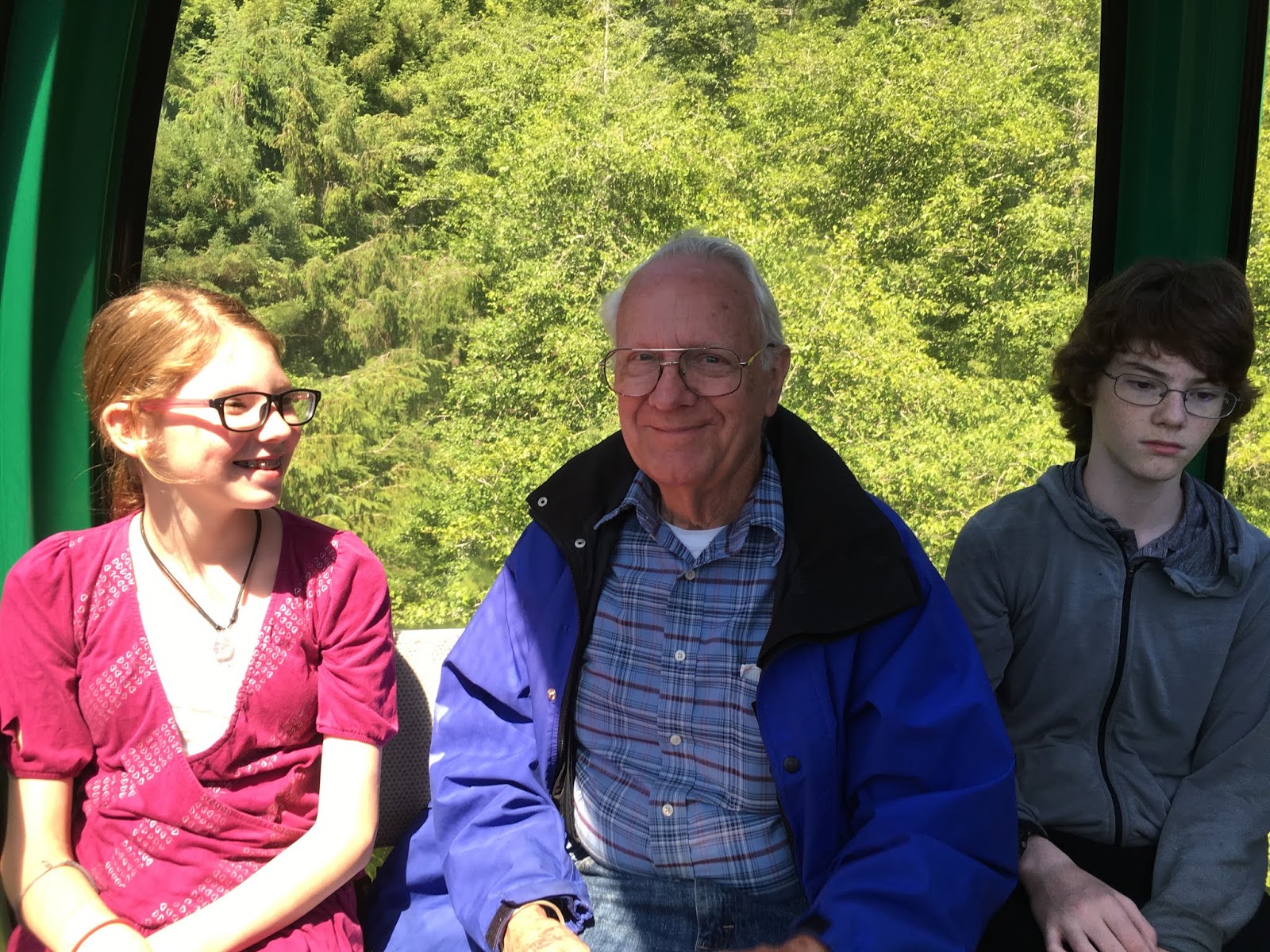
Tuesday, July 3, 2018

AND the good side...

      I know you want to hear the positive from the trip, too.  So this post is really just going to be a travel log...
      Sunday, June 17: Following church drove to Medford, Or.
      Monday, June 18: drove to Kelso, WA.  On the way, had a lovely visit at Crater Lake:


      Tuesday, June 19: drove to Port Angeles, WA and on the way saw Mt. Saint Helens. One of the amazing gifts we experienced was that we were able to take a helicopter ride to the Mountain and actually look into the crater itself.  What an awesome experience!!  We were also able to drive by the house where my grandfather had lived when I was a kid in Sequim, WA.


    Wednesday, June 20: We took the Ferry over into Victoria, BC.  There we checked into our hotel where we would stay for four nights, visited Miniature World and had High Tea at the Empress Hotel.


After High Tea, the girls and I found a lovely park to walk around in called Beacon Hill.  There we met a peacock who seemed convinced we were there to feed it.  It followed us around for awhile, finally giving up with a large squawk, before turning around and heading back.


     Thursday, June 21: Visited Butchart Gardens, the Butterfly Museum, did some foot exploring of the city of Victoria and rode a horse drawn carriage around an older part of the city.  We enjoyed this day very much.  The horse drawn carriage ride was meant to be a tour, but we ended up engaging the "tour guide" who was driving the carriage, instead, in conversation.  She is about to start her final year of college, is majoring in Medieval studies and Eldest, this young woman and I had way too much to talk about that just took priority over the tour.  That was a real gift: to meet this young woman and have such a wonderful conversation about school, politics, countries,  and life in general.


   Friday, June 22: We went to the Royal BC Museum and Craigdarroch Castle.  At the Royal BC Museum we were able to see an IMAX movie about the efforts in China to restore the Panda population from near extinction.  There is some success with these efforts and we are learning, so I think there will be more success as time goes by.  Additionally, several Indigenous Tribes were present at the Museum, and were giving talks about their cultures and the work throughout Canada to be more open, accepting and celebrating of Indigenous faiths,  practices and peoples.  We happened to be there at the time of an Indigenous Cultural Festival and there were dancers who came and shared some of the traditional dances, as well as the meanings of those dances.  That was amazing!  My pictures of this were not great, but perhaps that is better anyway.  This is part of who they are, not for our entertainment, but hopefully we learn from other people and can appreciate the beauty of our diversity, as we learn to honor other traditions, cultures and faiths.


    Saturday, June 23: We visited the Parliament building, the Maritime Museum, the Bug Zoo (some of us), Christ Church Cathedral (some of us), and then we walked around town more.  The kids, David and I ended up having dinner at a Games Café.  What a blast that was!  For $5 each, we could sit and play any of the games in their extensive games library as well as eating snacks and just being together.  We spent four and half hours exploring different games and having dinner.  We didn't buy any games, but we really had fun just being together.  


        Sunday, June 22: Well, I have to admit we didn't go to church.  However, the kids picked out a couple scriptures and asked me to give them an impromptu sermon... Honest to God, it was their idea!  They said they missed church and wanted me to preach for them.  While I was expostulating, we walked around downtown Victoria, found an outdoor market which we enjoyed, then walked along the North Harbor, across a bridge and along the Bay.  It was beautiful.  And we had a couple of amazing bonuses.  In the outdoor market, we came across a woman who made beautiful jewelry, including a Celtic Moon that was something Eldest had been looking for.  We talked for a while and the woman basically gave Eldest some of the Jewelry she made!  (I snuck back and paid her: I think it is really important to pay artists for the work they do.  But it was awesome that Eldest felt she'd been given this gift by someone who just liked her and wanted to do that for her!).  And THEN, as we were walking along the bridge to cross the bay into the North Harbor we saw Taxi Boats that were boating together and in patterns.  As we watched, we heard a loud speaker across the Bay announcing that the Taxi Boats were going to perform their "world famous water ballet" in a half hour! We'd been watching them practice in an area that was less touristy. So we walked for a half hour then sat on the shore of the Bay and watched the taxi boat ballet!  It was a blast.  Youngest said it was her favorite part of the whole trip, perhaps especially since it was unexpected, unplanned and we just happened to see it by wandering...


Later that day we took the ferry off of Vancouver Island and onto mainland Canada.


     Monday, June 25: We stayed in Vancouver but visited the British Columbia Museum of Mining (I didn't go in so I don't have any pictures: I hadn't been able to sleep the previous night and that morning had my run in with the guy I talked about yesterday who was mean in the café.  I just needed some alone time, so I rested a bit while the rest of the family went to the Museum).  The rest of the family learned a lot though.  The museum and guides talked about how their mining had destroyed the local river, wiping out several unique fish species and harming the people downstream who had made their livings as fisher-folk.  But they also shared that because of that disaster, their mining techniques have greatly improved and the river is on its way to recovery.  Afterwards we went to the Capilano Suspension Bridge Park.  As I said, it had not been a great beginning to the day for me.  However, there was live music that really touched me in the Suspension Bridge Park.  We had lovely walks among the trees: just the kids and I (David doesn't do heights), and it was a healing, calming time. 


     Tuesday, June 26: We went to the Science World in Vancouver which was AWESOME!  We saw a guy do an amazing demonstration on illusions, watched a movie about the Amazon and natural selection, and were able to see just a part of the many wonderful exhibits in this museum.  We wanted to stay much longer, but we had to get through customs because we had a scheduled tour at Boeing in Seattle late that afternoon (where we were not allowed to take pictures... sorry).


  Wednesday, June 27: We started in Seattle with the Space Needle, the Chihuly Garden of Glass and the Science Fiction Museum/Pop Museum.  We were divided: those who don't like elevators or heights went to the Science Fiction Museum while the rest of us did the Space needle and Glass Garden.  After that we drove to Tacoma where we went to the Museum of Glass.  That was an unexpected awesome, too.  In the Tacoma museum of glass they have a theater space where on the stage are glass ovens and the glass workers.  A man with a microphone walks around answering questions for all of us to hear about the work the glass workers are doing.  You can sit for hours and watch this amazing process.  It was beautiful.


Thursday, June 28: We went to the Lewis and Clark Historical Park in Fort Clatsop where we walked among the trees as well as hearing history, seeing the fort, learning how to start fire with flint, and communing with different eco-systems.  We then went to Tilamook where we ate dinner at the cheese factory.  It was a delicious meal!  


Friday, June 29: Mostly a driving day along the Oregon Coast.  However, we made one stop at the Sandland Adventures area, where we were taken on a very fast Dune buggy ride over the sand dunes. It was a rollar coaster ride up to 60mph up and down and over and around.  I screamed a lot, Youngest gripped her seat in terror, Eldest opted out completely, but the boys loved it.  Big surprise there... No pictures of Dune Buggy ride: they warned against getting sand into your phone and camera..  But lots of beach pictures!


Saturday, June 30: more beach, and Trees of Mystery.  This is also the day we had our near head-on collision.  But we are fine, and again, the time in the trees was healing and helpful.


Sunday, July 1: We head home.  But not before going to the Skunk Train in Fort Bragg and the Mendocino Botanical Gardens.  The gardens were also a wonderful surprise.  Absolutely beyond our expectations.


We came home tired, but with our minds and hearts full.  Good people, good food, new experiences.  We had a lot of laughter, a great deal of learning, and most importantly, time together.  Some of the photos I posted here are just silly, some are sweet, some show beautiful or interesting things that we saw.  All of that is as true as what I wrote yesterday. I am very grateful for this time.  I hope it created life time memories for my kids.  I know it did for me.  The time away was full and meaningful.  And it was time to come home and be with my community once again.  I am grateful for it all. 


Monday, July 2, 2018

The bad news first

       We just returned from two weeks of vacation, during which we drove up to Canada, spent a week there and then drove back along the coast.  We saw a lot, met some wonderful people, had good family time, and returned exhausted but full of our adventures.  I will write more about all we saw and did at a later time.  But today I want to start by writing about some of the negative, and some of the harder things I'm taking from this vacation.
       We experienced quite a bit of stupid on this trip. At one point we had stopped on the Oregon Coast at a vista site off the highway: a very high cliff looking over the ocean.  We were separated from the cliff by a small stone wall, with clear signs written all over it, "Danger!  Erosive area.  Do NOT go beyond wall."  But, despite the postings, and the obvious danger of a cliff that dropped straight down, there were people on the other side of the wall.  One boy, probably around 13 years of age, was actually sitting on the cliff, feet dangling between two large boulders under which there appeared to be nothing but air.  I freaked out.  My father yelled at the boy to not be stupid, which finally roused him to back up a little.  His parents eventually noticed him and read him the riot act.  After seeing that the boy's parents were trying to get him off the cliff, as well as my dad, I tried to get my own kids back in the car.  I didn't know why the boy was acting like this, but I didn't want my kids to see this kid fall to his death. I didn't think they needed that image forever plastered on their minds.  I get the thrill of risk-taking.  But there is a line...
      Two days ago we were driving in Oregon on Hwy 101.  Hwy 101 is very curvy in places, lots of blind corners, but still a highway with 55mph speed limits for much of the road.  We were driving on a section that was three lanes wide: two lanes going South (where we were driving) and one lane heading North.  The road was divided by a clear double yellow line.  I was driving in the left of the two lanes heading South because there was a car in the right-most lane that was going about 50 mph and I wanted to drive closer to the posted 55 limit.  We came to a blind curve and as I turned, I saw an oversized pick-up in my lane, going North and heading straight for me.  Fortunately, I was not yet next to the car I was trying to pass, so I very quickly swerved into the right lane, so quickly that I over-corrected and had to swerve back a little to stay on the road.  There wasn't time to honk, and my father, who had been driving behind me, also nearly missed the guy but was able to swerve back into the right lane.  My father was able to honk, which "woke" the guy up who then went back into his correct lane.  I missed the truck by only a foot or so.  It was close enough that I had to pull off the road because I was shaking so hard at this near head-on collision.  I don't know why he was driving in the wrong lane.  Playing chicken?  Drunk?  Sleeping?  Whatever the reason, that "stupid" nearly got all of us killed.  All of us.  Killed.
       We also experienced meanness on this trip.  We spent one night in a small harbor town in Canada.  David and I walked down early in the morning to try to find a place for the seven of us to get breakfast.  We walked into the only open café at that time and saw that there were about 4 people standing in a line at the register.  Next to this line was a display case with pastries and other food items showing what they had for sale.  So David and I walked over to the display case to see what was available, and if there were foods that all of us could eat (my mother is a diabetic, my daughter is a vegetarian, my son has sensory integration disorder and doesn't eat very many foods).  We walked up to the case when this very tall (at least 6'4") man shouted at us, "Hey!  There's a line you know!"  I turned around simply astonished.  "We were just looking to see what the café has" I said.  To which he shouted, "Well I can't see around you!" after which he ordered his food from the cashier, clearly not needing to "see around me," though I found it astonishing to think this huge person could not see around me, even if he had "needed" to.
          Later that day, after a lot of driving and museum hopping, all seven of us tried to find a place to eat.  The first place we went was closed (no notice on the web-site about it, but it was closed).  The second place was hard to find.  The third place looked a little pricey, but by this time we were all just really, really hungry.  (Did I mention my mother is a diabetic?  Not smart to go too long without eating.)  We stepped inside and told the host that there were seven of us.  He took one look at us and said, "well, we are going to have to move some tables together, so it will be a half hour wait."  I could see a number of empty tables behind him, so I said, "well, we can split into two groups.  Each group can pay for the people at their own table.  Therefore it's like two different groups.  Can we be seated faster that way?"  "I'll have to ask my manager," he nonsensically replied.  I tried to explain again.  "We would be just two small groups.  I see there is room.  Can we be seated sooner if we come in just as two smaller groups: one of three and one of four?"  "I'll have to ask my manager," he said, looking me up and down in a way that made it very clear that he didn't want to seat us because we didn't look fancy enough.  We were dressed casually, as in tourist mode.
        Still later that same day, at a hotel back in the US now, we were in an elevator when we were joined by a transgender couple.  They were talking really loudly about how all Christians are horrible.  It took me a minute to realize I was wearing my "Clayton Valley Presbyterian Church" shirt.  I understand why they would feel that way.  But just as they do not like assumptions to be made about who they are based on their orientation or gender, I would hope they would practice this same policy and not make assumptions about what all "Christians" think and believe.  We got off the elevator and I was talking to my dad about logistics of our trip when I looked up and saw another woman giving me the most hateful glare I have ever, ever seen.  This time it was not shirt related as I had my sweatshirt on.  I don't know why she was looking at me that way.  I have no idea at all what possessed her to be so angry in my direction.  I tried to smile, and the fury and hate just deepened on her face.
       We experienced the pain of people on this trip:  We saw a number of "tent cities" in Canada.  And while I was glad that the dispossessed and homeless had places where they were able to set up their tents without legal harassment or worse, the sheer number of people in these tent cities was astonishing.  I was struck again and again with the cruelty of the fact that people do not care for or about other people.  We are okay with people being this poor.  We do nothing about cities that have no clean water.  We allow children to be taken from their parents.  We send people who are threatened with violence or extreme conditions at home, back to those horrible situations.  We don't see one another as connected to us, we don't understand that your poverty is my poverty and your pain is my pain.  We forget that we are interdependent on one another and we fail to treat each other with respect, love and dignity.  We accept unacceptable conditions for others.  We accept it, we make policies that enforce it, and we don't blink an eye at the intense suffering of other people.
       On our trip we went to a number of history and science places because that is what my father, in particular, likes to do.  But at each one of these the lessons were the same.  It started with the fact that we are cruel to each other.  I'll let you in on a secret.  I hate being white.  I hate it.  I hate being part of a group that has wiped out native peoples, enslaved and continues to enslave people of color, takes away the rights of those who do not look like us and then claims we are the ones being threatened.  I am sorry about the attitudes and destructive behaviors of my ancestors and people who look like me.  I am sorry for my own privilege and the ways in which I have it and use it without even being aware.  I read again and again about the destruction of this tribe, that tribe, this group of folk and that group of people, and it is my people who did this: people who look like me.  I have the rights and privileges I have because of what my people have done to others.  All I have has been earned off the backs of people who have not been given opportunities and have had their resources taken away from them at some point in time.  It breaks my heart.
      And then it went deeper.  Because we don't just destroy other people.  Every science center and museum we went to talked about the destruction of the environment.  We destroy long term growth forests.  We destroy species.  We take up their natural habitats and make it impossible for them to live.  We are causing the environmental destruction not only of the water, of the air, of the forests, but also of our weather systems.  We are destroying the world not only for ourselves but for every other living thing.  Humans are a virus: we grow beyond what the earth can support, we devour everything in our path and we even destroy our host planet.
      Every story I've shared today is about entitlement.  The boy felt entitled to risk his life on the cliff, the truck driver felt entitled to drive on the wrong side of the road, the man in the café felt entitled to yell at strangers, the host at the restaurant felt entitled to turn us away because he didn't like how we looked, the couple in the elevator felt entitled to judge and criticize every person of a group that has some people who are awful (as does every group), people feel entitled to have nice houses while others are homeless, white people have felt entitled to take the land from natives and to take other people as slaves and servants, and all people have felt entitled to using the earth for our own purposes to the point at which we are destroying her and everything on her.  The greed of humanity makes me not only wish I were not white, but frankly, wish I were not human.  I feel helpless to stop this.  But I also feel very clear that none of this is what the Divine, whatever that means to you, wants.  People are not entitled.  We are not entitled.  We are just greedy and selfish.  God does not love us more than the earth, or than other species or than other plants or than other people.  We are called to love all of it: all of the earth, all of each other, ALL.  And our inability to do so will lead to our own destruction.  Given how awful I feel humans are right now, that isn't such a tragedy to me anymore.  What is a tragedy is that we will take the planet with us when we destroy ourselves.
      I know that as a pastor I am supposed to write blogs that encourage, that support, that tell the Good News.  And I know there is Good News out there... there are people who care, there are people who are fighting and standing up for the earth, for other people, especially the poor, disenfranchised, oppressed and marginalized.  There are changes being made, although slowly. God loves all of us, and wants the best for us, even when we mess up. There is Good News.  But I will tell you the truth, I don't always feel hopeful, and it is hard to share Good News when I worry that perhaps those working for change are too few and too late. Many of us who really care feel impotent to help, to make real change. I come back from this vacation not only sad about being white, but sad about being human.  And that is real.  It may not be comfortable to hear, but it is real.
       I post this because I believe we have to start from truth.  Going forward with a Pollyannaish attitude will not help us.  We have to start with the reality of who we are as a people, as a species.  We have to start there in order to move forward with wisdom and hope.  So I speak my truth today.
         Our vacation was a good one.  But perhaps not in the way that I had hoped or intended.  It sobered me up, even more than the last year and a half have done, to the reality of who we are.  I turn over this truth to God and ask for guidance through it all.

Sunday, June 17, 2018

Mustard Seeds


Mark 4:26-34

2 Corinthians 5:6-17


            We know that violence breads violence, that hate breads hate.  We know this, and this last year has shown us this in abundance.  As more and more school shootings happen, as the numbers of suicides grow, as the hate speech escalates… we are reminded and see again and again that negativity can be contagious and can spread like wildfire. The uncaring that is becoming so rampant, especially as children are separated from their parents and caged which is so incredibly inhumane, and the fact that people are numb to this, are not standing up against it, shows that the negativity has spread so far that people no longer care about the most vulnerable people in the world: our children. People are suspicious of each other, angry at each other.  We see this at a much smaller level every single day just in our cars: road rage causes more road rage.  And the negativity is growing, is spreading…

            But todays’ scriptures, such as these two beautiful parables from Mark also point out that the reverse is equally true.  God can take the smallest seed, the smallest bit of good, and once it is planted, it can grow and grow into things that are beautiful and wonderful and awesome!  The parables tell us that little seeds grow into big plants even without help.  God’s love is like that, God’s care is like that.  Our good actions are contagious.  With plants we don’t have to pull on the stem or say magic words. Plants grow because they have been made to do just that. We can choose to be part of helping them to grow by watering them, putting them in the sun.  But our care is minimal to the miracle of each seed becoming something wonderful, something big, something beautiful.  Even plants that aren’t cared for such as all the trees and plants in our forests and wild areas grow completely on their own. 

            So it is with all the good things we do, all the good efforts we make, all the simple acts of kindness.  Kindness, too, breads more kindness.  It grows, it spreads, it is contagious.  Warm hearts warm our hearts.  Sunny dispositions can melt the coldness in our beings and bring out the best in us, the best of who we are.

Thomas Merton put it this way: “Every moment and every event of every person’s life on earth plants something in her or his soul. For just as the wind carries thousands of winged seeds, so each moment brings with it germs of spiritual vitality that come to rest imperceptibly in the minds and wills of men and women.”

            We are invited into love, into justice, into kindness, into being mustard seeds.  Church services, by the way, are supposed to provide the soil for the seeds to grow, the richness of the earth so that after church we have the strength and motivation and energy to spread, to plant other seed, to go out in the world and to bring love and kindness, to do the work of God.  We should be producing fruit.  Church itself, worship itself, is not actually the point of our faith or the end of our faith.  It is merely supposed to feed us so that we can BE the church in the world, doing the work of God in the world.  If your faith ends here in this place, then the church has not been a fertile soil for you in which you are nurtured. Worship is just the resting, nurturing ground that gives us the strength to enter the world with conviction, with love, with compassion, to follow Christ, to do the call God has given us to do.

            Our acts of kindness, of compassion, of love and empowerment of others – our actions of care towards one another are little seeds which God can grow into big plants. I don’t know that we often take the time to think about what we want to spread, who we want to be in the world, what we would like to pass on and pass forward.  So I invite you into a time of reflection.  Who are the people that you most admire and why?  How do they handle adversity?  Confrontation?  Who do you want to be in the world?  Who do you think God wants you to be in the world?  Think about this past week.  What are acts you did this last week that reflect who you want to be?  What are actions in this past week that you wish you’d done differently.  And if so, how do you wish you would have behaved? 

            What are little things that you do…that are seeds which, when nurtured can grow into big and beautiful trees?  What are kindnesses that you don’t do that you might be willing to try, willing to challenge yourself to do?

God can take our acts of kindness and make them big.  God can take our good things and made them into things that feed others, help others.

I think about the people others have told me are their heroes, are their mentors.  These are people who changed us for the better by their actions.  And most of the time, it is their kindnesses, their actions for the justice and empowerment of others, their ability to put aside anger or respond to hatred with love and grace that move us, that change us.  We can choose to be like that as well.  God can take the desire within us to do good, to be kind, to have mercy and justice; and God can grow it into a beautiful blooming plant of grace.  I remember Mitch Albom’s book, Have a Little Faith.  He shares about being asked to walk with a Rabbi who wanted Mitch to do his eulogy at this funeral.  Mitch made the comment, ““And is often the case with faith, I thought I was being asked a favor, when in fact I was being given one".”  He went on to describe a man who was kind, who was generous, who was loving.. .and through all of that changed who Mitch was.  I think about my own heroes, one of whom is Mr. Rogers.  The way he dealt with hardships, the non-anxious, non-defensive presence that he used with others inspires me daily.  It is a seed waiting to grow, as many of you know, but one that gets watered and nurtured every time I read one of his quotes or see one of his programs.  We have that opportunity to be kindness for others, to teach that to others, to practice it and watch it grow.  There is a Facebook page called “clayton Kindness” that is just kind, nice words.  It is helpful too, as it reminds us to treat each other well.  Little seeds, that God can grow.

            Every time we do something God asks us to do: to bring justice and care to these children I mentioned, for example, we plant a seed that can change the world.  I remember a Joan of Arcadia episode in which Joan was asked to do a small thing: to join AP Chem by the God character.  She didn’t understand why, but she did it.  And in the end God showed her how that one act had changed so many lives for the better.  Because of meeting someone in the class, she had introduced that person to her father who was a police officer.  As a result, the father talked to the boy’s parents who knew about a car for disabled drivers.  As a result, her disabled brother had gotten the car.  The God character went on to point out other results: catching a murderer, building important relationships between people who had previously not trusted each other, bringing down a crime ring.  As God was explaining all of this, Joan turned to God and said in astonishment, “How far does this go?  How far does the one act of following your request by joining AP chem go?”  To which God replied, “It goes all that way, baby.  All the way.”  “Always for the better?” Joan asked.  “Yep.  That’s how it works with me,”  God replied.  That’s how it is with God.

In the story Lord of the Rings, there is one moment in which Frodo is so angry about Gollum still being alive.  He makes the comment, “It’s a pity Bilbo didn’t kill him when he had the chance.”  Gandalf replies, “Pity? It was pity that stayed Bilbo’s hand. Many that live deserve death. Some that die deserve life. Can you give it to them, Frodo? Do not be too eager to deal out death in judgment. Even the very wise cannot see all ends. My heart tells me that Gollum has some part to play yet, for good or ill before this is over. The pity of Bilbo may rule the fate of many.”  That kindness, that pity, that grace, that mercy… that was, in the end, the saving of Frodo.  We just do not know how far kindness goes, or in what way it returns to us.

God’s ability to help a seed grow can even use those parts of us that we see as flaws:

An elderly Chinese woman had two large pots, each hung on the ends of a pole which she carried across her neck. One of the pots had a crack in it while the other pot was perfect and always delivered a full portion of water. At the end of the long walks from the stream to the house, the cracked pot arrived only half full. For a full two years this went on daily, with the woman bringing home only one and a half pots of water. Of course, the perfect pot was proud of its accomplishments. But the poor cracked pot was ashamed of its own imperfection, and miserable that it could only do half of what it had been made to do. After two years of what it perceived to be bitter failure, it spoke to the woman one day by the stream. 'I am ashamed of myself, because this crack in my side causes water to leak out all the way back to your house.' The old woman smiled, 'Did you notice that there are flowers on your side of the path, but not on the other pot's side?' 'That's because I have always known about your flaw, so I planted flower seeds on your side of the path, and every day while we walk back, you water them.' For two years I have been able to pick these beautiful flowers to decorate the table. Without you being just the way you are, there would not be this beauty to grace the house.'  Each of us has parts of ourselves we consider to be flaws, but when we give them to God, God can take even the cracked seeds and made beautiful flowers grow from them.

            Sometimes we don’t see or understand the gifts God has given us, the seeds God has given us to plant.  I heard about a woman, recently, who has the gift of dance.  She is a wonderful dancer, but more, her dancing gives her great joy.  However, she became convinced that God wanted her to give up this gift because she loved it so much.  I don’t believe in a God who asks us to give up the very gifts God has given us.  We are called, always, to use our gifts for good, for love, for joy for others and ourselves.  That does not mean giving that gift up.  You may all be familiar with the story of Cat Stevens.  A similar one: he came to believe that somehow his singing was not what God wanted and he stopped sharing the amazing gift he had that had brought so many people joy, and had brought so many people close to God.  I think about his piece, “Morning has broken” and the joy that has given to so many, the invitation to appreciation of all God has done and made that invites each of us to be our best, most grateful, most aware selves.  I felt at the time he stopped singing that he had misheard God’s call.  Fortunately, he, too eventually came to that realization and he is singing again.  But he missed years of using God’s best gift to him and to those who would hear his words, his voice and his commitment to faith.   I’ve shared with you before about a woman I knew who refused to allow laughter into her home, feeling that silliness was also ungodly somehow.  Laughter, too, is a great gift from God: the gift of joy, the gift of relaxing, the healing that comes from laughter.  Squandering God’s best gifts – that is a sin.

We are called to use the gifts that God has given us.  But Kindness is a particularly wonderful gift because we can all claim it.  We can all GROW it.  And that kindness can change the fate of the world.  God can use it and grow it beyond our imaginings.

            God gives us seeds, gifts, beauty to use and to share and to plant.  God can take the best, and even sometimes the worst, of each of us, the seeds, the gifts and will grow them into something magnificent.  All we have to do is plant, and watch, and pray and wait.

            Amen.

Tuesday, June 12, 2018

Attacking what we don't understand


1 Samuel 8:4-20

Mark 3:20-35


The people of Israel didn’t understand God enough to trust that they could have only God as king and not need a human king.  And when they didn’t understand, they responded by attacking what they didn’t know, demanding something different, refusing to listen to the warnings coming their way. The Pharisees assumed that even though he was actually healing people, Jesus must have been doing this by the power of Satan.  They didn’t understand how Jesus could successfully have driven out the demons, so they attacked and accused him of evil, even in the face of the amazing good he was doing.  Even Jesus’ family, when they didn’t understand his behavior, decided he must have been crazy and tried to get him away from the people. 

We do this too.  When we don’t understand another person’s perspective, or what is happening around us in the community, in our country, in our world, it is so easy to simply attack that which we don’t understand.  If we can vilify the other, then we don’t ever have to understand it.  We can simply discount it as evil or crazy.  How much harder is it to actually listen to another opinion, to actually pay attention to what someone else says just for itself without our preconceived ideas.  How much easier if we don’t have to look, don’t have to listen, and don’t have to be open to learn or to grow when we can just discount the other as evil or crazy or just completely wrong.

We all do this.  No matter where we stand theologically or politically, there are things all of us don’t understand and therefore refuse to even consider.  These may be things that scare us, things that don’t fit in with our vision or our worldview, things that may challenge us at our core, things that make life feel that it might not be the safe, contained, organized world that we know – all of these we may refuse to even consider. I would like to invite you to take a moment and think about what you won’t even entertain.  What will you not allow your mind to even consider as possibly true?  As possibly accurate?  As possibly good? 

I want to remind you that as we see in Jesus, that it is in the unknown, the uncomfortable, that which we would never consider in which we find God.  God shows us this in Jesus, who was completely other than what the people of God, the religious people of the time, expected.  He healed those deemed unworthy and rejected by the people.  He cared for those whom others knew it was illegal by law to even interact with.  He appeared crazy and even evil to the Pharisees, who again were the religiously righteous of the day, and even to his family.  That’s where God is: God is in the unexpected, the unknown, the unseen.  God is in the mystery, those things we don’t understand: those things that are beyond our understanding and sometimes those things we refuse to consider. The Israelites were God’s people but they could not see or accept God as the only king they needed. The Pharisees were the religious people of the day and yet they who were most faithful to the synagogue and the religious laws of the time could not see that the healing Jesus did was by the Spirit.  If we think that we are better than these faithful people, we need to look at ourselves again.  What is it that we block out that God could be saying to us, speaking to us, calling us to notice, see, love, and take in as God’s people?

I shared with you before that Scott Peck describes evil in his book, “People of the Lie.” He has a psychiatric practice, but he is also a strong Christian who believes in the existence of evil, as well as the power of love to confront it, overcome it, and change it.   As he worked with people, both the victims of evil and those who perpetrated it, he came to believe that people who do evil are people who simply cannot accept truth.  They cannot accept the truths of their own sinfulness and they project it out onto others and then try to destroy it in others.  As he puts it himself, “it is characteristic of those who are evil to judge others as evil. Unable to acknowledge their own imperfection, they must explain away their flaws by blaming others. And if necessary, they will even destroy others in the name of righteousness.”  We see this happening on a regular basis: televangelists who condemn and criticize a certain behavior only to be discovered engaging in the very behavior they condemn.  Politicians similarly who push for certain rules only to be found engaging in the behaviors they are working so hard to make illegal.    We see the truth in this as we learn that people like Hitler who may have had Jewish blood himself.  We see this reflected in our literature, such as the way Voldermort was trying to kill anyone who was not “pure blood” when he himself was only half-Wizard.

Dr. Peck also put it this way, “evil is…the imposition of one’s will upon others by overt or covert coercion – in order to avoid spiritual growth.”  And also, “(those who do evil have) a brand of narcissism so total that they seem to lack, in whole or in part, this capacity for empathy…..This narcissism permits them to ignore the humanity of their victims as well….There is only one particular kind of pain they cannot tolerate; the pain of their own conscience, the pain of the realization of their own sinfulness and imperfection….  They never think of themselves as (doing) evil; on the other hand, they consequently see much evil in others…evil people are often destructive because they are attempting to destroy evil.  The problem is that they misplace the locus of the evil.  Instead of destroying others, they should be destroying the sickness within themselves.  As life often threatens their self-image of perfection, they are often busily engaged in hating and destroying that life – usually in the name of righteousness.  They are unceasingly engaged in the effort to maintain the appearance of moral purity….  Since the evil, deep down, feel themselves to be faultless, it is inevitable that when they are in conflict with the world, they will invariably perceive the conflict as the world’s fault.  Since they must deny their own badness, they must perceive others as bad.  They project their own evil onto the world.  They never think of themselves as evil; on the other hand, they consequently see much evil in others.”

Richard Rohr echoed these ideas in his column, “Jesus: Forgiving Victim.”  He wrote, “Fighters are looking for the evil, the sinner, the unjust one, the oppressor, the bad person "over there." He or she "righteously" attacks, hates, or even kills the wrong-doer, while feeling heroic for doing so (see John 16:2). Philosopher René Girard sees this tendency to scapegoat others as the central story line of human history. Why? Because it works, and it is largely an immediate and an unconscious egoic response… We are all tempted to project our problems on someone or something else rather than dealing with it in ourselves. The zealot--and we've all been one at different times--is actually relieved by having someone to hate, because it takes away his or her inner shame and anxiety and provides a false sense of innocence.  As long as the evil is "over there" and we can keep our focus on changing or expelling someone else … then we feel at peace. …Playing the victim is a way to deal with pain indirectly. You blame someone else, and your pain becomes your personal ticket to power because it gives you a false sense of moral superiority and having been offended. You don't have to grow up, you don't have to pray, you don't have to let go, you don't have to forgive or surrender--you just have to accuse someone else of being worse than you are. And sadly that becomes your very fragile identity, which always needs more reinforcement.   (Another way to deal with our pain is to)… refuse s to live in the real world of shadow and contradiction. (Some) divide the world into total good guys and complete bad guys, a comfortable but untrue worldview of black and white. This approach comprises most fundamentalist and early stage religion. It refuses to carry the cross of imperfection, failure, and sin in itself. It is always others who must be excluded so I can be pure and holy.… These patterns perpetuate pain and violence rather than bring true healing.”

Richard Rohr goes on to explain how Jesus is the opposite of this because he takes our hatred without returning it, nor does it use it to play the victim. He suffers without making the other suffer..

 The thing is that most evil works from a place of fear.  We fear our own sinfulness.  We fear the other out of a place of not knowing them, refusing to really get to know, understand or have compassion for the other, for that which is different.  But as we know, fear leaves no room for beauty or grace or anything truly good.

I found myself thinking about the movie, “The Devil wears Prada”.  The movie’s main character, Andi, starts as a person with goals and integrity.  She wants to be a journalist, and she has written about injustices such as poor work conditions.  She is in a committed relationship and values her time with her friends and family.  Her values do not include high fashion, expensive things, or working to the exclusion of everything else.  She is down-to-earth, centered, and knows where she is heading and what she wants.  When she first applies for the job as Assistant to the Director of Runway Magazine, she is appalled by the value system that surrounds her – the emphasis on accessories that make no real difference to one’s well-being, the insistence on being thin, on looking “right,” on dressing “right.”  But when she takes the job, she finds her values and her identity being slowly pushed, slowly and subtly undermined.  She finds herself giving up more and more of her time with her friends, family and significant other.  She finds herself being pulled into the drama of fast paced work and eventually into valuing the clothing and accessories she didn’t used to care about.  The choices she is faced with – to choose depth and relationships, or to choose appearance and achievement are subtle, but she finds herself choosing for the latter again and again, and she finds herself saying to those who would challenge those choices, “well, I didn’t have a choice!” She says that when she hurts her friend by going in her place to France because the boss asked her to do that.  She says that when she misses her boyfriend’s birthday.  She says it when she has no time to spend with the people who love her.  She loses and gives up more and more, and slips down the slope into being a person who has thrown out her own deeply held values, all with the phrase, “I didn’t have a choice.”  She didn’t realize that she was choosing “evil”, even when she did something that devastated another human, that took away another human’s hopes and dreams.  She told herself that she had no choice because she had to keep her job.  But that lie that she told herself, that the job was the most important thing, that lie led her more and more into “hell”…she lost her friends, she lost her significant other, she lost her sense of self and her values.  She refused to see the sin in her own behavior and projected it outwards, harming others.  As her boyfriend breaks up with her, she receives a phone call from her boss, and she says, “I’m sorry.  I have to answer this,” STILL not realizing she is making a choice.  She couldn’t see evil.  She couldn’t see she had a choice.  She couldn’t look at herself or consider the idea that maybe there was a different choice for her to make.

Bonhoeffer put it this way, “Judging others makes us blind, whereas love is illuminating. By judging others we blind ourselves to our own evil and to the grace which others are just as entitled to as we are.” 

While the talk of evil or evil people may not be comfortable language for you, I think it is something we have to look at.  We attack what we don’t understand.  We attack what we are UNWILLING to understand – sometimes parts of ourselves that we are uncomfortable with, parts of ourselves that we would deny, parts of ourselves that simply make us uneasy.  But in attacking what we are unwilling to understand, we refuse to confront the sinfulness or errors or bad choices in ourselves, to change it, to grow.  We ignore the opportunities to grow more deeply with God.  We also injure others, we attack good things, as the case of Jesus and the Israelites show us, we attack that which is godly, which is holy, God’s own children who are different from us but whom God still loves.  We attack that which is bringing life to others of God’s people. 

If the Pharisees had been willing to consider that Jesus was a man of God, their lives would have been changed for the better; they would have met God, they may have found healing for their own souls.  If the Israelites were to have relied on God alone to be king, they might have learned faith and trust at a much deeper level, they would not have risked being exploited by their leadership, as Samuel warned them they would be, they might not have found themselves exiled over and over again.  And if we might be willing to consider that which we refuse to consider, we might find ourselves making friends and crossing bridges with those who are different from us, we might find ourselves called into action that helps those we normally don’t even see, we might see God’s face in an unexpected stranger, and get to know God at deeper and fuller levels. 

An old Cherokee told his grandson, “My son, there is a battle between two wolves inside us all.  One is Evil.  It is anger, jealousy, greed, resentment, inferiority, lies and ego.  The other is Good.  It is joy, peace, love, hope, humility, kindness, empathy and truth.”  The boy thought about it, and asked, “Grandfather, which wolf wins?”  The old man quietly replied, “The one you feed.”

But the good news in this is that there is hope, even when we don’t want to see, even when we don’t choose well.  Because God is a God of love, of healing, and of hope.  And if we turn it all over to God, to really spend time LISTENING to God, there is hope, there is movement, there is possibility for us as well.  Love truly can overcome evil or pain or hate or fear.  We just have to be open, and let God do God’s work within us.  Amen.